
 ES ES
ES ES
A biceps tendon tear can cause sudden shoulder pain, weakness, bruising, and difficulty lifting or rotating the arm. While many partial tears and some complete tears can be managed without surgery, tendon tear surgery may be recommended when pain persists, strength is significantly reduced, or the injury interferes with work, sports, or daily activities.
Modern procedures such as biceps tendon repair, biceps tenodesis surgery, or long head biceps tendon surgery can restore shoulder function and reduce pain in carefully selected patients. At Miami Shoulder Institute, treatment recommendations are individualized based on the location of the tear, activity level, associated shoulder injuries, and recovery goals.
The biceps muscle is located at the front of the upper arm and plays an important role in shoulder and elbow movement.
It has two tendons at the shoulder:
These tendons attach the muscle to the shoulder, while another tendon attaches it to the forearm.
The long head biceps tendon is more commonly injured because it passes through the shoulder joint and experiences significant stress during lifting and overhead activities.
Also Read More – Shoulder Surgery in Miami: Cost, Insurance, and What to Expect
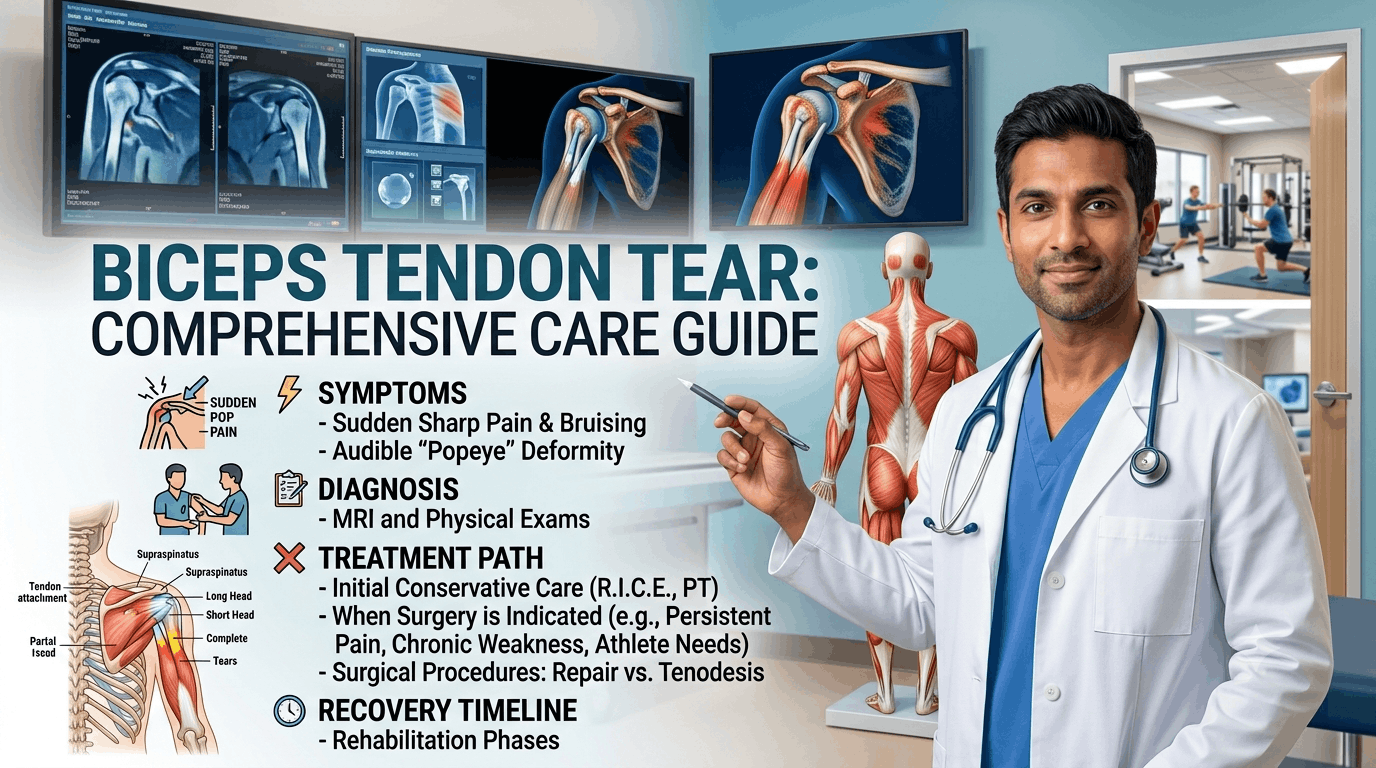
A biceps tendon tear occurs when one of the tendons connecting the biceps muscle partially or completely tears.
The injury may occur:
The severity determines whether conservative treatment or tendon tear surgery is the most appropriate option.
Read More – Best Exercises After Shoulder Surgery in Miami
Partial Tear
A partial tear means some tendon fibers remain attached.
Symptoms may develop gradually and include:
Many partial tears improve without surgery.
Complete Tear
A complete tear means the tendon has detached completely.
Symptoms often include:
Some complete tears require biceps tendon repair depending on patient needs.
Several factors can contribute to tendon injury.
Age-Related Wear
Over time, tendons naturally weaken.
Degenerative changes are one of the leading causes of tears.
Repetitive Overhead Activities
Common among:
Repeated overhead motion increases tendon stress.
Heavy Lifting
Sudden heavy lifting may overload the tendon.
Sports Injuries
Contact sports and weightlifting frequently contribute to tendon injuries.
Falls
Landing on an outstretched arm may result in acute tendon damage.
Read More – Shoulder MRI vs X-Ray: Which Test Do You Need?
Recognizing symptoms early may improve treatment outcomes.
Common symptoms include:
Sudden Shoulder Pain
Many patients feel a sharp pain in the front of the shoulder.
Audible Pop
Some patients hear or feel a popping sensation during injury.
Bruising
Bruising may develop along the upper arm within several days.
Weakness
Patients often notice weakness during:
Popeye Deformity
A bulge in the upper arm may develop when the tendon retracts.
This is a classic sign of certain complete tears.
Shoulder Cramping
Muscle fatigue and cramping may occur during activity.
Pain With Overhead Motion
Overhead activities often aggravate symptoms.
At Miami Shoulder Institute, diagnosis begins with a comprehensive evaluation.
Medical History
Your provider will ask about:
Physical Examination
The examination evaluates:
Special tests help identify biceps tendon involvement.
Read More – Most Common Sports Shoulder Injuries and Their Treatments
X-rays
Although tendons are not visible on X-rays, they help rule out fractures and arthritis.
MRI
MRI provides detailed images of:
MRI is often the preferred study when surgery is being considered.
Ultrasound
In some cases, ultrasound helps evaluate tendon movement dynamically.
Not every tear requires surgery.
Conservative treatment may include:
Activity Modification
Reducing painful activities allows inflammation to settle.
Physical Therapy
Therapy focuses on:
Anti-Inflammatory Treatment
May help reduce pain and swelling.
Guided Rehabilitation
Structured rehabilitation improves shoulder mechanics and function.
Many patients recover well without surgery.
Tendon tear surgery may be recommended in several situations.
Persistent Pain
Pain continues despite months of conservative care.
Significant Weakness
Difficulty lifting, pulling, or carrying objects.
Active Lifestyle
Athletes and physically demanding workers often require greater strength.
Complete Tendon Rupture
Certain complete tears benefit from surgical repair.
Associated Shoulder Injuries
Many patients also have:
Combined injuries may increase the need for surgery.
Biceps tendon repair reconnects the torn tendon to its normal attachment.
The goal is to:
Repair is generally recommended in selected patients based on injury pattern and activity level.
One of the most common procedures performed today is biceps tenodesis surgery.
Rather than repairing the tendon at its original attachment, the surgeon reattaches it lower on the humerus.
Benefits may include:
This procedure is commonly used when the long head tendon is chronically damaged.
Read More – What Happens During Your First Shoulder Specialist Appointment?
The long head biceps tendon surgery specifically addresses injuries involving the tendon that travels through the shoulder joint.
Depending on the injury, surgery may involve:
The most appropriate procedure depends on:
Many modern biceps tendon procedures are performed arthroscopically.
This involves:
Advantages include:
At Miami Shoulder Institute, minimally invasive techniques are used whenever appropriate.
Recovery occurs in several phases.
Weeks 1–2
Goals include:
Weeks 2–6
Patients begin:
Weeks 6–12
Therapy focuses on:
Months 3–6
Most patients continue improving in:
Return to sports or heavy lifting depends on healing progress.
While not every injury is preventable, you can reduce risk by:
Healthy shoulder mechanics reduce tendon stress.
Consult a biceps tendon specialist if you experience:
Early evaluation can improve diagnosis and treatment planning.
Miami Shoulder Institute specializes exclusively in shoulder and upper extremity care, providing advanced diagnosis and treatment for tendon injuries, rotator cuff tears, labral injuries, arthritis, fractures, and sports-related shoulder conditions.
Whether treatment involves rehabilitation, biceps tendon repair, biceps tenodesis surgery, or long head biceps tendon surgery, care is individualized to restore strength, reduce pain, and help patients return to the activities they enjoy.
The goal is not simply repairing a tendon—it is restoring long-term shoulder performance and quality of life.
1. Does every biceps tendon tear need surgery?
No. Many partial tears and some complete tears can be treated successfully without surgery.
2. What is biceps tenodesis surgery?
It is a procedure that reattaches the long head biceps tendon to the upper arm bone to reduce pain and improve function.
3. What is the difference between tendon repair and tenodesis?
Tendon repair restores the tendon to its original attachment, while tenodesis relocates and secures it to a different position on the humerus.
4. How long does recovery take after tendon tear surgery?
Recovery varies but often takes several months with structured rehabilitation.
5. Can a torn biceps tendon heal without surgery?
Some tears become manageable with conservative treatment, depending on severity and patient goals.
6. What are the symptoms of a long head biceps tendon tear?
Common symptoms include shoulder pain, weakness, bruising, a popping sensation, and a “Popeye” muscle deformity.
7. When should I see a biceps tendon specialist?
If you experience persistent shoulder pain, weakness, or suspect a tendon rupture after an injury, prompt evaluation is recommended.
Also Read More – Types of Shoulder Surgery: Which Procedure Is Right for Your Condition?
Best Shoulder Surgeon in Miami: Diagnosis, Treatment & Recovery Explained