

 ES ES
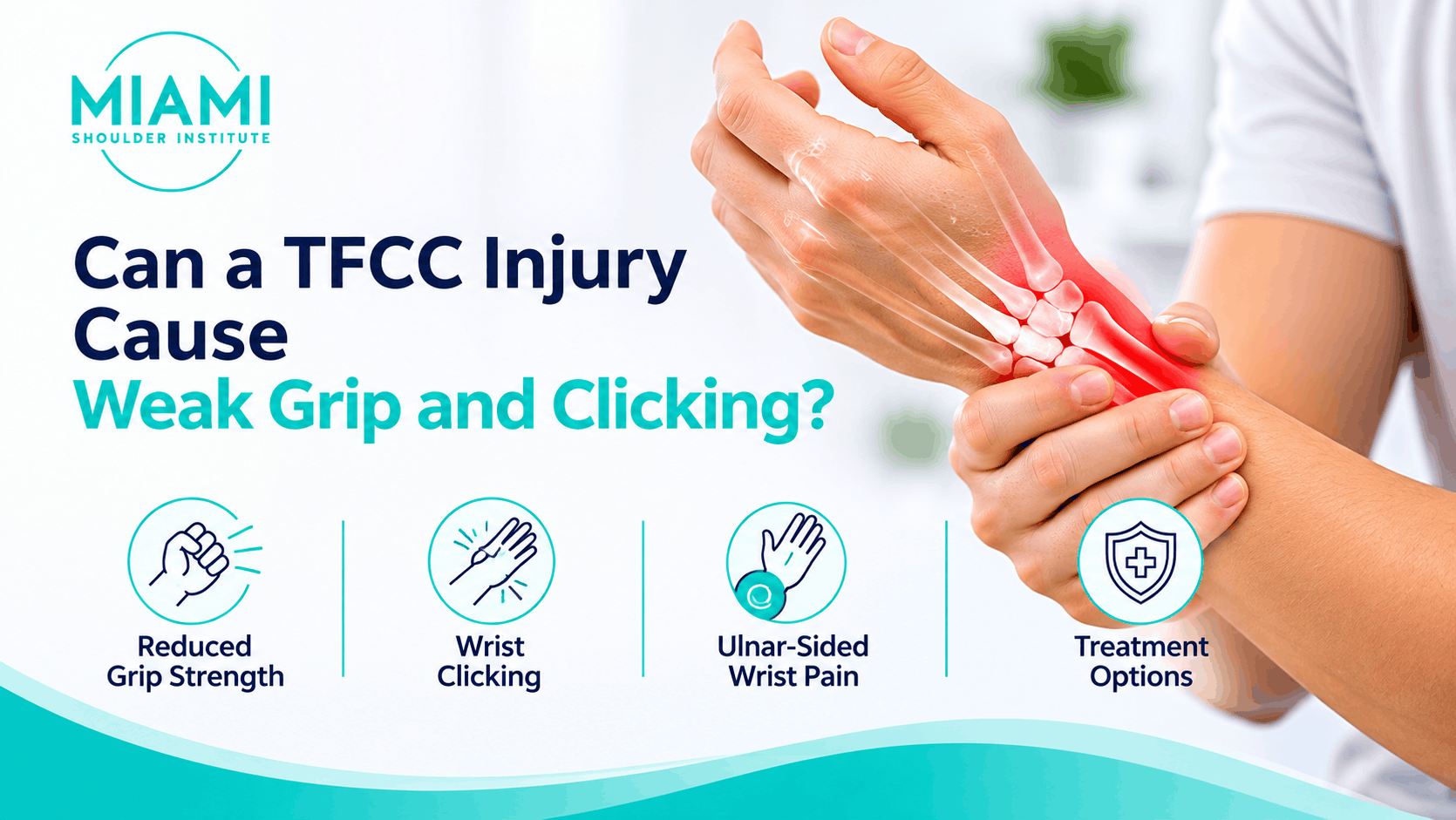
A triangular fibrocartilage complex (TFCC) injury can cause weak grip, wrist clicking, and pain on the little-finger side of the wrist. The TFCC is a group of cartilage and ligament structures that helps stabilise the wrist, support the forearm bones during rotation, and distribute forces across the wrist joint. When it becomes damaged, activities such as gripping objects, opening jars, turning a key, or rotating the forearm may become uncomfortable or difficult.
The severity of symptoms depends on the type and extent of the injury. Some TFCC injuries improve with appropriate non-surgical treatment, while persistent pain, instability, or significant structural damage may require further assessment and, in selected cases, surgery.
The triangular fibrocartilage complex, commonly called the TFCC, is a group of cartilage and ligament structures located on the ulnar side of the wrist, near the little finger.
It plays several important roles in wrist function. It helps stabilise the distal radioulnar joint (DRUJ), where the radius and ulna meet near the wrist. This joint allows the forearm to rotate when you turn your palm upwards or downwards.
The TFCC also helps distribute pressure across the wrist and provides support during gripping, lifting, and weight-bearing activities.
Because it contributes to both stability and movement, damage to the TFCC can affect everyday hand and wrist function.
Yes. A TFCC injury can reduce grip strength, particularly when gripping causes pain or when the wrist feels unstable.
The TFCC helps support the wrist during activities that require force. If the structure is injured, applying pressure through the hand may produce discomfort on the little-finger side of the wrist.
People may notice that they:
It is important to understand that weak grip does not always mean the muscles themselves are damaged. Pain can cause protective inhibition, meaning the body reduces the force generated by the hand to avoid aggravating the injured area.
In some cases, reduced wrist stability or associated injuries may also contribute to weakness.
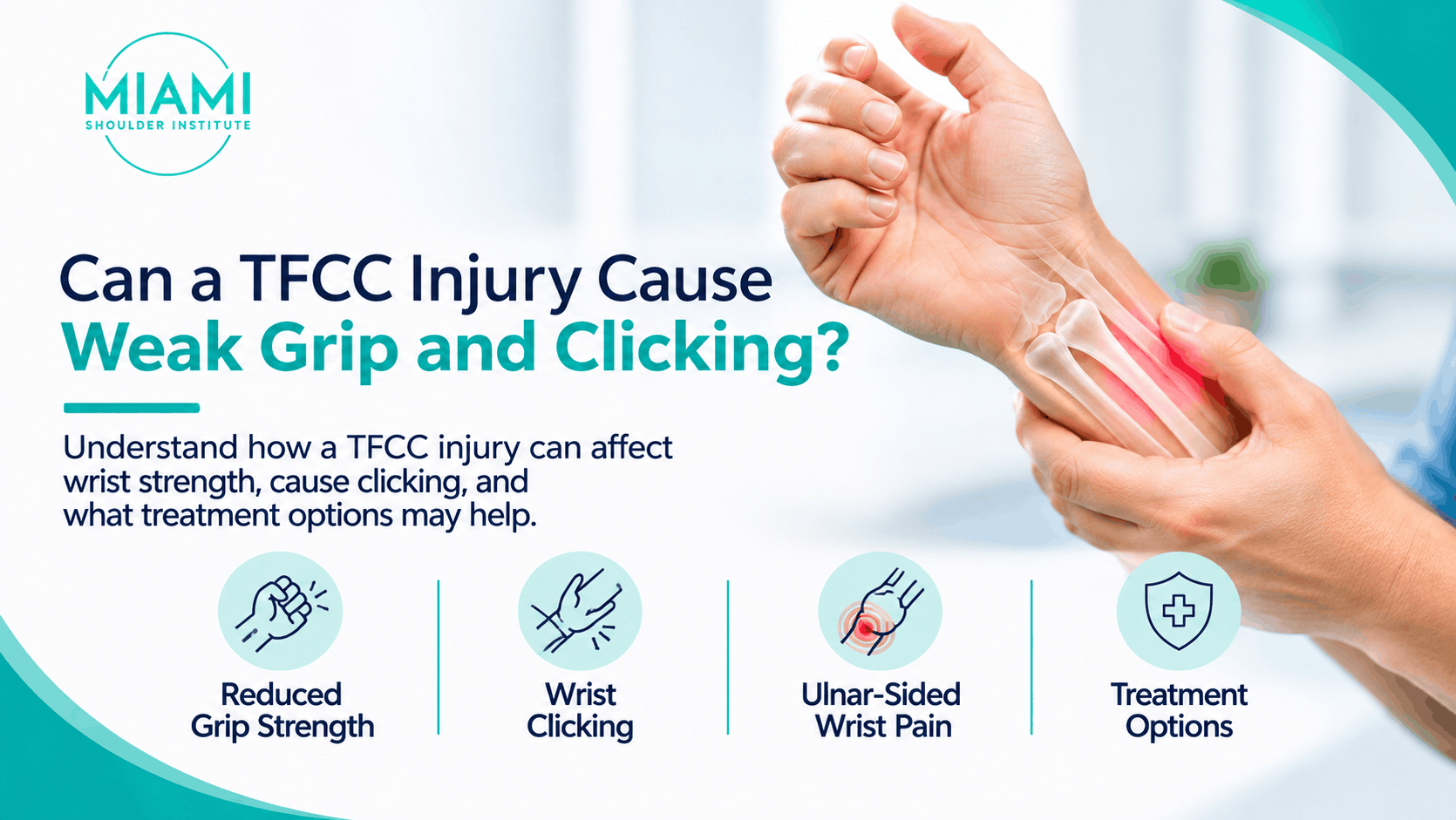
Wrist clicking can occur with a TFCC injury, particularly when the wrist or forearm moves through certain positions.
The TFCC contributes to the stability of the wrist and distal radioulnar joint. If part of this complex is damaged, normal movement may become less smooth or the joint may feel less stable.
Clicking or popping sensations may occur when:
However, not every wrist click indicates a TFCC tear. Painless clicking can occur for several reasons, including normal joint movement and tendon motion.
Clicking is more concerning when it occurs alongside pain, swelling, reduced grip strength, or a feeling that the wrist is shifting or giving way.
TFCC tear symptoms can vary depending on the location and severity of the damage. Some people experience symptoms immediately after an injury, while others develop discomfort gradually.
Common symptoms include:
1. Ulnar-Sided Wrist Pain
Pain on the little-finger side of the wrist is one of the characteristic symptoms associated with TFCC injuries.
The discomfort may be felt near the ulnar head, which is the bony prominence on the little-finger side of the wrist. It may become more noticeable when gripping, twisting, or lifting objects.
2. Weak Grip Strength
A person may struggle to hold objects firmly because gripping increases pressure through the wrist.
This weakness may be particularly noticeable when carrying bags, holding a heavy cup, opening containers, or performing manual tasks.
3. Painful Clicking or Popping
Some people experience clicking during wrist movement. When the clicking is associated with pain or instability, it may indicate an underlying structural problem that needs assessment.
4. Pain During Forearm Rotation
Turning the palm upwards or downwards can aggravate a TFCC injury because the complex helps stabilise the distal radioulnar joint.
This may make activities such as turning a key, using a screwdriver, or opening a jar uncomfortable.
5. Wrist Tenderness
The area near the little-finger side of the wrist may feel tender when touched or pressed.
6. Reduced Wrist Function
Persistent discomfort can make everyday activities difficult. People may begin avoiding movements that place pressure on the wrist, which can affect work, exercise, and household tasks.
Read More – Wrist Pain Treatment in Miami
TFCC injuries can develop suddenly after trauma or gradually due to repetitive loading and age-related changes.
Sudden Wrist Injury
A fall onto an outstretched hand can place considerable force through the wrist and damage the TFCC.
Other traumatic causes may include:
Repetitive Wrist Stress
Repeated wrist movements and loading can contribute to TFCC irritation or damage.
Activities involving frequent gripping, twisting, or weight-bearing may increase stress on the wrist, particularly when performed with poor technique or insufficient recovery.
Examples include weightlifting, racket sports, manual work, and repetitive tool use.
Age-Related Changes
The TFCC can become thinner and less resilient with age. Degenerative changes may make it more susceptible to injury, sometimes without a single identifiable traumatic event.
These changes do not always cause symptoms. Imaging findings must be interpreted alongside the person’s symptoms and examination.
Associated Wrist Conditions
Some wrist conditions can increase stress on the TFCC. For example, differences in the relative length of the ulna and radius may influence how forces are distributed across the wrist.
An accurate assessment is important to identify whether the TFCC is the main source of symptoms or whether another wrist structure is involved.
Not all pain on the little-finger side of the wrist is caused by a TFCC injury. Several conditions can produce overlapping symptoms.
| Condition | Common symptoms |
| TFCC injury | Ulnar-sided wrist pain, painful clicking, weak grip, discomfort with forearm rotation |
| ECU tendon problems | Pain near the ulnar side of the wrist, sometimes with tendon snapping during movement |
| Ulnar-sided wrist arthritis | Pain, stiffness, and discomfort during wrist movement |
| Distal radioulnar joint instability | A feeling of shifting or instability during forearm rotation |
| Wrist sprain | Pain and tenderness after stretching or injuring wrist-supporting structures |
Because these conditions can have similar symptoms, self-diagnosis based on clicking or pain location alone is unreliable.
A TFCC injury is diagnosed through a combination of medical history, physical examination, and imaging when appropriate.
Medical History
A clinician may ask when the symptoms started, whether there was a fall or twisting injury, and which activities make the pain worse.
Details about clicking, grip weakness, swelling, and forearm rotation can help identify possible causes.
Physical Examination
The wrist may be examined for tenderness, movement restrictions, grip strength, and signs of instability.
Specific examination manoeuvres may place controlled pressure on the TFCC region or assess the stability of the distal radioulnar joint. No single test confirms every TFCC injury, so findings must be considered together.
X-Rays
X-rays do not usually show the TFCC itself, but they can help assess the bones and joint alignment.
They may identify fractures, arthritis, or anatomical factors that influence loading across the wrist.
MRI
Magnetic resonance imaging (MRI) may help assess the TFCC and other soft tissues around the wrist.
However, an MRI finding does not automatically prove that the TFCC is responsible for symptoms. Some structural changes can be present in people who do not experience wrist pain.
Arthroscopy
In selected cases, wrist arthroscopy may be considered when symptoms persist and further assessment or treatment is required. It allows a specialist to examine structures inside the wrist using a small camera.
Whether this is appropriate depends on the clinical findings and the individual’s circumstances.
Read More – Wrist Arthroscopy Surgery in Miami: Minimally Invasive Wrist Treatment
TFCC treatment depends on the type of injury, symptom severity, wrist stability, activity requirements, and response to initial care.
Many TFCC injuries can initially be managed without surgery.
1. Activity Modification
Reducing activities that aggravate symptoms can help prevent repeated stress on the injured wrist.
This may involve temporarily limiting heavy lifting, forceful gripping, repetitive twisting, or weight-bearing exercises.
The aim is not necessarily to stop all wrist movement but to avoid repeatedly provoking the injury while it is being assessed and managed.
2. Wrist Support or Immobilisation
A wrist brace or splint may be recommended to reduce painful movement and support the joint.
The type and duration of support depend on the injury. Some injuries may require more substantial immobilisation, particularly when joint stability is a concern.
Prolonged immobilisation without clinical guidance can contribute to stiffness and weakness.
3. Medication
Appropriate pain-relieving or anti-inflammatory medication may help manage discomfort in some patients.
Medication suitability depends on individual medical history, other medicines, and potential side effects. It is best to discuss these options with a healthcare professional.
4. Physiotherapy and Rehabilitation
Rehabilitation may help restore wrist movement, improve strength, and support a gradual return to daily activities.
A programme may include:
Exercises should be selected according to the injury and should not repeatedly trigger significant pain or instability.
5. TFCC Surgery
Surgery may be considered when symptoms remain significant despite appropriate non-surgical treatment, or when the injury involves structural damage or instability that is unlikely to improve adequately without an operation.
The procedure depends on the location and type of TFCC damage.
TFCC repair: Some tears, particularly those involving areas with a better blood supply, may be suitable for repair using surgical techniques.
TFCC debridement: In selected cases, damaged or unstable tissue may be trimmed or removed to address symptoms.
Additional procedures: If there is an associated problem, such as significant distal radioulnar joint instability or abnormal loading across the wrist, additional treatment may be considered.
Not every TFCC tear requires surgery. The decision should be based on symptoms, examination findings, imaging, and individual functional needs.
TFCC recovery time varies considerably. It depends on the injury’s severity, whether the wrist is stable, the treatment approach, and the person’s overall health and activity requirements.
Some less severe injuries improve with activity modification, support, and rehabilitation. More complex injuries may take longer to recover, particularly when there is associated joint instability or when surgery is required.
Recovery may involve several stages:
Returning to demanding activities too early may aggravate symptoms. Progress should be guided by functional improvement and clinical advice rather than a fixed timeline.
Occasional painless wrist clicking may not require urgent assessment. However, persistent pain, reduced grip strength, or painful clicking after an injury should not be ignored.
Consider seeking a specialist assessment if:
Seek urgent medical attention after a significant injury if the wrist appears deformed, there is severe swelling or pain, or you experience numbness, unusual colour changes, or a cold hand.
Early assessment can help identify the cause of symptoms and determine an appropriate treatment plan.
Read More – Carpal Tunnel Surgery in Miami: When Wrist Pain Requires Surgery
Persistent wrist pain, painful clicking, and reduced grip strength can interfere with work, exercise, and everyday activities. Understanding whether these symptoms are related to a TFCC injury or another wrist condition is an important first step.
Miami Shoulder Institute provides an orthopaedic-focused approach to evaluating shoulder, hand, and wrist concerns. Assessment may involve reviewing the injury history, examining wrist movement and stability, and considering appropriate imaging.
Treatment recommendations depend on the individual’s diagnosis, symptoms, and functional needs. The aim is to identify the underlying problem and discuss suitable treatment options, whether non-surgical management or a surgical approach is being considered.
If you are experiencing persistent ulnar-sided wrist pain, weak grip, or painful clicking, a specialist evaluation can help clarify the cause and guide the next steps.
A TFCC injury can cause weak grip, wrist clicking, and pain on the little-finger side of the wrist. These symptoms may become more noticeable during gripping, lifting, twisting, and forearm rotation.
Although some TFCC injuries improve with non-surgical treatment, persistent pain or instability requires proper assessment. Identifying the location and severity of the injury helps determine whether activity modification, wrist support, rehabilitation, or surgery may be appropriate.
If wrist clicking is accompanied by pain or reduced grip strength, an evaluation can help identify the underlying cause and guide suitable treatment.
1. Can a TFCC tear cause weak grip?
Yes. A TFCC tear can cause weak grip because gripping places pressure through the wrist. Pain, reduced joint stability, and protective muscle inhibition may make it difficult to hold objects firmly.
2. Why does my wrist click when I rotate it?
Wrist clicking during rotation can occur when the TFCC or other structures around the wrist are injured. Tendon movement and joint mechanics can also cause clicking. Painful clicking or clicking accompanied by instability should be assessed.
3. Where does TFCC injury pain occur?
TFCC injury pain is typically felt on the ulnar side of the wrist, near the little finger. It may become worse during gripping, twisting, lifting, or forearm rotation.
4. Can a TFCC injury heal without surgery?
Yes. Some TFCC injuries improve with activity modification, wrist support, and rehabilitation. However, treatment depends on the tear’s location, severity, and whether the wrist joint is stable.
5. How do I know if my wrist clicking is caused by a TFCC tear?
Clicking alone cannot confirm a TFCC tear. Pain on the little-finger side of the wrist, reduced grip strength, and discomfort during forearm rotation may raise suspicion. A clinical examination and appropriate imaging can help assess the cause.
6. Can I exercise with a TFCC injury?
Some exercises may be appropriate, but activities that cause pain, forceful gripping, heavy lifting, or wrist loading may aggravate symptoms. A rehabilitation programme should be tailored to the injury and current stage of recovery.
7. Does an MRI always detect a TFCC tear?
MRI can help identify TFCC abnormalities, but it does not detect every injury with complete accuracy. Imaging findings must be interpreted alongside symptoms and physical examination results.
8. When is surgery needed for a TFCC tear?
Surgery may be considered when symptoms persist despite appropriate non-surgical treatment, or when there is significant structural damage or instability. The choice of procedure depends on the injury’s characteristics.
9. Can a TFCC injury cause pain when opening a jar?
Yes. Opening a jar involves gripping and rotating the forearm, both of which can place stress on the TFCC. This movement may cause pain or weakness when the structure is injured.
10. Is wrist clicking without pain a sign of a TFCC tear?
Not necessarily. Painless clicking can occur during normal joint or tendon movement. It becomes more concerning when accompanied by persistent pain, weakness, swelling, or instability.