

 EN EN
EN EN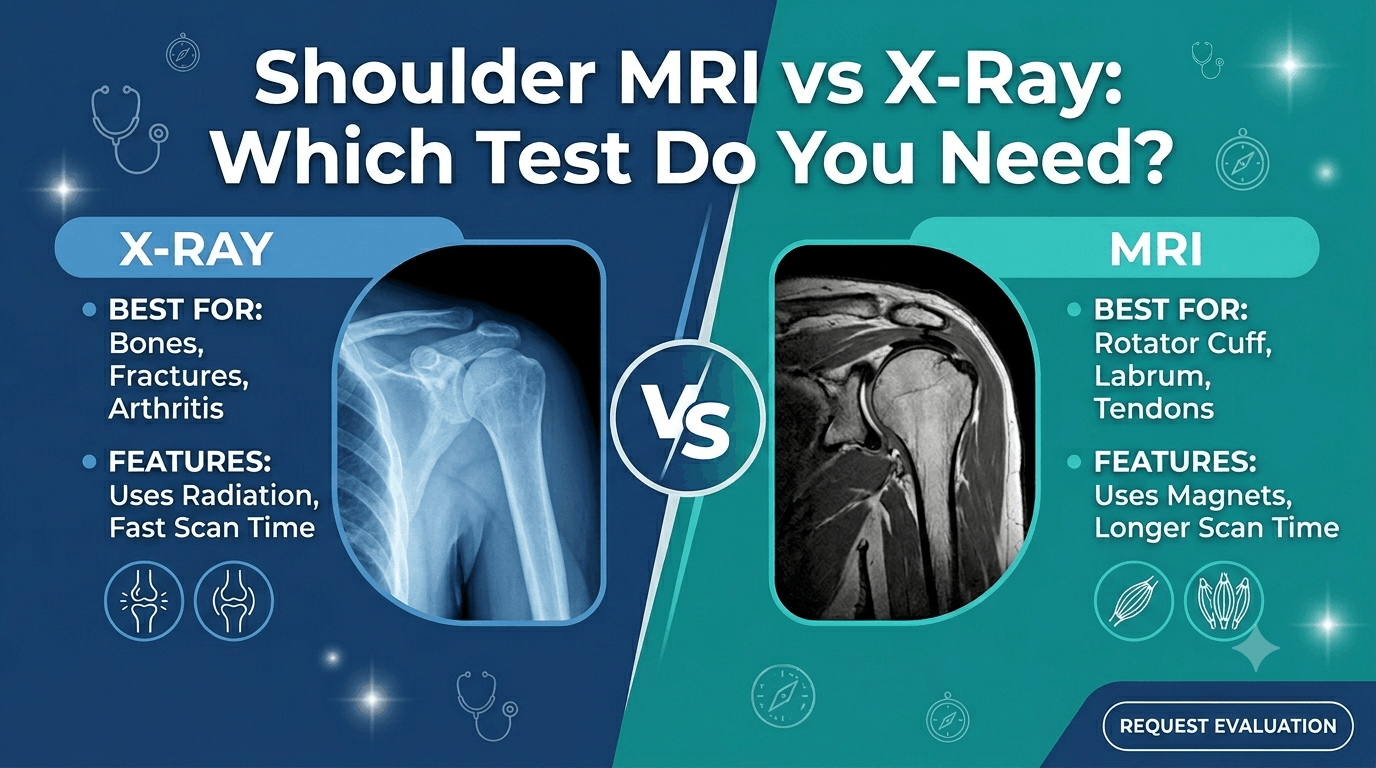
If you’re experiencing shoulder pain, one of the most common questions is whether you need an MRI or an X-ray. The answer depends on the type of symptoms you have, the suspected injury, and what your healthcare provider is trying to diagnose.
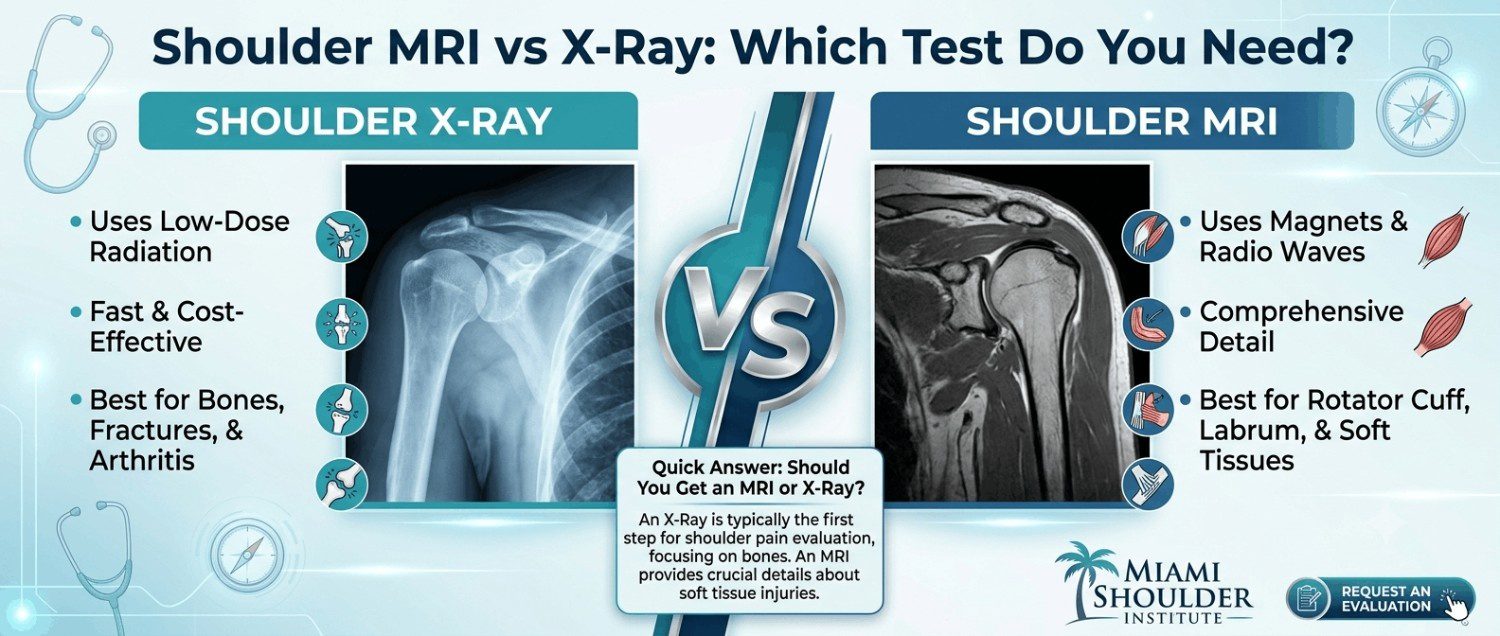
In general, an X-ray is often the first imaging test used during a shoulder pain evaluation Miami patients undergo because it provides excellent information about bones, fractures, arthritis, and joint alignment. A shoulder MRI Miami patients may need is typically recommended when soft tissue structures such as tendons, muscles, cartilage, ligaments, or the labrum require closer evaluation.
At Miami Shoulder Institute, imaging recommendations are based on clinical findings, medical history, and physical examination rather than ordering advanced tests unnecessarily.
The shoulder is one of the most complex joints in the human body.
It contains:
Many different conditions can produce similar symptoms, including:
An accurate shoulder diagnosis Miami patients receive helps ensure the correct treatment plan is selected from the beginning.
An X-ray uses low-dose radiation to create images of bones and joint structures.
It is typically the first imaging study performed for shoulder pain.
X-rays are excellent for evaluating:
Fractures
Broken bones are usually visible on standard X-rays.
Arthritis
Joint space narrowing and bone changes can often be identified.
Bone Spurs
Extra bone growth may contribute to shoulder impingement.
Shoulder Dislocations
Joint alignment problems are usually clearly visible.
Joint Degeneration
Age-related changes can often be detected.
Benefits include:
For many patients, X-rays provide important information during the initial evaluation.
While X-rays are extremely useful, they do not show soft tissues well.
They cannot reliably evaluate:
This is where MRI becomes valuable.
A shoulder MRI Miami patients undergo uses powerful magnets and radio waves to create detailed images of both soft tissues and bones.
MRI provides significantly more detail than an X-ray when evaluating soft tissue injuries.
MRI is commonly used to evaluate:
Rotator Cuff Tears
One of the most common reasons for MRI imaging.
Labral Tears
Important in patients with instability and clicking.
Tendon Injuries
MRI helps assess tendon inflammation and damage.
Cartilage Damage
Joint surface abnormalities can often be identified.
Bursitis
Inflamed bursa tissue is visible on MRI.
Muscle Injuries
Muscle tears and atrophy can be assessed.
Shoulder Instability
MRI helps evaluate structures responsible for joint stability.
Read More – Most Common Sports Shoulder Injuries and Their Treatments
Benefits include:
MRI is often considered the gold standard for many shoulder soft tissue conditions.
Despite its strengths, MRI is not always necessary.
Potential limitations include:
Not every shoulder problem requires an MRI
During a shoulder pain evaluation Miami patients receive, an X-ray is often the starting point.
Common situations include:
Shoulder Pain
Persistent pain often warrants initial imaging.
Arthritis Evaluation
X-rays provide excellent information about joint degeneration.
Injury Assessment
Falls and trauma frequently require X-ray imaging.
Suspected Fractures
Bone injuries are usually evaluated first with X-rays.
Shoulder Instability
Joint alignment can be assessed quickly.
In many cases, X-rays provide enough information to begin treatment.
Read More – Top Shoulder Surgeons in Miami Offering Advanced Orthopedic Care
A shoulder MRI Miami specialist may recommend becomes more valuable when soft tissue injuries are suspected.
Common examples include:
Rotator Cuff Tears
MRI can show tear size, location, and severity.
Labral Injuries
MRI helps identify cartilage damage affecting shoulder stability.
Persistent Symptoms
When pain continues despite treatment.
Unclear Diagnosis
If physical examination and X-rays do not fully explain symptoms.
Surgical Planning
MRI provides detailed information before surgery.
| Feature | X-Ray | MRI |
| Bone Evaluation | Excellent | Good |
| Rotator Cuff Assessment | Limited | Excellent |
| Labrum Assessment | Limited | Excellent |
| Arthritis Detection | Excellent | Good |
| Fracture Detection | Excellent | Good |
| Soft Tissue Evaluation | Poor | Excellent |
| Imaging Time | Short | Longer |
| Radiation Exposure | Yes | No |
Both tests have important roles in shoulder care.
Rotator Cuff Tear
Most often evaluated with MRI.
Shoulder Arthritis
Usually diagnosed initially with X-rays.
Shoulder Fracture
X-rays are generally the first choice.
Labral Tear
MRI is often preferred.
Shoulder Impingement
X-rays may show bone spurs, while MRI evaluates tendon involvement.
Frozen Shoulder
Diagnosis is often clinical, though imaging may help rule out other conditions.
Read More – Types of Shoulder Surgery: Which Procedure Is Right for Your Condition?
Yes.
This surprises many patients.
Pain can result from:
Imaging findings must always be interpreted alongside physical examination and symptoms.
This is why imaging alone does not determine treatment.
Sometimes.
Studies have shown that some individuals without symptoms may still have:
This means treatment decisions should focus on:
Not just imaging results.
Many patients feel anxious before their first MRI.
The process typically involves:
The procedure is painless.
At Miami Shoulder Institute, diagnosis begins with more than imaging.
Evaluation often includes:
Medical History
Reviewing symptoms and injury history.
Physical Examination
Assessing:
Imaging Review
Selecting the most appropriate imaging study based on clinical findings.
The goal is accurate diagnosis rather than unnecessary testing.
Read More – Difference Between an Orthopedic Shoulder Specialist and a General Orthopedic Doctor
Ordering the correct test at the right time can:
Every patient has unique needs, which is why imaging decisions should be individualized.
Miami Shoulder Institute focuses exclusively on shoulder conditions and utilizes a comprehensive diagnostic approach that combines medical history, physical examination, and appropriate imaging.
Whether symptoms require X-rays, MRI, rehabilitation, injections, or surgery, the goal is always to provide accurate diagnosis and personalized treatment recommendations.
1. Do I need an MRI for shoulder pain?
Not always. Many shoulder conditions can initially be evaluated with X-rays and a physical examination.
2. What is better for shoulder pain, MRI or X-ray?
Neither is universally better. The correct choice depends on the suspected condition.
3. Can an X-ray detect a rotator cuff tear?
Not directly. MRI is generally better for evaluating rotator cuff injuries.
4. Does an MRI show arthritis?
Yes, but X-rays are often the preferred first test for diagnosing arthritis.
5. Is MRI painful?
No. MRI is a painless imaging procedure.
6. Can I have shoulder pain even if my MRI is normal?
Yes. Pain can occur from inflammation, movement dysfunction, or other conditions not always visible on imaging.
7. Who decides whether I need an MRI?
Imaging recommendations are based on symptoms, physical examination findings, and diagnostic needs.
Also Read About – Best Shoulder Surgeon in Miami: Diagnosis, Treatment & Recovery Explained