

 ES ES
ES ES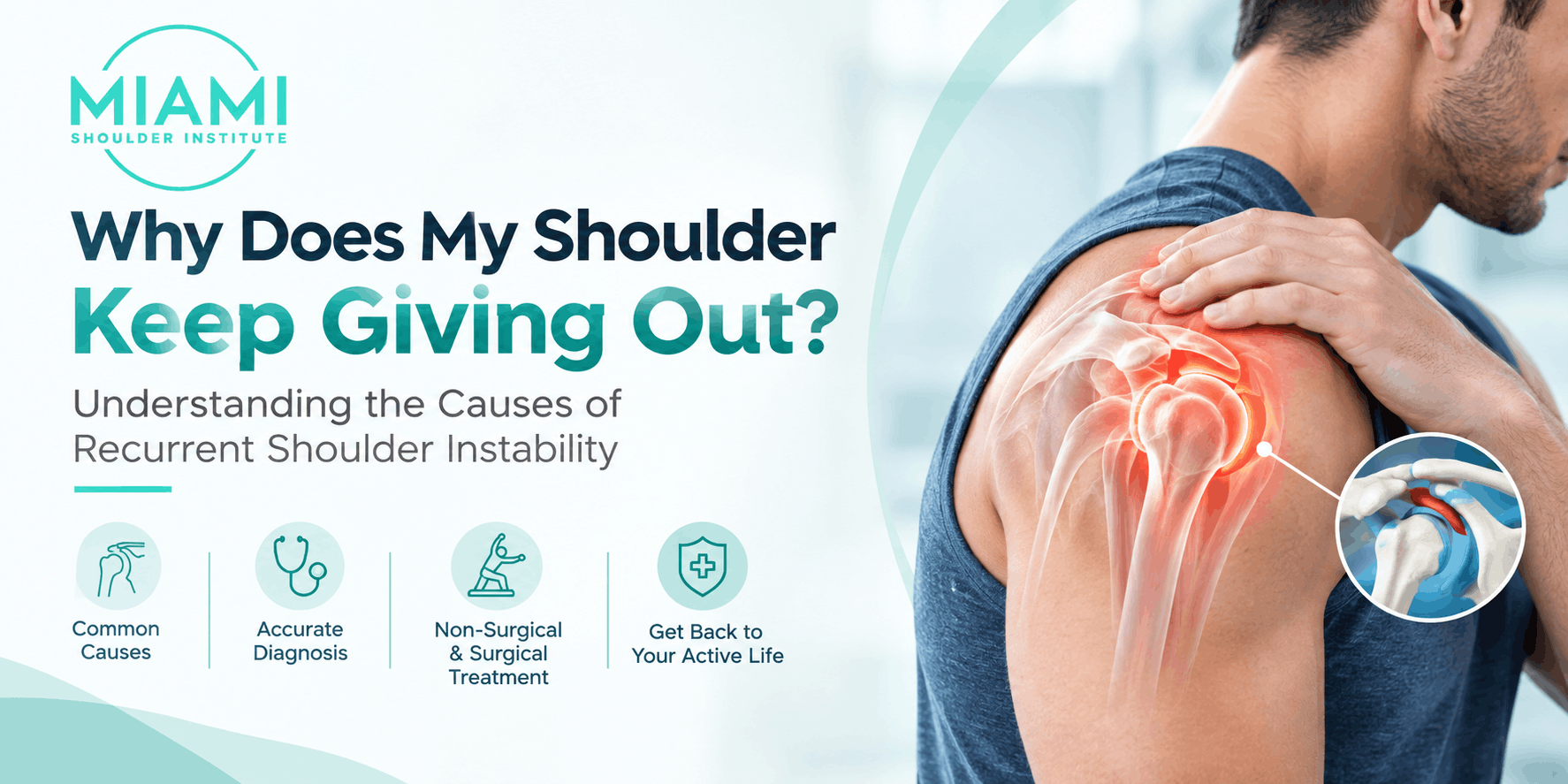
If your shoulder keeps giving out, slipping, popping out, or feeling as though it may suddenly move out of place, you may have shoulder instability. The causes of recurrent shoulder instability can include a previous shoulder dislocation, stretched or torn ligaments, damage to the labrum or bone, repetitive overhead activity, muscle weakness, or naturally loose joints. Repeated instability can make the shoulder more vulnerable to additional episodes and may cause further damage to structures that help keep the joint stable.
Treatment depends on the cause, severity, frequency of instability episodes, age, activity level, and whether other shoulder structures have been injured. Some people improve with activity modification and targeted rehabilitation, while patients with recurrent dislocations, significant structural damage, or a high risk of recurrence may be evaluated for shoulder stabilization surgery. A shoulder specialist can determine the underlying cause through a physical examination and, when appropriate, imaging such as X-rays, MRI, or CT.
Have you ever reached for something, raised your arm, played a sport, or made a sudden movement and felt as though your shoulder was about to come out of place?
Perhaps it did not completely dislocate.
Maybe it simply felt loose.
You may describe the sensation as:
These symptoms should not automatically be dismissed as ordinary weakness.
The shoulder is designed to provide a very large range of movement. Its mobility, however, means it depends heavily on muscles, ligaments, the labrum, and the shape of the joint to maintain stability. When one or more of these structures are damaged or insufficiently controlled, the shoulder may become unstable.
Understanding the causes of recurrent shoulder instability is important because repeated episodes can sometimes lead to additional damage.
When someone says their shoulder keeps giving out, they may be describing instability rather than simple muscle weakness.
Shoulder instability occurs when the ball of the upper arm bone does not remain securely centred within the shoulder socket.
Instability can range from:
Subluxation
A partial slipping or separation of the joint that may correct itself quickly.
Dislocation
A more significant event in which the joint surfaces become completely displaced.
Functional instability
The shoulder may feel unstable during certain movements even when there has not been a complete dislocation.
A person may experience one or more of these problems depending on the underlying cause.
Shoulder instability can also occur after trauma or without a major traumatic event, particularly in people with naturally loose joints.

There is no single explanation for every unstable shoulder.
The most common shoulder instability causes include previous dislocation, soft-tissue injury, bone injury, repetitive stress, muscle-control problems, and joint laxity.
A previous dislocation is one of the most important risk factors for future instability.
When the shoulder dislocates, ligaments and other stabilising structures may become stretched or torn. Once the shoulder has been displaced, it can become easier for another instability episode to occur.
This can create a cycle:
Dislocation → tissue damage → instability → another dislocation
Repeated episodes may progressively affect the structures responsible for shoulder stability.
A recurrent shoulder dislocation means the shoulder has come completely out of its normal position more than once.
Repeated dislocations should be taken seriously.
Every instability event can potentially affect structures such as:
The risk of additional damage can increase with repeated instability events.
If the shoulder has dislocated multiple times, it is reasonable to have the underlying cause assessed rather than simply treating each episode individually.
Read More – Best Exercises After Shoulder Surgery in Miami
The labrum is a ring of cartilage around the edge of the shoulder socket.
It contributes to the stability and depth of the socket.
A traumatic instability event can injure the labrum, potentially making the shoulder less stable.
Depending on the location and severity of the injury, a labral tear may contribute to:
Not every labral injury requires surgery, but determining whether it is contributing to instability can be important when symptoms persist.
Ligaments help connect bones and provide passive stability to the shoulder.
A traumatic injury can stretch or tear these tissues.
If the stabilising structures become excessively lax, the shoulder may have difficulty remaining centred during certain movements.
This can be particularly relevant after repeated dislocations.
The appropriate treatment depends on the extent of the injury and the patient’s overall clinical situation.
Not every unstable shoulder is caused by a major injury.
Some people naturally have greater joint flexibility or laxity.
This can contribute to multidirectional instability, particularly when the muscles surrounding the shoulder do not provide sufficient dynamic control.
In these cases, the problem may involve how the shoulder is controlled rather than one isolated traumatic injury. Shoulder instability can occur without significant trauma in people with particularly flexible joints or certain connective-tissue conditions.
The muscles around the shoulder help provide dynamic stability.
When these muscles are weak, fatigued, poorly coordinated, or inadequately rehabilitated after injury, the shoulder may feel less secure.
Targeted rehabilitation can focus on:
A structured programme should be appropriate for the underlying condition rather than based solely on generic shoulder exercises.
Certain activities place substantial demands on the shoulder.
Examples include:
A previous instability injury combined with repeated high-demand movement may increase the likelihood of another episode.
The risk is particularly relevant when the shoulder has not fully recovered or when underlying structural damage remains.
Repeated instability can sometimes be associated with damage to the bones forming the shoulder joint.
Bone loss or fractures involving the socket or upper arm bone can affect the mechanics of the joint.
This is one reason recurrent instability should be evaluated carefully.
An X-ray may be useful for assessing the bones, while CT or MRI may be considered when additional information about bone or soft-tissue structures is needed.
Shoulder instability does not always feel like a dramatic dislocation.
You may experience:
Some people become particularly uncomfortable with positions where the arm is raised or rotated because they feel that the shoulder is no longer secure.
The exact symptoms depend on the type and cause of instability.
Exercise can expose instability because certain movements place greater demands on the stabilising structures of the shoulder.
For example, overhead lifting or sports movements may challenge:
If the shoulder has previously been injured, these movements may reproduce a sensation of slipping or apprehension.
That does not necessarily mean you need surgery.
However, repeatedly experiencing instability during exercise is a reason to have the problem evaluated, especially if it is becoming more frequent.
It can.
Repeated instability events may increase the risk of damage to structures including cartilage, bone, the labrum, and rotator cuff tissues. Recurrent instability has also been associated with an increased risk of shoulder arthritis.
This does not mean every unstable shoulder will inevitably deteriorate.
The important point is that recurrent episodes should not automatically be considered harmless.
An accurate diagnosis can help determine whether the shoulder can be managed with rehabilitation or whether additional treatment needs to be considered.
Diagnosis begins with a detailed medical history.
A shoulder specialist may want to know:
A physical examination can then assess:
Imaging may also be recommended.
X-rays can help evaluate bone position and certain bony injuries. MRI can provide information about soft tissues, while CT may be useful when detailed assessment of bone is required.
In many cases, rehabilitation is an important part of treatment.
Non-surgical management may involve:
The purpose is to improve the muscles’ ability to dynamically support the joint.
Focused physical therapy is commonly used as an initial treatment approach for shoulder instability, although treatment decisions depend on the individual’s risk factors and structural injuries.
A rehabilitation programme should be tailored to the specific type of instability.
Shoulder stabilization surgery may be considered when the shoulder continues to become unstable despite appropriate non-surgical management or when the risk of recurrence is considered high.
Factors that may influence the decision include:
Surgery is not automatically required simply because the shoulder has become unstable.
The decision should be based on the individual’s examination, imaging, activity requirements, previous treatment, and overall risk profile.
For some patients with multiple instability events or additional structural damage, surgery may be considered to restore stability.
The specific procedure depends on the type and extent of the instability.
Surgical treatment may involve repairing or tightening damaged soft tissues or addressing associated bone problems.
The objective is to improve the stability of the joint while preserving as much appropriate movement and function as possible.
The exact procedure cannot be determined from symptoms alone.
A detailed evaluation is necessary to identify what is actually causing the instability.
If your shoulder repeatedly feels unstable, avoid repeatedly testing the movement that causes it.
Depending on the situation, sensible steps may include:
If a shoulder is dislocated, attempting to put it back into position yourself can damage nerves, blood vessels, or surrounding soft tissue. Immediate medical assessment is recommended.
Consider evaluation by a shoulder specialist if:
A specialist evaluation can help distinguish true structural instability from other causes of shoulder pain or weakness.
Read More – Shoulder Surgery in Miami: Cost, Insurance, and What to Expect
No.
Although weakness can contribute to instability, the two conditions are not identical.
Shoulder weakness
Usually refers to reduced ability to generate force.
Shoulder instability
Refers to inadequate stability or abnormal movement of the joint.
A person can have:
This distinction matters because treatment should address the underlying problem rather than simply strengthening the shoulder without a diagnosis.
Prevention depends on the cause.
After appropriate treatment, a rehabilitation programme may focus on maintaining:
Strengthening the muscles supporting the shoulder can help improve stability and reduce the risk of further injury.
However, exercise cannot correct every structural problem.
Someone with significant recurrent instability may require a different treatment approach from someone with mild functional instability.
The longer recurrent instability continues without understanding its cause, the harder it can be to know whether each episode is contributing to additional damage.
This does not mean every episode is an emergency.
But recurrent instability deserves attention.
A proper evaluation can answer important questions:
Is the shoulder actually dislocating?
Is it partially slipping?
Is there a labral injury?
Is there bone damage?
Are the muscles providing enough stability?
Could rehabilitation help?
Is shoulder stabilization appropriate?
These questions are more useful than simply asking whether the shoulder feels weak.
Read More – Difference Between an Orthopedic Shoulder Specialist and a General Orthopedic Doctor
At Miami Shoulder Institute, the focus should be on identifying why the shoulder is unstable, rather than treating every patient with the same approach.
The evaluation of recurrent instability can consider the patient’s history, physical examination, activity demands, previous dislocations, and relevant imaging.
Treatment may range from structured rehabilitation and activity modification to surgical evaluation when recurrent instability or structural damage makes additional intervention appropriate.
The goal is to create a treatment plan based on the specific cause of instability and the patient’s functional needs.
Why does my shoulder keep giving out?
A shoulder that repeatedly feels as though it is slipping or giving out may have instability. Potential causes include a previous dislocation, stretched or torn ligaments, labral injury, bone damage, muscle weakness, repetitive activity, or naturally loose joints.
What are the main causes of recurrent shoulder instability?
Common causes include previous shoulder dislocation, damage to the labrum or ligaments, bone injury, inadequate muscular control, repetitive shoulder stress, and general joint laxity.
Is a shoulder that keeps giving out always dislocated?
No. The shoulder may partially slip out of position, known as a subluxation, or it may simply feel unstable during certain movements. A complete dislocation is a more significant event in which the joint surfaces become displaced.
Can a recurrent shoulder dislocation be treated without surgery?
Sometimes. Treatment can include activity modification and focused physical therapy to improve strength and shoulder stability. However, surgery may be considered for patients with repeated instability, high recurrence risk, or associated structural damage.
When is shoulder stabilization surgery necessary?
There is no single rule that applies to every patient. Shoulder stabilization may be considered when instability repeatedly occurs, rehabilitation has not adequately controlled the problem, or structural injuries increase the risk of further instability.
Can physical therapy fix shoulder instability?
Physical therapy can improve strength, coordination, and dynamic shoulder stability and is often part of non-surgical treatment. Whether it is sufficient depends on the underlying cause and severity of the instability.
Can a shoulder dislocation cause future instability?
Yes. Once a shoulder has dislocated, it can become more susceptible to future dislocations, particularly when stabilising structures have been damaged.
Should I see a shoulder specialist for recurrent instability?
If your shoulder repeatedly slips, partially dislocates, completely dislocates, or feels unstable during normal activities or sports, an evaluation by a shoulder specialist can help determine the cause and appropriate treatment.
What tests are used to diagnose shoulder instability?
Diagnosis may involve a physical examination and imaging. X-rays can evaluate the bones and joint position, while MRI or CT may be used when more detailed assessment of soft tissues or bone is needed.
Can shoulder instability get worse?
Repeated instability events can increase the risk of additional damage to structures such as the labrum, cartilage, bone, and rotator cuff. Recurrent instability is also associated with an increased risk of shoulder arthritis.
Can I exercise with shoulder instability?
Exercise may be an important part of treatment, but exercises should be appropriate for the type of instability. Activities that repeatedly cause slipping or dislocation should not simply be pushed through without evaluation.
What should I do if my shoulder is currently dislocated?
Seek urgent medical care. Do not attempt to force the shoulder back into position yourself, because this can potentially injure nerves, blood vessels, or surrounding tissues. Keep the shoulder supported and avoid unnecessary movement while seeking medical attention.
Also Read More – 8 Possible Reasons Your Shoulder Pops or Cracks During Workouts