

 ES ES
ES ES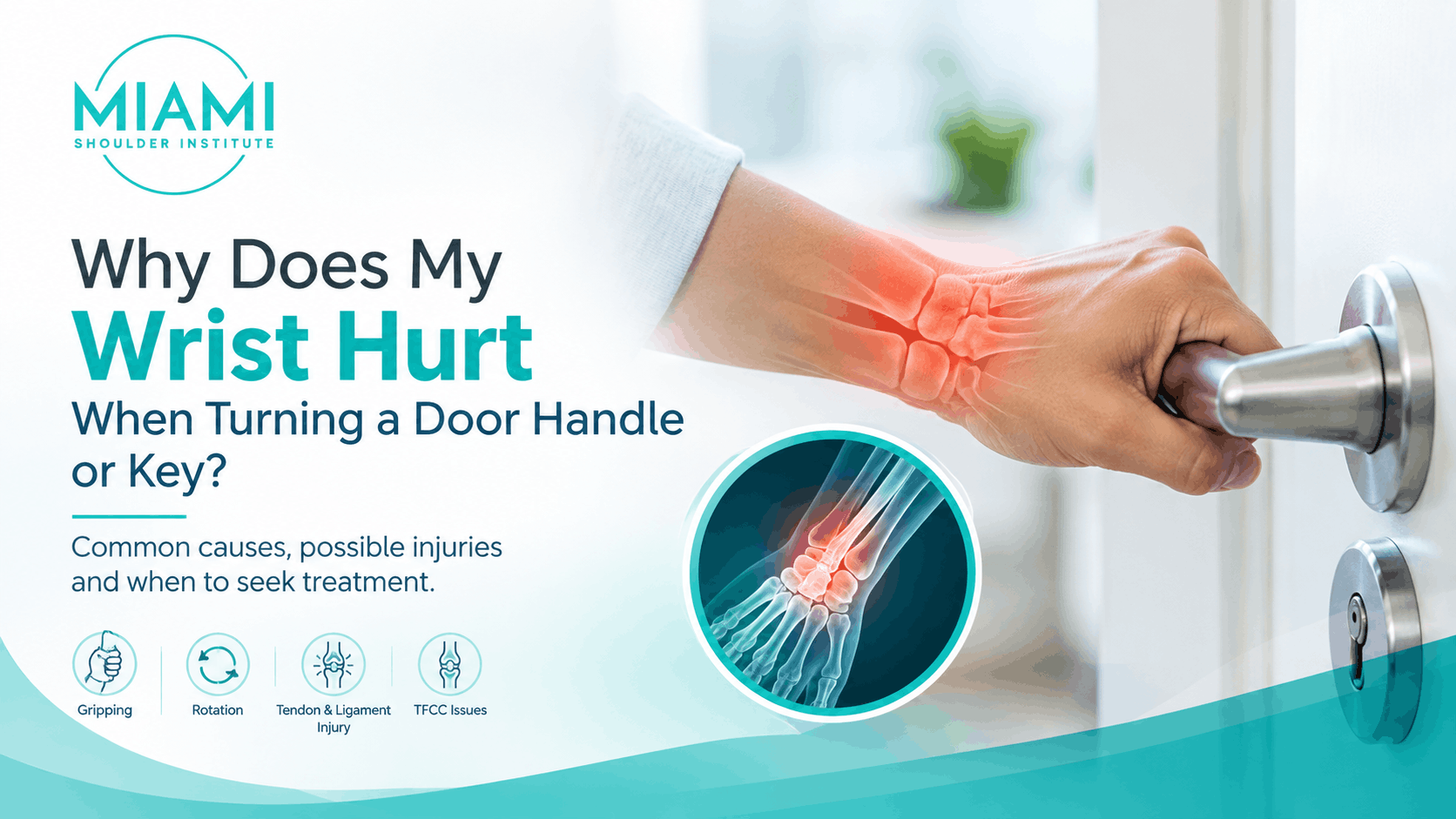
Wrist pain turning a door handle, key, tap or similar object can occur because these movements require the wrist and forearm to rotate while the hand applies grip and torque. Pain may come from the wrist joint, tendons, ligaments, the triangular fibrocartilage complex (TFCC), or structures in the forearm.
A common reason is irritation from repetitive gripping and rotation. However, pain during rotation can also occur after a fall, wrist sprain, fracture, ligament injury or TFCC problem.
Wrist pain rotation is particularly important to evaluate when it is accompanied by clicking, weakness, swelling, reduced range of motion or a feeling that the wrist is unstable.
TFCC pain often occurs on the little-finger side of the wrist and may become noticeable during gripping, twisting or forearm rotation. Other conditions, including tendon irritation, arthritis and previous wrist injuries, can produce similar symptoms.
Treatment depends on the cause. Mild symptoms may improve with activity modification, rehabilitation and gradual strengthening, while persistent pain or structural injuries may require imaging and specialist treatment.
If turning a key or door handle consistently causes pain, a wrist injury should not be assumed or ignored. A proper examination can help determine which structure is responsible and whether additional treatment is necessary.
Turning a door handle may seem like a simple movement, but it actually involves several coordinated actions.
When you turn a handle, you typically:
Turning a key can involve an even smaller and more concentrated force because the fingers grip a relatively small object while the forearm and wrist generate rotational torque.
This means that pain during these activities may not necessarily mean that the problem is located in one specific wrist structure.
The wrist, hand and forearm work together.
The forearm can rotate through two primary movements:
These movements occur through coordinated motion between the radius and ulna, particularly around the distal radioulnar joint (DRUJ).
The wrist also contributes to positioning the hand while the forearm rotates.
Because several structures participate in the movement, identifying the exact source of forearm rotation pain can sometimes require a detailed examination.

One of the important causes of rotational wrist pain is a problem involving the triangular fibrocartilage complex, commonly called the TFCC.
The TFCC helps support the ulnar side of the wrist and contributes to stability between the radius and ulna.
Symptoms of a TFCC problem can include:
This is why TFCC pain can become noticeable when turning a key, opening a jar or rotating a door handle.
TFCC problems can develop after an injury or repetitive loading. They do not all require surgery; treatment depends on the type and severity of the problem and whether the wrist remains stable.
Also Read More – Shoulder Surgery in Miami: Cost, Insurance, and What to Expect
Ligaments connect the bones of the wrist and help maintain stability.
A wrist injury involving a ligament can alter how the wrist moves under load.
A ligament injury may occur after:
A person may notice pain when rotating the wrist even if the original injury occurred weeks or months earlier.
Other symptoms may include:
If rotational pain persists after an injury, an evaluation can help determine whether a ligament problem is involved.
A wrist sprain occurs when the supporting ligaments are stretched or injured.
Mild sprains may cause temporary pain with movement.
More significant sprains may cause persistent pain or instability.
Turning a door handle can reveal a sprain because the wrist has to stabilise the hand while the forearm generates rotational force.
A wrist sprain may initially appear minor but should be reassessed if symptoms do not improve as expected.
Several tendons cross the wrist and help control the hand and wrist.
Repetitive gripping and twisting can irritate these structures.
Tendon-related pain may become noticeable when:
Unlike some ligament or cartilage problems, tendon irritation may be more closely associated with repetitive use.
The location of tenderness can help distinguish tendon-related symptoms from other causes.
Arthritis can affect the wrist joint and make movement painful or stiff.
When the wrist is already irritated by joint degeneration or inflammation, rotational activities can increase symptoms.
Possible symptoms include:
Arthritis can develop gradually, although post-traumatic arthritis may occur after a previous injury.
A wrist fracture can affect the mechanics of the wrist and forearm even after the fracture has healed.
Depending on the injury, a person may experience:
This can make turning a key or door handle uncomfortable.
If rotational pain develops after a previous fracture, the history of the injury is important when determining the cause.
The distal radioulnar joint helps the forearm rotate.
Problems involving this joint can produce pain during pronation and supination.
People may describe pain when:
DRUJ problems may occur following trauma, ligament injury, fracture or other wrist conditions.
Read More – Top Orthopedic Shoulder Surgeons in Miami
Wrist instability means the normal relationship between wrist structures is compromised enough to affect movement or load tolerance.
Some people describe:
Rotational activities can expose instability because the wrist must control force while the forearm moves.
Sometimes the cause is not a single injury.
Repeated gripping and rotation can gradually irritate the tissues around the wrist.
This can happen with:
The problem may become noticeable when relatively simple activities such as turning a key begin to hurt.
This pattern can provide an important diagnostic clue.
Flexing and extending the wrist are different movements from rotating the forearm.
If the wrist moves comfortably up and down but hurts during rotation, structures involved in rotational stability may deserve particular attention.
These may include:
This does not identify the diagnosis by itself, but the movement that triggers pain can help a clinician narrow down the possible causes.
Pain on the little-finger side of the wrist is often called ulnar-sided wrist pain.
Several structures are located in this region, including the TFCC and other ligaments, tendons and joints.
TFCC pain is one possible explanation, particularly when symptoms occur during:
However, ulnar-sided wrist pain has several possible causes.
An examination is important because different conditions can produce similar symptoms.
The act of turning a key usually does not cause a major wrist injury in a healthy wrist.
However, repetitive or forceful twisting may aggravate an existing problem.
A sudden forceful rotation can also cause an acute wrist injury, particularly if the wrist is simultaneously loaded or positioned awkwardly.
If pain started immediately after a forceful twisting event, rather than developing gradually, the situation should be assessed differently from ordinary exercise-related soreness.
Rotational wrist pain deserves greater attention when it occurs with other symptoms.
Warning signs include:
These symptoms do not automatically mean surgery is necessary.
They indicate that identifying the underlying cause may be important.
A clinician will generally begin with a detailed history and physical examination.
The examination may assess:
Wrist Motion
The wrist may be tested through flexion, extension and side-to-side movement.
Forearm Rotation
Pronation and supination may be compared between the affected and unaffected sides.
Grip Strength
Reduced grip may provide additional information about the severity or location of the problem.
Stability
Specific examination manoeuvres may be used to evaluate ligament and DRUJ stability.
Tenderness
The location of tenderness can help distinguish between possible causes.
Read More – Wrist Ligament Surgery in Miami: Treatment for Severe Wrist Injuries
Not everyone with wrist pain needs imaging.
The appropriate test depends on the suspected condition.
X-Ray
X-rays can help identify fractures, arthritis, alignment abnormalities and some post-traumatic changes.
MRI
MRI can provide information about soft tissues such as:
It may be useful when a soft-tissue injury is suspected.
CT Scan
CT provides detailed information about bone structure and can be useful in selected cases involving fractures or joint alignment.
Wrist Arthroscopy
In certain situations, wrist arthroscopy may be used to directly inspect structures inside the wrist and, when appropriate, treat selected problems.
The appropriate approach depends on the cause, but several general strategies may reduce aggravation.
Reduce Repetitive Rotation
If repeatedly turning tools, keys or handles triggers pain, reducing unnecessary repetition may give irritated tissues an opportunity to settle.
Avoid Forceful Twisting
Do not repeatedly force the wrist through painful rotation.
Modify Activities
Where possible, use tools or techniques that reduce the amount of force required.
Gradually Rebuild Strength
Once symptoms have improved and the underlying condition is understood, progressive strengthening may help improve tolerance.
Follow a Rehabilitation Plan
A personalised rehabilitation programme may address:
Treatment depends entirely on the underlying cause.
For mild overuse-related symptoms, treatment may involve:
For some ligament or TFCC injuries, conservative treatment may initially be appropriate.
More significant structural injuries may require additional intervention.
Surgery is generally considered based on factors such as:
The goal is to treat the underlying problem rather than simply suppress the symptom.
Consider evaluation by a wrist specialist if:
A specialist can determine whether the pain is coming from the TFCC, ligaments, tendons, joint or another structure.
Read More – 8 Possible Reasons Your Shoulder Pops or Cracks During Workouts
Why does my wrist hurt when turning a door handle?
Wrist pain turning a door handle can result from repetitive loading, tendon irritation, ligament problems, TFCC problems, arthritis, instability or a previous wrist injury.
Why does my wrist hurt when turning a key?
Turning a key combines gripping with forearm rotation. Pain may occur when structures involved in wrist and forearm stability are irritated or injured.
What is the most common cause of wrist pain during rotation?
There is no single cause for every patient. Overuse, tendon irritation, previous injury, TFCC problems, ligament injury and joint conditions can all contribute to rotational wrist pain.
What is TFCC pain?
TFCC pain refers to symptoms associated with irritation or injury of the triangular fibrocartilage complex. It commonly involves the little-finger side of the wrist and may worsen with gripping or forearm rotation.
Can a TFCC injury cause pain when turning a key?
Yes. TFCC problems can cause pain during gripping and rotational movements, although other conditions can produce similar symptoms.
Why does my wrist hurt when I rotate my forearm?
Forearm rotation pain can come from the distal radioulnar joint, TFCC, ligaments, tendons, previous fractures or other wrist and forearm conditions.
Can a wrist sprain cause pain during rotation?
Yes. A wrist sprain can cause pain when the wrist is loaded or when the hand and forearm rotate, particularly while the supporting tissues are healing.
Should I keep rotating my wrist if it hurts?
It is generally better not to repeatedly force a painful movement. If rotational pain persists, particularly after an injury, professional evaluation may help identify the cause.
When does wrist rotation pain require medical attention?
Persistent pain, significant swelling, weakness, instability, clicking, reduced motion or symptoms following trauma are reasons to consider an evaluation.
Can wrist pain from turning a door handle be treated without surgery?
Many causes of wrist pain can initially be managed without surgery. The appropriate treatment depends on the underlying diagnosis, severity and response to conservative care.
Pain when turning a door handle or key may seem like a minor inconvenience, but the movement provides useful information about how the wrist and forearm are functioning.
Because these activities combine gripping, wrist stabilisation and forearm rotation, several structures can contribute to symptoms. Wrist pain rotation may be associated with the TFCC, ligaments, tendons, joints, previous injuries or repetitive overload.
Pay particular attention to the location and behaviour of the pain. Little-finger-side discomfort, clicking, weakness or pain during gripping may raise the possibility of a TFCC-related problem, while a history of trauma may point toward a ligament, fracture or other structural wrist injury.
If the pain continues or begins interfering with everyday activities, evaluation by a wrist specialist can help identify the underlying cause and determine an appropriate treatment plan.
Also Read About- Shoulder Fracture Surgery in Miami: Expert Orthopedic Care
Difference Between an Orthopedic Shoulder Specialist and a General Orthopedic Doctor