
 EN EN
EN EN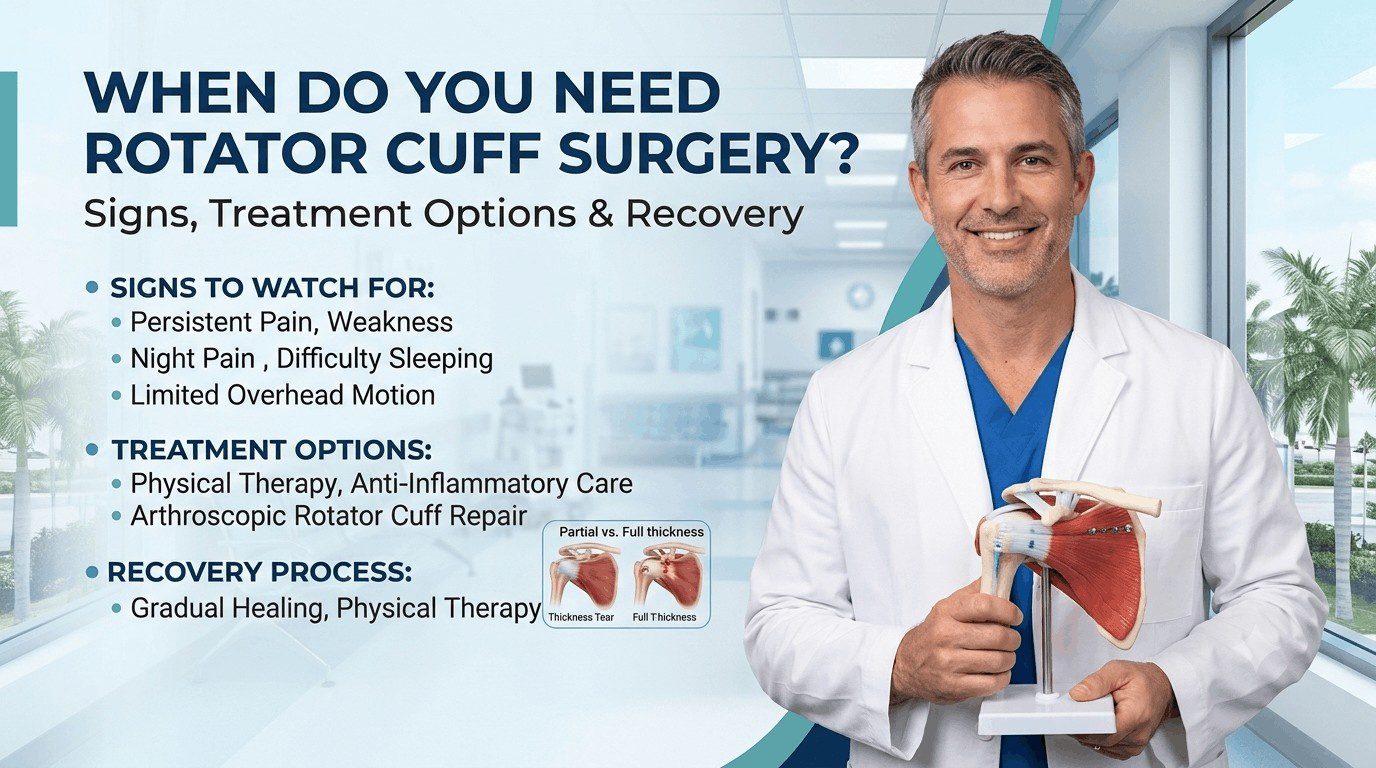
Not every rotator cuff tear requires surgery. Many patients improve with physical therapy, activity modification, and conservative care. However, rotator cuff surgery may become necessary when a tear causes persistent pain, significant weakness, loss of function, or continues to worsen despite non-surgical treatment.
Patients with large tears, traumatic injuries, recurrent symptoms, or major functional limitations may benefit from rotator cuff repair surgery to restore shoulder strength and reduce pain. At Miami Shoulder Institute, treatment recommendations are based on tear severity, lifestyle demands, imaging findings, and long-term functional goals.
The rotator cuff is a group of four muscles and tendons surrounding the shoulder joint. These structures help:
Because the shoulder is highly mobile, the rotator cuff plays a critical role in both strength and stability.
When one or more rotator cuff tendons become damaged, pain and dysfunction can develop.
Read More – Top Shoulder Surgeons in Miami Offering Advanced Orthopedic Care
A rotator cuff tear occurs when tendon fibers become partially or completely torn.
There are two primary types:
Partial Thickness Tear
Only part of the tendon is damaged.
Symptoms may be mild initially but can worsen over time.
Full Thickness Tear
The tendon is completely torn.
These tears often cause greater weakness and functional loss.

Rotator cuff tears may occur gradually or suddenly.
Age-Related Degeneration
Over time, tendons naturally weaken.
This is one of the most common causes.
Repetitive Overhead Activity
Common among:
Repeated overhead stress increases tendon wear.
Sports Injuries
Throwing and impact sports can overload the rotator cuff.
Falls or Trauma
A sudden fall can cause an acute tear.
Many patients initially ignore early symptoms.
Common warning signs include:
Persistent symptoms may indicate the need for professional evaluation.
Read More – Best Shoulder Surgeon in Miami: Diagnosis, Treatment & Recovery Explained
One of the biggest patient concerns is determining whether surgery is necessary.
Below are the most common situations where rotator cuff surgery may be recommended.
1. Persistent Pain Despite Treatment
Many patients first try conservative rotator cuff tear treatment.
This may include:
If pain persists despite appropriate treatment, surgery may be considered.
2. Significant Shoulder Weakness
Weakness is often more concerning than pain alone.
Warning signs include difficulty:
Major weakness may indicate a significant tear.
3. Large or Full Thickness Tears
Large tears are more likely to worsen over time.
These tears may lead to:
This makes early intervention important in selected patients.
4. Acute Traumatic Tear
Sudden injuries often require faster evaluation.
Examples include:
Acute tears in active patients often benefit from earlier repair.
5. Loss of Function
If your shoulder interferes with daily life, surgery may be worth considering.
Examples include difficulty with:
Function often matters more than imaging alone.
6. Failed Conservative Treatment
Many patients improve without surgery.
But if symptoms persist after structured treatment, surgery may offer better long-term results.
Not every tear requires surgery.
Many patients do well without an operation.
Non-surgical care may be effective if:
A personalized evaluation helps determine the right approach.
Before surgery, many patients undergo conservative management.
Physical Therapy
Therapy focuses on:
This is often the foundation of rotator cuff tear treatment.
Activity Modification
Reducing aggravating activities helps decrease symptoms.
Examples:
Anti-Inflammatory Treatment
This may help reduce:
Injections
In selected patients, injections may provide temporary symptom relief.
The goal of surgery is to repair the torn tendon and restore function.
Modern rotator cuff repair surgery is commonly performed using minimally invasive techniques.
Arthroscopic Rotator Cuff Repair
Today, many repairs are done using arthroscopic rotator cuff repair.
This involves:
Benefits may include:
At Miami Shoulder Institute, many repairs are performed arthroscopically when appropriate.
Open vs Arthroscopic Surgery
Not every tear is identical.
Some complex tears may require different surgical approaches.
Procedure selection depends on:
Procedure time varies depending on tear complexity.
Factors include:
Your rotator cuff surgeon Miami specialist can explain expected surgical details.
Read more – 8 Possible Reasons Your Shoulder Pops or Cracks During Workouts
Recovery takes time because tendons heal slowly.
Understanding recovery helps set realistic expectations.
Weeks 1–2: Protection Phase
Goals include:
Most patients wear a sling.
Weeks 3–6: Early Mobility
Therapy may begin with:
Healing remains fragile.
Weeks 6–12: Active Movement
Patients gradually begin:
Pain often improves significantly.
Months 3–6: Strength Recovery
Rehabilitation focuses on:
Patients gradually resume more activities.
6 Months and Beyond
Full recovery can continue for months.
Return to sports or heavy labor depends on:
Patience is essential.
What Affects Recovery?
Recovery speed depends on:
Every patient heals differently.
Read More – Top Orthopedic Shoulder Surgeons in Miami
Some tears remain stable.
Others may worsen.
Potential progression includes:
This is why monitoring matters.
Most patients experience meaningful improvements in:
Success often depends heavily on:
Consult a rotator cuff surgeon Miami specialist if you experience:
Early evaluation can improve treatment options.
Miami Shoulder Institute specializes exclusively in shoulder care, including advanced diagnosis and treatment of rotator cuff injuries, shoulder instability, arthritis, fractures, and sports-related conditions.
Whether treatment involves conservative therapy or rotator cuff surgery, care is personalized to help patients restore strength, reduce pain, and return to the activities they enjoy.
The focus is not simply repairing a tendon—it is restoring long-term shoulder function.
1. When do you need rotator cuff surgery?
Surgery may be needed when pain, weakness, or functional loss persists despite conservative treatment.
2. Can a rotator cuff tear heal without surgery?
Some tears become manageable without surgery, especially partial tears.
3. What is arthroscopic rotator cuff repair?
It is a minimally invasive procedure using small incisions and a camera to repair torn tendons.
4. How long is rotator cuff surgery recovery?
Recovery varies but often takes several months.
5. Is rotator cuff surgery painful?
Postoperative discomfort is expected but improves gradually during recovery.
6. Can delaying surgery make a tear worse?
In some cases, yes. Tears may enlarge or become harder to repair.
7. Who should see a rotator cuff surgeon?
Patients with persistent pain, weakness, or significant functional limitations should seek specialist evaluation.
Also Read More – How Long Does Shoulder Surgery Recovery Take? A Week-by-Week Guide