
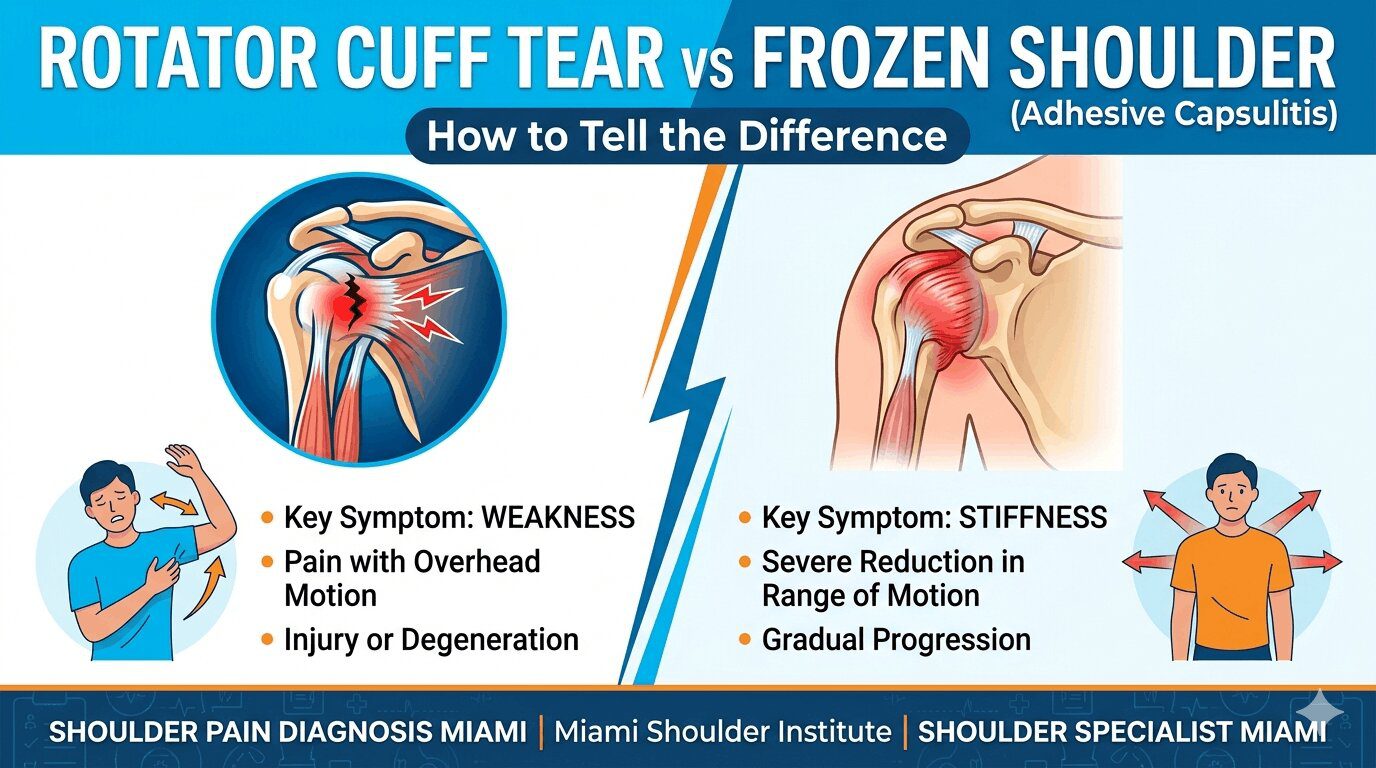
When patients experience shoulder pain and limited movement, one of the most common questions is whether they have a rotator cuff tear or frozen shoulder. While both conditions can cause pain and difficulty using the arm, they affect the shoulder differently and require different treatment approaches.
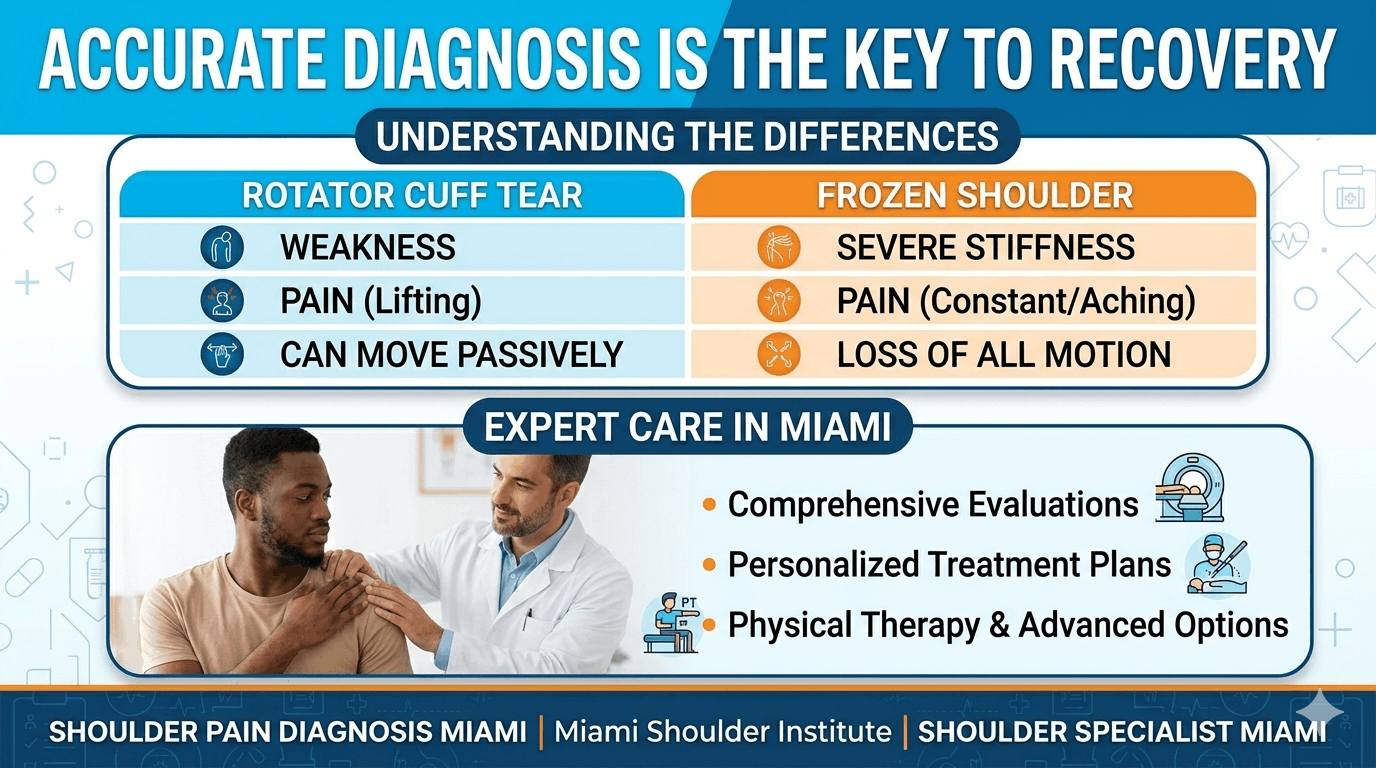
In a simple comparison of rotator cuff tear vs frozen shoulder, a rotator cuff tear typically causes weakness and pain during movement, while frozen shoulder primarily causes severe stiffness and a progressive loss of motion. Accurate diagnosis is essential because treatment strategies vary significantly.
At Miami Shoulder Institute, patients receive comprehensive evaluations designed to identify the true cause of shoulder pain and create an effective treatment plan.
Many shoulder conditions share similar symptoms, including:
Because these symptoms overlap, many patients assume they have the wrong condition.
An accurate shoulder pain diagnosis Miami patients receive is critical because:
Understanding the differences between frozen shoulder and rotator cuff tears can help patients know when to seek specialist care.
The rotator cuff consists of four muscles and tendons that help stabilize the shoulder and control arm movement.
A tear occurs when one or more of these tendons become damaged.
Tears may be:
Partial Tears
Only part of the tendon is damaged.
Full Thickness Tears
The tendon is completely torn.
Rotator cuff tears commonly occur because of:
Patients with rotator cuff tears often experience:
One of the most important signs is weakness. Many patients can move the shoulder but struggle to generate strength.
Frozen shoulder, also known as adhesive capsulitis, occurs when the shoulder capsule becomes inflamed, thickened, and tight.
Unlike a tendon tear, frozen shoulder primarily affects the joint capsule.
The condition develops gradually and often progresses through stages.
It commonly occurs in:
Read More – Shoulder Surgery in Miami: Cost, Insurance, and What to Expect
Patients with frozen shoulder typically experience:
Unlike rotator cuff tears, stiffness becomes the dominant symptom.
1. Weakness vs Stiffness
Rotator Cuff Tear
Patients often have:
Frozen Shoulder
Patients experience:
This is one of the easiest ways a shoulder specialist Miami patients trust can differentiate the two conditions.
2. How Symptoms Begin
Rotator Cuff Tear
Symptoms often begin after:
Frozen Shoulder
Symptoms usually develop gradually without a major injury.
Patients frequently notice increasing stiffness over weeks or months.
3. Range of Motion
Rotator Cuff Tear
Patients may struggle to move the arm due to pain or weakness, but passive motion is often preserved.
Frozen Shoulder
Both active and passive motion become restricted.
Even someone helping move the arm encounters resistance.
4. Pain Patterns
Rotator Cuff Tear
Pain is often:
Frozen Shoulder
Pain is often:
5. Progression Over Time
Rotator Cuff Tear
Symptoms may remain stable or worsen gradually depending on tear size.
Frozen Shoulder
Typically progresses through stages:
Freezing Phase
Increasing pain and stiffness.
Frozen Phase
Less pain but severe stiffness.
Thawing Phase
Gradual improvement in motion.
Yes.
Some patients develop frozen shoulders after a rotator cuff injury.
Others may have:
This is why professional evaluation is important rather than self-diagnosis.
At Miami Shoulder Institute, diagnosis typically involves:
Medical History
Understanding:
Physical Examination
A detailed assessment of:
Imaging Studies
Depending on symptoms, imaging may include:
The goal is to establish an accurate shoulder pain diagnosis Miami patients can rely on.
Treatment depends on tear severity.
Options may include:
Physical Therapy
Improves strength and shoulder mechanics.
Activity Modification
Reduces aggravating activities.
Anti-Inflammatory Treatment
Helps control symptoms.
Injections
May provide temporary relief.
Surgery
Larger or symptomatic tears may require repair.
Also Read More – 8 Possible Reasons Your Shoulder Pops or Cracks During Workouts
Frozen shoulder treatment focuses on restoring mobility.
Common approaches include:
Stretching Programs
Improve flexibility and motion.
Physical Therapy
Helps reduce stiffness.
Pain Management
Supports participation in rehabilitation.
Injections
May reduce inflammation.
Surgery
Reserved for selected cases that do not improve with conservative treatment.
Consultation with a shoulder specialist Miami patients trust may be beneficial if:
Early diagnosis often leads to more treatment options and better outcomes.
Miami Shoulder Institute focuses exclusively on shoulder conditions. Patients benefit from specialized expertise in diagnosing and treating complex shoulder problems, including rotator cuff tears, frozen shoulder, instability, arthritis, and sports-related injuries.
Whether symptoms require conservative treatment or surgical care, the focus remains on restoring function, reducing pain, and helping patients return to their normal activities.
1. How do I know if I have a rotator cuff tear or frozen shoulder?
Rotator cuff tears typically cause weakness, while frozen shoulders primarily cause stiffness and loss of motion.
2. Can frozen shoulders heal without surgery?
Yes. Many cases improve with time, stretching, and physical therapy.
3. Does a rotator cuff tear always require surgery?
No. Many partial tears can be treated successfully without surgery.
4. Which condition causes more stiffness?
Frozen shoulders generally cause significantly more stiffness than a rotator cuff tear.
5. Can MRI distinguish between the two conditions?
Yes. MRI is often useful in identifying rotator cuff tears and other shoulder abnormalities.
6. Can I have both conditions at the same time?
Yes. Some patients develop frozen shoulder alongside rotator cuff injuries.
7. When should I seek professional evaluation?
If pain, stiffness, or weakness persists for several weeks or affects daily activities.
Also Read More – Best Shoulder Surgeon in Miami: Diagnosis, Treatment & Recovery Explained
Top Shoulder Surgeons in Miami Offering Advanced Orthopedic Care