
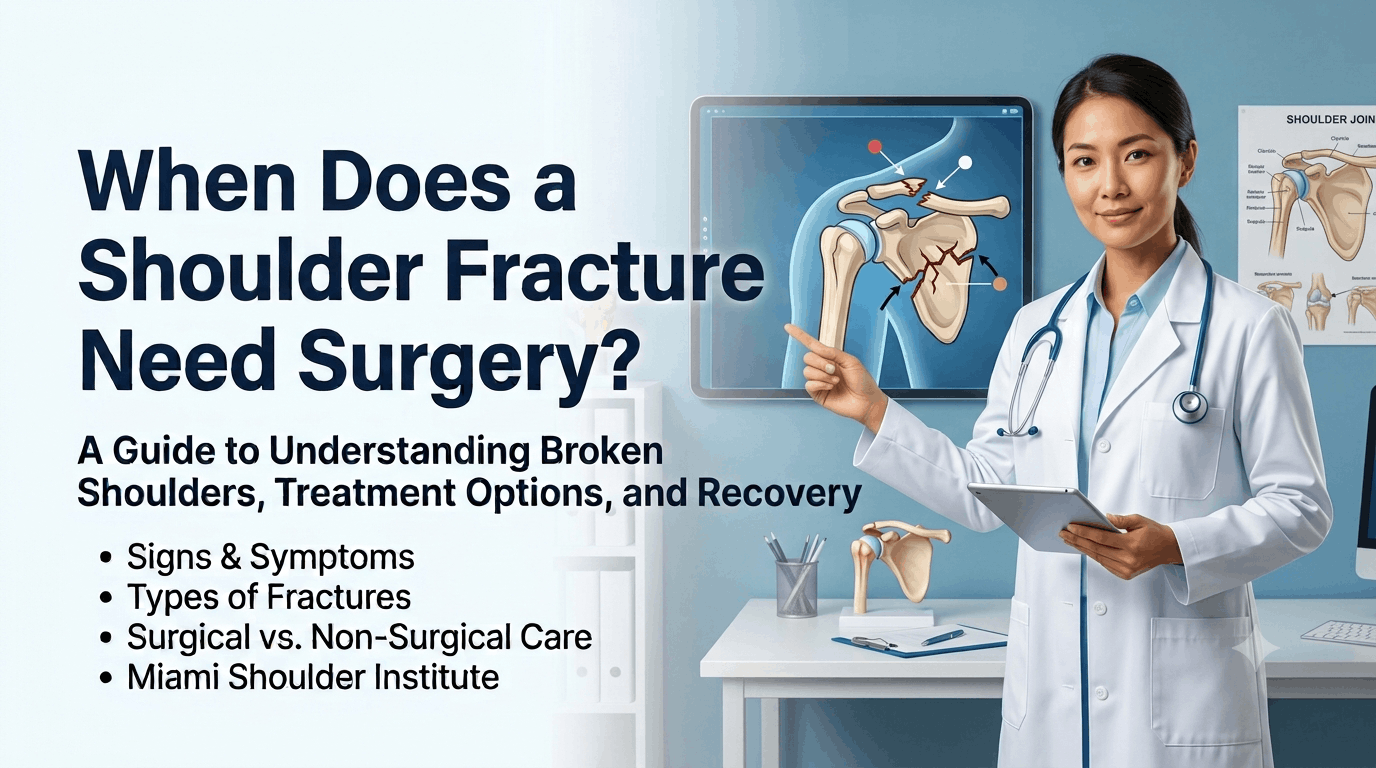
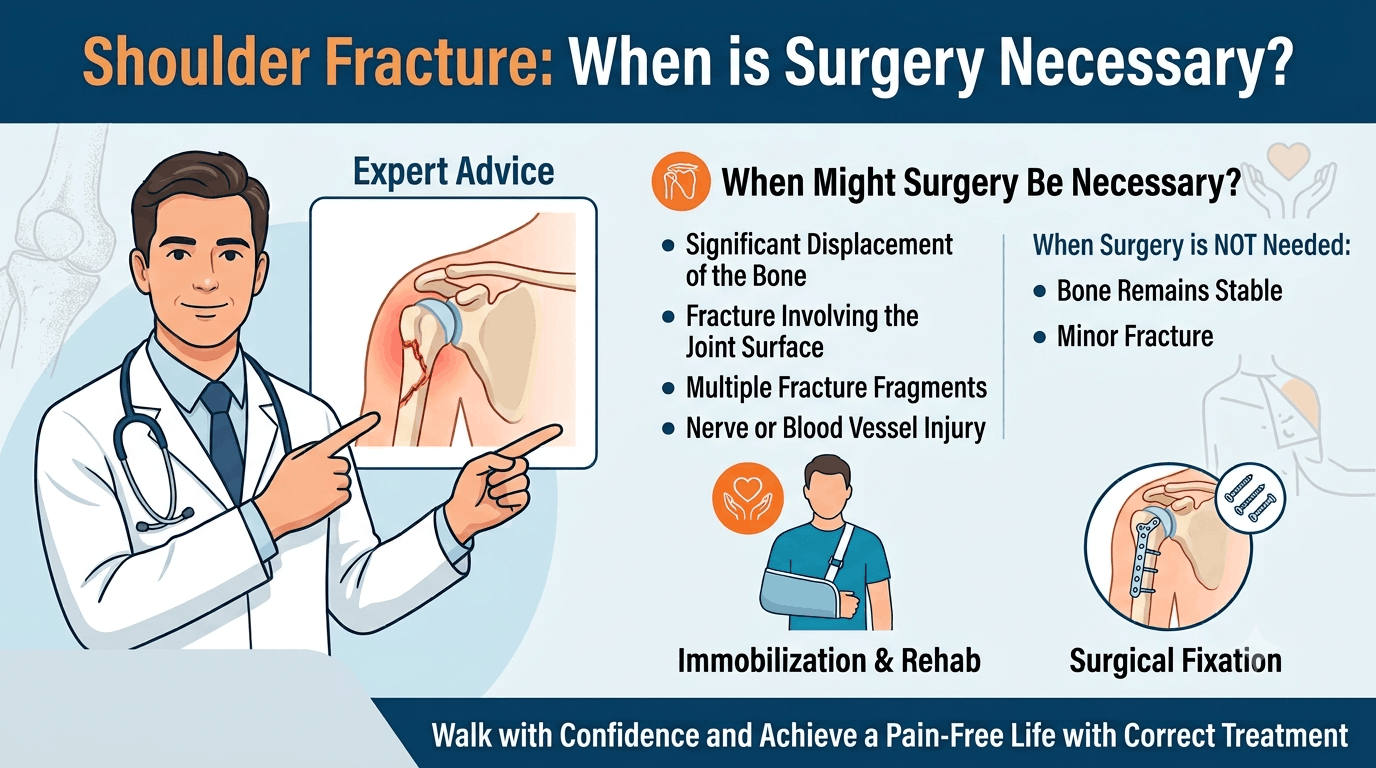
Not every shoulder fracture requires an operation. Many simple, stable fractures heal successfully with immobilization, pain management, and rehabilitation. However, when the broken bones are significantly displaced, unstable, involve the joint surface, or are associated with nerve or blood vessel injuries, surgery may be the best option to restore shoulder function.
The right shoulder fracture treatment depends on the type of fracture, its location, your age, activity level, bone quality, and overall health. At Miami Shoulder Institute, every shoulder fracture is carefully evaluated to determine whether non-surgical care or procedures such as proximal humerus fracture surgery or fracture fixation surgery shoulder offer the best chance for recovery.
A shoulder fracture occurs when one or more bones forming the shoulder joint break.
The shoulder consists of:
Although fractures can occur in any of these bones, the most common shoulder fracture involves the upper part of the humerus, known as the proximal humerus.
Because the shoulder is responsible for a wide range of motion, fractures can significantly affect mobility, strength, and daily function.
Different fractures require different treatment approaches.
Proximal Humerus Fracture
This is the most common shoulder fracture.
It occurs near the ball of the shoulder joint and is especially common in:
Some fractures remain stable, while others require proximal humerus fracture surgery.
Clavicle Fracture
Also called a collarbone fracture.
These injuries often occur after:
Many heal without surgery, although severe displacement may require repair.
Read More – Most Common Sports Shoulder Injuries and Their Treatments
Scapular Fracture
Fractures of the shoulder blade are relatively uncommon and usually result from high-energy trauma such as:
These injuries often require specialist evaluation.
Shoulder fractures usually occur after significant force.
Common causes include:
Falls
Especially in older adults.
Sports Injuries
Examples include:
Motor Vehicle Accidents
High-impact collisions frequently cause complex fractures.
Direct Trauma
A heavy blow to the shoulder may result in a fracture.
Common symptoms include:
Some patients also experience numbness or tingling if nearby nerves are affected.
At Miami Shoulder Institute, diagnosis begins with a comprehensive evaluation.
Medical History
Your provider will ask about:
Physical Examination
Evaluation includes:
Imaging helps determine fracture severity.
X-rays
Usually the first imaging study.
They help identify:
CT Scan
May be recommended for complex fractures requiring surgical planning.
MRI
Occasionally used if tendon or ligament injuries are suspected.
The primary goals of shoulder fracture treatment are to:
Treatment is always individualized.
Many fractures heal successfully without surgery.
Conservative treatment may be appropriate when:
Non-surgical treatment may include:
Careful follow-up is essential to ensure proper healing.
Read More – Shoulder Surgery in Miami: Cost, Insurance, and What to Expect
Not every fracture heals well without surgery.
The following situations commonly require broken shoulder surgery.
1. Significant Bone Displacement
When fractured bone fragments move out of position, healing may be compromised.
Surgery helps restore proper alignment.
2. Multiple Fracture Fragments
Complex fractures involving several bone pieces often require stabilization.
3. Joint Surface Involvement
Fractures extending into the shoulder joint may increase the risk of arthritis if left untreated.
4. Open Fractures
If the broken bone penetrates the skin, urgent surgery is usually required.
5. Nerve or Blood Vessel Injury
Associated injuries require immediate specialist evaluation.
6. Failed Non-Surgical Treatment
Some fractures shift during healing despite initial conservative care.
These cases may eventually require surgery.
Proximal humerus fracture surgery aims to restore normal shoulder anatomy and improve long-term function.
Treatment depends on:
The surgical plan is individualized for each patient.
One of the most common procedures is fracture fixation surgery shoulder.
The goal is to stabilize broken bone fragments while they heal.
Surgeons may use:
Stable fixation allows bone healing while minimizing movement at the fracture site.
In some patients—particularly older adults with severe, non-reconstructable fractures—shoulder replacement may be considered instead of fixation.
This option may be appropriate when:
Treatment decisions depend on individual circumstances.
Read More – How to Sleep Comfortably After Shoulder Surgery
Complex shoulder fractures benefit from evaluation by an experienced shoulder trauma surgeon.
Look for a specialist with expertise in:
Specialized experience can help optimize treatment decisions.
Recovery occurs in phases.
Weeks 1–2
Goals include:
Early healing is the priority.
Weeks 2–6
Patients gradually begin:
Progress depends on fracture stability.
Weeks 6–12
Rehabilitation focuses on:
Bone healing continues.
Months 3–6
Patients gradually return to:
Recovery speed varies by patient and fracture complexity.
Without proper treatment, complications may include:
Early diagnosis helps reduce these risks.
Rehabilitation is essential regardless of whether surgery is performed.
Physical therapy helps:
Successful recovery depends on both treatment and rehabilitation.
Read More – Difference Between an Orthopedic Shoulder Specialist and a General Orthopedic Doctor
While not all fractures are preventable, risk may be reduced by:
Healthy bones are less likely to fracture.
Miami Shoulder Institute specializes in diagnosing and treating complex shoulder conditions, including fractures, instability, arthritis, rotator cuff injuries, and sports-related trauma.
Whether treatment involves conservative care, proximal humerus fracture surgery, or fracture fixation surgery shoulder, patients receive individualized care focused on restoring shoulder function, relieving pain, and supporting long-term recovery.
The goal is not simply healing the bone—it is restoring confident, pain-free movement.
1. Does every shoulder fracture need surgery?
No. Many stable fractures heal successfully without surgery.
2. What is proximal humerus fracture surgery?
It is surgery performed to repair fractures involving the upper portion of the humerus near the shoulder joint.
3. What is fracture fixation surgery?
It is a procedure that uses plates, screws, or other implants to stabilize broken bones during healing.
4. How long does shoulder fracture recovery take?
Recovery varies depending on fracture severity and treatment but often takes several months.
5. Can a broken shoulder heal without surgery?
Yes. Many minimally displaced fractures heal well with conservative treatment.
6. When should I see a shoulder trauma surgeon?
You should seek prompt evaluation after any suspected shoulder fracture, especially following significant trauma.
7. Will I need physical therapy after a shoulder fracture?
Yes. Rehabilitation is an important part of restoring strength, mobility, and function.