
 EN EN
EN EN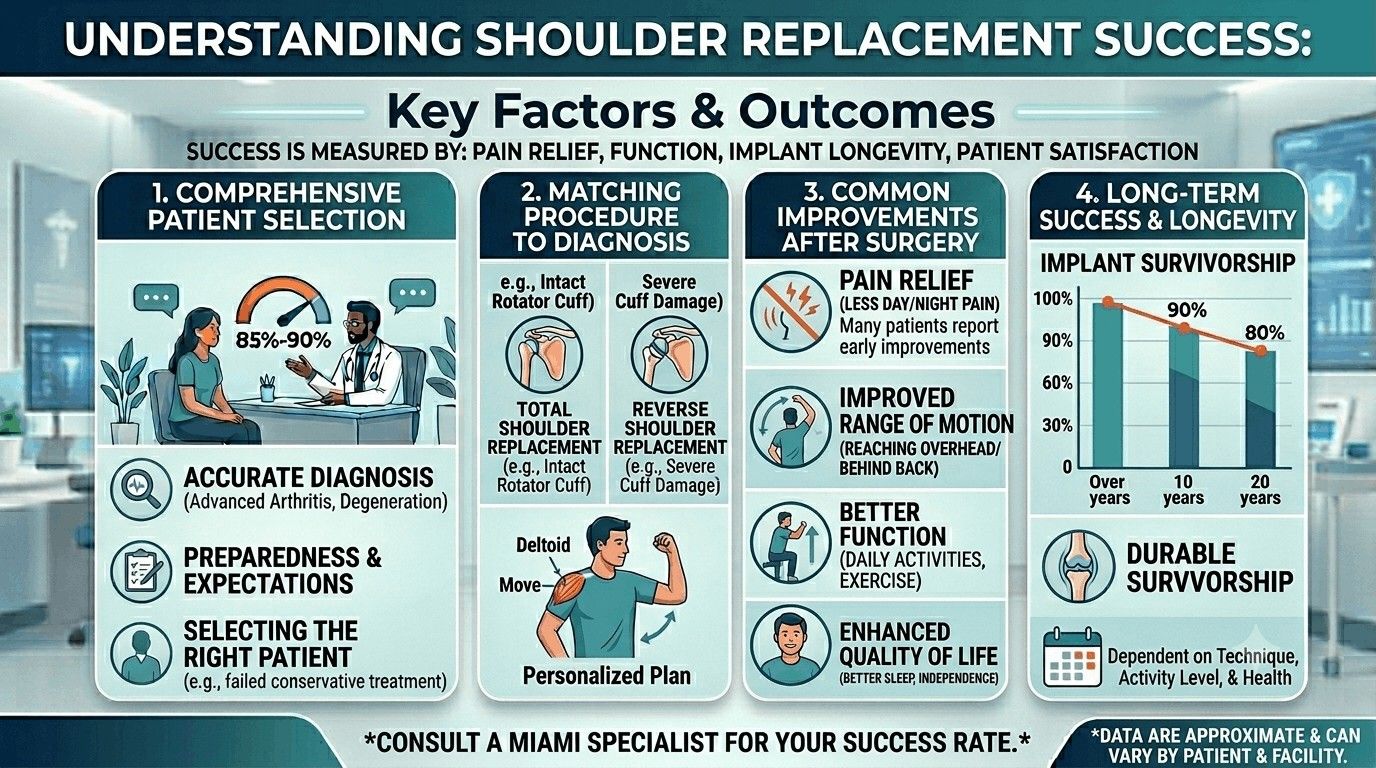
Shoulder replacement surgery is considered one of the most successful procedures for treating advanced shoulder arthritis, severe joint damage, and certain complex shoulder conditions. Most patients experience significant pain relief, improved mobility, and better quality of life after surgery.
When discussing the shoulder replacement success rate, it is important to understand that success is measured by several factors, including pain reduction, functional improvement, implant longevity, patient satisfaction, and return to daily activities. Modern shoulder replacement procedures generally produce excellent outcomes when performed for the right reasons and followed by proper rehabilitation.
At Miami Shoulder Institute, patients receive comprehensive evaluations to determine whether shoulder replacement Miami treatment is appropriate and which procedure is most likely to provide lasting benefits.
Shoulder replacement surgery involves replacing damaged portions of the shoulder joint with artificial components designed to restore movement and reduce pain.
The shoulder functions as a ball-and-socket joint.
Over time, conditions such as arthritis, injury, or severe tendon damage can cause the joint surfaces to deteriorate, leading to:
When conservative treatment no longer provides adequate relief, shoulder replacement may become an option.
Read More – Shoulder Surgery in Miami: Cost, Insurance, and What to Expect
Many patients live with shoulder pain for years before seeking treatment.
Common reasons for considering surgery include:
Persistent Pain
Pain that affects sleep and daily activities.
Loss of Motion
Difficulty reaching overhead or behind the back.
Reduced Quality of Life
Inability to participate in hobbies, sports, or work.
Failed Conservative Treatment
When physical therapy, medications, injections, and activity modification no longer help.
The primary goal is to restore comfort and improve shoulder function.
Not every shoulder replacement is the same.
The procedure selected depends on the patient’s diagnosis, anatomy, and rotator cuff function.
Total Shoulder Replacement
This procedure replaces both sides of the shoulder joint.
It is commonly recommended for:
Many patients achieve excellent long-term outcomes with total shoulder replacement.
Reverse Shoulder Replacement
A reverse shoulder replacement Miami specialist may recommend is designed differently from a traditional replacement.
In this procedure:
Reverse shoulder replacement is often used when:
This innovation has dramatically expanded treatment options for patients who previously had limited solutions.
When discussing the shoulder replacement success rate, patients often assume success simply means the implant remains intact.
In reality, success includes:
A successful outcome is ultimately measured by how well the surgery improves the patient’s life.
Most patients report significant improvements in several areas.
Pain Relief
Pain reduction is often the primary reason patients pursue surgery.
Many patients experience:
For many individuals, pain relief begins relatively early during recovery.
Improved Range of Motion
Patients often notice improvements in:
The degree of improvement varies depending on the condition treated and preoperative stiffness.
Better Function
Many patients regain the ability to:
Functional improvements often continue for several months after surgery.
Enhanced Quality of Life
Perhaps the most important measure of success is improved quality of life.
Patients frequently report:
Read More – Difference Between an Orthopedic Shoulder Specialist and a General Orthopedic Doctor
Not all outcomes are identical.
Several factors contribute to surgical success.
Accurate Diagnosis
Proper patient selection is essential.
The underlying condition must be appropriate for shoulder replacement.
Surgical Technique
Modern surgical planning and precise implant placement contribute to successful outcomes.
Implant Design
Advancements in implant technology have improved durability and function.
Rehabilitation Participation
Recovery does not end after surgery.
A structured rehabilitation program helps maximize results.
Overall Health
General health, bone quality, and medical conditions may influence recovery.
Patients often wonder whether one procedure is more successful than the other.
The answer depends on the patient’s condition.
Traditional shoulder replacement Miami procedures work well when:
Reverse shoulder replacement Miami procedures often provide excellent outcomes when:
The most successful procedure is the one that best matches the patient’s anatomy and diagnosis.
Read More – Rotator Cuff Problem? Put a Patch on it – Literally
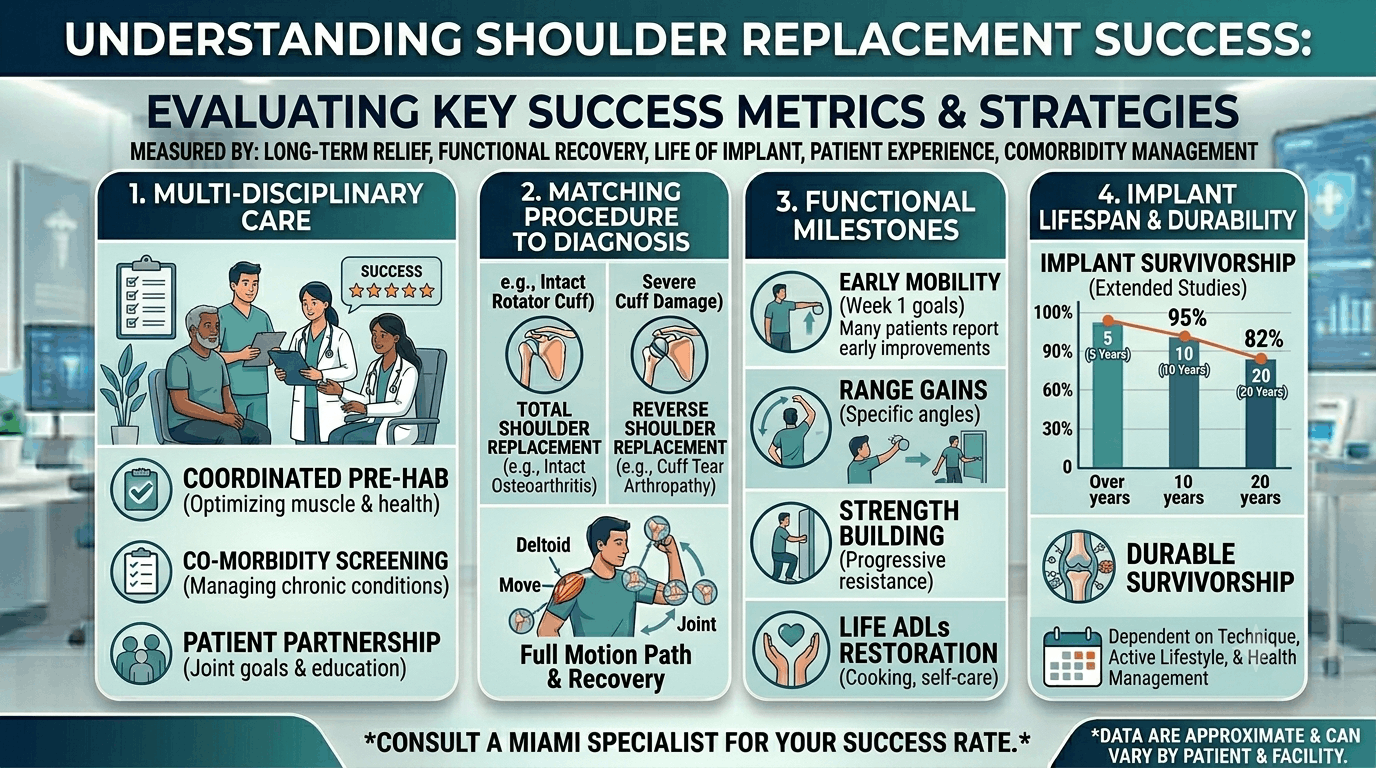
Longevity is an important part of the shoulder replacement success rate discussion.
Modern implants are designed to provide long-term durability.
Factors influencing longevity include:
Many patients enjoy years of improved shoulder function following surgery.
Several diagnoses may eventually require surgery.
Shoulder Arthritis
One of the most common reasons.
Rotator Cuff Arthropathy
Arthritis associated with severe rotator cuff damage.
Complex Fractures
Certain fractures may not be reconstructable.
Failed Previous Procedures
Revision surgery may sometimes be necessary.
Severe Joint Degeneration
Progressive wear may eventually require replacement.
Recovery occurs gradually and requires patience.
Early Recovery
The first few weeks focus on:
Rehabilitation Phase
Therapy typically focuses on:
Long-Term Recovery
Improvement often continues for several months.
Patients gradually resume:
Consistency is one of the most important factors in achieving successful outcomes.
Read More – Finding the Best Shoulder Surgeon in Miami: What Patients Should Look For
Several variables influence how quickly patients recover.
These include:
Every patient progresses at a different pace.
Surgery is not always the first option.
Many patients initially benefit from:
Surgery is typically considered when conservative measures no longer provide adequate relief.
Many patients preparing for surgery want to know:
A thorough consultation helps answer these questions and establish realistic expectations.
Miami Shoulder Institute focuses exclusively on shoulder care, providing advanced evaluation and treatment for arthritis, rotator cuff conditions, fractures, instability, and complex shoulder disorders.
Whether a patient requires conservative treatment, shoulder replacement Miami, or reverse shoulder replacement Miami, care is individualized to optimize long-term outcomes and quality of life.
1. What is the shoulder replacement success rate?
Most patients experience significant improvements in pain, function, and overall quality of life following shoulder replacement surgery.
2. Is shoulder replacement more successful than other shoulder surgeries?
It depends on the condition being treated, but shoulder replacement is considered highly effective for advanced arthritis and joint degeneration.
3. How long does recovery take after shoulder replacement?
Recovery occurs gradually over several months and varies by individual.
4. What is reverse shoulder replacement?
A reverse shoulder replacement changes the joint mechanics and is commonly used when the rotator cuff is severely damaged.
5. Will shoulder replacement eliminate all pain?
Most patients experience major pain relief, although individual results vary.
6. Can I return to activities after shoulder replacement?
Many patients return to daily activities, exercise, and recreational pursuits after recovery.
7. How do I know if I need shoulder replacement?
A comprehensive evaluation helps determine whether surgery is appropriate based on symptoms, imaging findings, and functional limitations.
Also Read About – Frozen Shoulder Recovery Time in Miami: What to Expect
Best Shoulder Doctor in Florida: How to Choose the Right Surgeon