

 EN EN
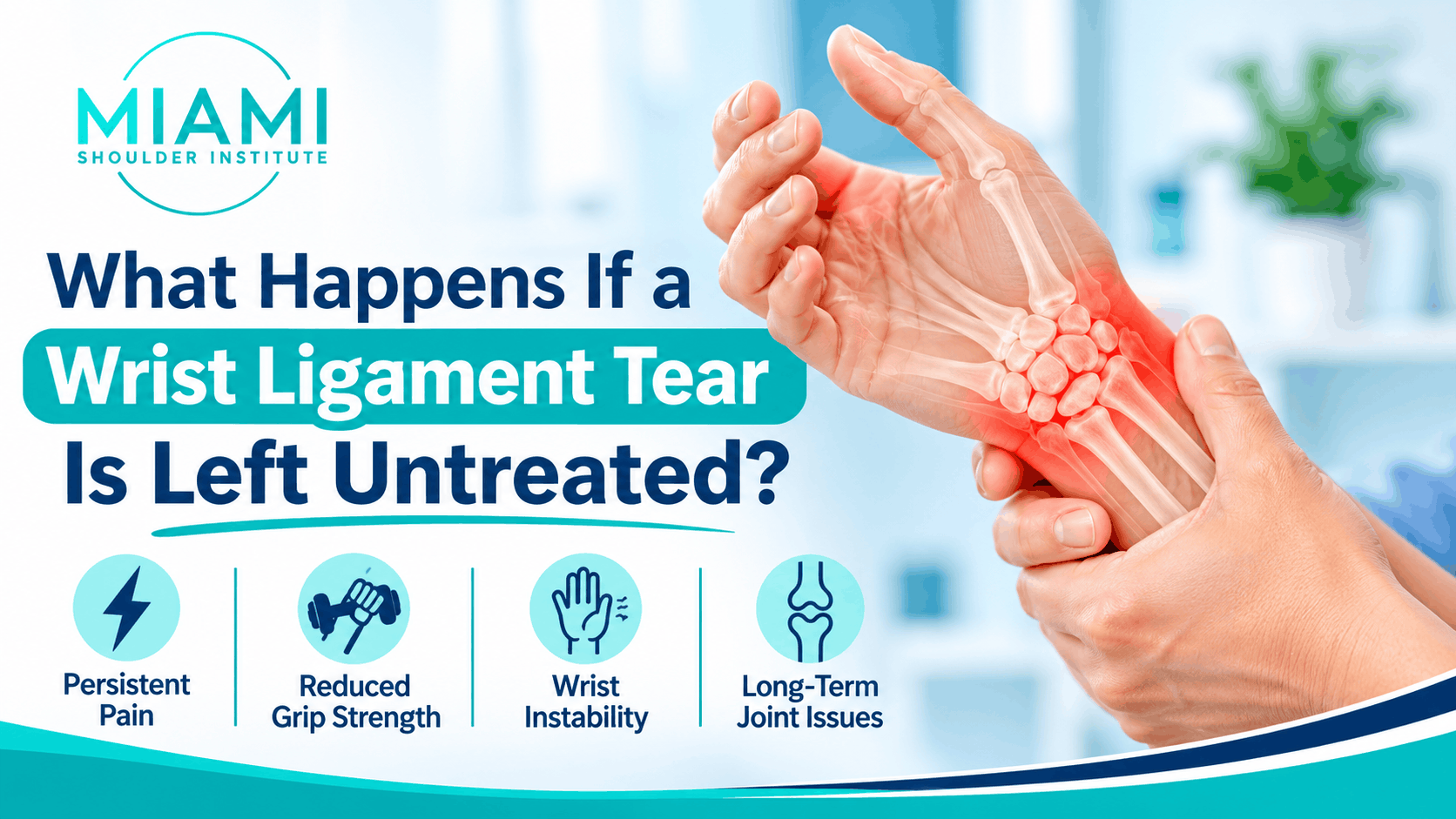
Leaving a wrist ligament tear untreated can sometimes lead to persistent pain, reduced grip strength, restricted movement, or wrist instability. The long-term effects depend on which ligament is injured, the severity of the tear, and whether the injury affects the stability of the wrist joint.
Some mild ligament injuries improve with appropriate non-surgical treatment. However, significant or unstable tears may not heal adequately without specialist care. In certain cases, an untreated injury can contribute to abnormal movement between wrist bones, cartilage damage, and degenerative changes over time.
Recognising the symptoms early and obtaining an accurate diagnosis can help prevent ongoing problems and guide appropriate ligament injury treatment.
Wrist ligaments are strong bands of connective tissue that connect bones and help maintain joint stability. They control movement between the small wrist bones and support the wrist during gripping, lifting, and everyday activities.
A ligament tear occurs when these fibres are stretched beyond their normal capacity or damaged.
Ligament injuries are commonly described according to their severity:
| Injury grade | Description |
| Grade 1 | Mild stretching or microscopic damage to ligament fibres |
| Grade 2 | Partial tear with some loss of structural strength |
| Grade 3 | Complete tear, which may cause significant joint instability |
The consequences depend on the specific ligament involved. A small tear in a less critical structure may cause limited symptoms, while damage to an important stabilising ligament can affect the mechanics of the entire wrist.
The outcome varies from person to person. Some injuries improve without surgery, while others can cause ongoing symptoms or structural problems.
1. Persistent Wrist Pain
One possible consequence is pain that continues beyond the expected recovery period.
An injured ligament may remain sensitive when the wrist is loaded during gripping, lifting, twisting, or weight-bearing activities.
People may notice discomfort when:
Persistent pain can also lead people to avoid certain movements, affecting their ability to work, exercise, or complete household tasks.
2. Wrist Instability
Wrist instability occurs when the structures responsible for supporting the joint cannot maintain normal alignment and controlled movement.
A significant ligament tear may allow the affected wrist bones to move abnormally in relation to one another.
Symptoms may include:
Not every ligament tear causes instability. However, untreated injuries involving important stabilising ligaments may increase the risk of persistent mechanical problems.
Read More – Why Does My Wrist Hurt When I Put Weight on My Hand?
3. Reduced Grip Strength
Ligament damage can make gripping uncomfortable or less effective.
The wrist needs a stable foundation to transfer force from the forearm muscles to the hand. If an injury affects this stability, gripping may become painful or difficult.
Reduced grip strength can interfere with everyday activities such as carrying objects, opening containers, holding tools, and lifting weights.
Pain can also cause protective muscle inhibition, where the body reduces the force generated by the hand to avoid aggravating the injured area.
4. Restricted Wrist Movement
Some people develop stiffness or reduced movement after a ligament injury.
This may happen because of ongoing pain, swelling, joint irritation, or changes in wrist mechanics. Avoiding movement for prolonged periods can also contribute to stiffness.
Restricted movement may affect wrist bending, extension, side-to-side movement, or forearm rotation, depending on the injured structure.
5. Cartilage Damage and Joint Degeneration
Certain significant ligament injuries can change how forces are distributed across the wrist.
When wrist bones no longer move in a coordinated way, abnormal loading may develop across joint surfaces. Over time, this can contribute to cartilage wear and degenerative changes.
One recognised example involves a significant scapholunate ligament injury. If the injury causes persistent instability, it may contribute to a pattern of progressive wrist degeneration known as scapholunate advanced collapse (SLAC).
This does not happen after every wrist ligament tear. The risk depends on the injury, its severity, and the degree of instability.
6. Difficulty Returning to Exercise or Sport
An untreated ligament injury may make it difficult to resume activities that place repeated stress on the wrist.
Sports and exercises involving gripping, pushing, pulling, or weight-bearing may repeatedly trigger symptoms.
People may find that wrist pain returns when they increase exercise intensity, even if the wrist feels comfortable during everyday activities.
Without identifying the underlying injury, repeated loading may continue to aggravate symptoms.
Read More – Why Does My Wrist Hurt When I Put Weight on My Hand?
Several ligaments support the wrist. The location of pain and the type of instability can vary depending on which structure is injured.
Scapholunate Ligament
The scapholunate ligament connects the scaphoid and lunate bones. It plays an important role in maintaining coordinated movement between these bones.
A significant tear may cause pain around the back of the wrist, reduced grip strength, clicking, and instability.
If left untreated, some injuries can progress to abnormal bone movement and degenerative wrist changes.
Lunotriquetral Ligament
The lunotriquetral ligament connects the lunate and triquetrum bones.
An injury may cause pain on the little-finger side of the wrist, tenderness, and discomfort during certain wrist movements. Some injuries may also contribute to instability between the affected bones.
Triangular Fibrocartilage Complex (TFCC)
The TFCC is a group of cartilage and ligament structures that supports the little-finger side of the wrist and helps stabilise the distal radioulnar joint.
A TFCC injury may cause ulnar-sided wrist pain, painful clicking, weak grip, and discomfort during forearm rotation.
Although it is not simply one wrist ligament, the TFCC is an important stabilising complex and is commonly involved in ulnar-sided wrist symptoms.
It is important to monitor changes in symptoms following a wrist injury.
Signs that may warrant further assessment include:
These symptoms do not automatically confirm a complete ligament tear. They indicate that the wrist may need further evaluation.
An accurate diagnosis helps determine whether the injury is likely to improve with non-surgical care or whether further treatment is needed.
Medical History
A clinician may ask how the injury occurred, when the pain started, and which movements make it worse.
A fall onto an outstretched hand, a sudden twisting movement, or repetitive wrist loading may provide useful clues.
Physical Examination
The wrist may be examined for tenderness, swelling, movement, grip strength, and joint stability.
Specific examination tests can help assess suspected ligament injuries. However, no single test identifies every type of wrist ligament tear.
X-Rays
X-rays help assess bone alignment, fractures, and certain signs of wrist instability.
Although they do not directly show most ligament tears, they may reveal changes in the spacing or alignment of wrist bones that suggest ligament damage.
MRI
MRI can provide detailed images of many wrist ligaments and surrounding soft tissues.
It may help identify a suspected tear, although the results must be interpreted alongside symptoms and examination findings. Some ligament abnormalities may also be present without causing symptoms.
CT or Arthroscopy
CT may be useful when detailed bone or joint alignment assessment is required.
In selected cases, wrist arthroscopy may be considered. It allows a specialist to examine structures inside the joint using a small camera and may also be used to treat certain injuries.
Yes. Some wrist ligament injuries improve with appropriate non-surgical treatment.
The likelihood of healing depends on the ligament involved, the severity of the tear, blood supply, joint stability, and how long the injury has been present.
Mild injuries and selected partial tears may be managed with:
However, some complete tears or injuries causing significant instability may require surgical assessment. Delaying evaluation of an unstable injury can make treatment more complex in certain cases.
Read more – Wrist Pain After Push-Ups: Injury, Technique or Overuse?
Treatment is selected according to the type of injury and its effect on wrist function.
1. Activity Modification
Reducing activities that place excessive stress on the injured wrist may help control symptoms.
This may include temporarily limiting heavy lifting, forceful gripping, repetitive twisting, and weight-bearing exercises.
2. Wrist Immobilisation
A brace or splint may be recommended to protect the injured structures and limit painful movement.
The type and duration of immobilisation depend on the specific ligament injury. Prolonged immobilisation without guidance may contribute to stiffness and weakness.
3. Physiotherapy and Rehabilitation
Rehabilitation may help restore wrist mobility, strength, and functional control.
Depending on the injury, it may include:
Exercise selection and progression should be based on the injury. Strengthening should not begin aggressively when a significant unstable tear is suspected.
4. Wrist Ligament Surgery
Surgery may be considered when there is a significant tear, persistent instability, or symptoms that do not improve with appropriate non-surgical treatment.
Possible procedures depend on the ligament and the age and characteristics of the injury.
Ligament repair: In selected injuries, the damaged ligament may be repaired to restore its connection and support.
Ligament reconstruction: When a ligament is too damaged or has become unsuitable for direct repair, reconstruction may be considered using tissue to restore stability.
Arthroscopic treatment: Certain injuries may be assessed or treated through minimally invasive wrist arthroscopy.
Additional procedures: If the injury has caused associated joint changes or bone alignment problems, additional treatment may be required.
Not every wrist ligament tear requires surgery. The decision depends on clinical findings, functional limitations, and the likely benefits and risks of treatment.
There is no single safe waiting period for every wrist ligament injury.
A mild sprain may improve with appropriate care, while a complete tear involving an important stabilising ligament may need timely assessment.
Some ligament injuries are more suitable for repair when identified early. Over time, a torn ligament may retract, scar tissue may develop, or secondary joint changes may occur. This can affect the available treatment options.
If pain, clicking, weakness, or instability persists after an injury, arranging an assessment is preferable to repeatedly testing the wrist through exercise or heavy activity.
Consider a specialist assessment if:
Seek urgent medical attention after an injury if there is severe pain, visible deformity, significant swelling, numbness, unusual colour changes, or a cold hand.
A wrist ligament tear can affect more than just comfort. If it compromises joint stability, it may interfere with gripping, lifting, exercise, and other everyday activities.
Miami Shoulder Institute takes an orthopaedic-focused approach to evaluating wrist and hand concerns. Assessment may include reviewing the injury history, examining wrist movement and stability, and considering imaging when clinically appropriate.
Treatment recommendations depend on the type and severity of the injury. Some patients may benefit from non-surgical management and rehabilitation, while selected cases may require surgical assessment.
If wrist pain, clicking, or instability continues after an injury, a specialist evaluation can help clarify the underlying problem and guide appropriate treatment.
Leaving a wrist ligament tear untreated can sometimes result in persistent pain, weakness, restricted movement, and wrist instability. Significant injuries involving important stabilising ligaments may also contribute to abnormal joint mechanics and degenerative changes over time.
However, not every ligament tear requires surgery. The right treatment depends on the affected structure, severity of the injury, and whether the wrist remains stable.
If wrist pain, clicking, or weakness continues after an injury, an appropriate assessment can help identify the problem and determine whether rehabilitation, bracing, or surgical treatment may be needed.
1. What happens if a wrist ligament tear is left untreated?
An untreated wrist ligament tear may cause persistent pain, reduced grip strength, stiffness, and wrist instability. Significant injuries may also contribute to abnormal movement between wrist bones and degenerative joint changes.
2. Can a wrist ligament tear heal on its own?
Some mild or partial ligament injuries improve with appropriate support, activity modification, and rehabilitation. Complete tears or injuries causing significant instability may require further treatment, including surgery in selected cases.
3. How do I know if my wrist ligament is torn?
Possible signs include pain, swelling, tenderness, weakness, painful clicking, and reduced wrist stability after an injury. A physical examination and appropriate imaging may help confirm the diagnosis.
4. Can an untreated wrist ligament tear cause arthritis?
Certain significant ligament injuries can lead to abnormal wrist mechanics and increased stress on joint surfaces. Over time, this may contribute to cartilage damage and degenerative changes, although it does not happen after every ligament tear.
5. Does a wrist ligament tear always require surgery?
No. Many wrist ligament injuries can initially be managed without surgery. Surgical treatment may be considered for significant tears, persistent instability, or symptoms that do not improve with appropriate non-surgical care.
6. How long does a wrist ligament tear take to heal?
Recovery varies depending on the ligament involved, the severity of the injury, and the treatment approach. Mild injuries may improve sooner, while more significant tears may require a longer period of protection and rehabilitation.
7. Can I exercise with a wrist ligament tear?
Exercise recommendations depend on the injury. Activities involving heavy gripping, pushing, pulling, or wrist rotation may need to be modified or temporarily avoided. A clinician can guide a safe return to activity.
8. What scan is best for diagnosing a wrist ligament tear?
MRI can help assess many wrist ligaments and surrounding soft tissues. X-rays may identify fractures or alignment changes, while CT and arthroscopy may be useful in selected cases. The appropriate investigation depends on the suspected injury.
9. What is the difference between a wrist sprain and a ligament tear?
A wrist sprain is an injury to one or more wrist ligaments. It can range from mild stretching and microscopic fibre damage to a partial or complete tear. The terms are not mutually exclusive.
10. When should I see a wrist specialist for a ligament injury?
Seek assessment if pain persists, grip strength decreases, or the wrist feels unstable. Painful clicking, restricted movement, or symptoms following a significant fall also warrant evaluation.