

 EN EN
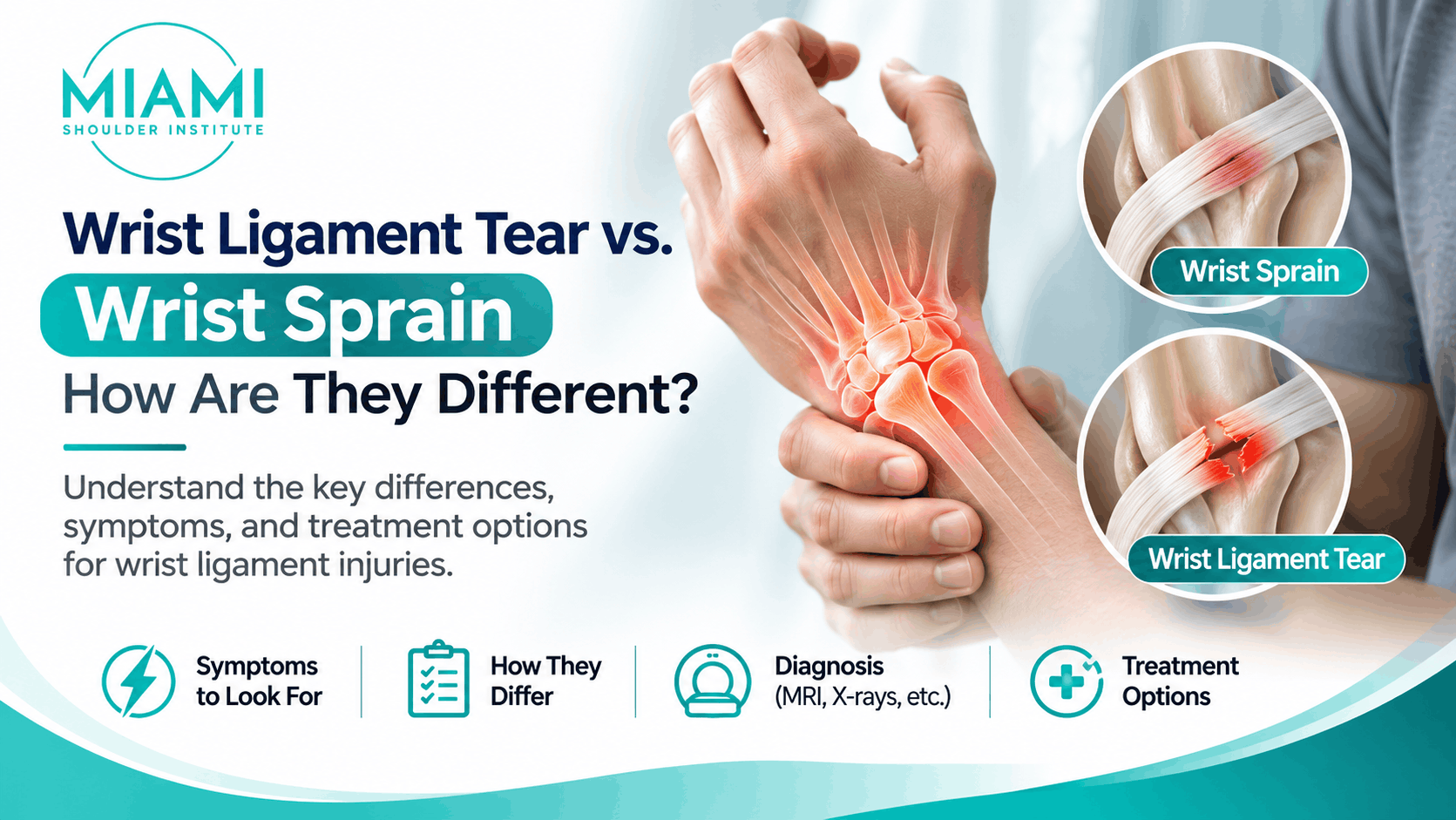
A wrist sprain and a wrist ligament tear are closely related injuries because both involve damage to the ligaments that support the wrist. The main difference is the extent of the damage. A mild sprain involves stretching or microscopic damage to ligament fibres, while a more severe injury may involve a partial or complete ligament tear.
Common wrist sprain symptoms include pain, swelling, bruising, tenderness, and difficulty moving the wrist. More significant wrist ligament injuries may also cause clicking, reduced grip strength, and wrist instability, particularly when lifting objects or putting weight through the hand.
Accurate wrist diagnosis may involve a physical examination, X-rays, MRI, or other specialised investigations. Mild and stable injuries can often be managed with activity modification, splinting, and rehabilitation. However, significant ligament tears that cause persistent instability may require specialist treatment or surgery.
Also Read More – Top Shoulder Surgeons in Miami Offering Advanced Orthopedic Care
A wrist sprain occurs when one or more ligaments are stretched beyond their normal limits or damaged by an external force.
Ligaments are strong bands of connective tissue that connect bones to other bones. In the wrist, they help maintain the correct position of the small carpal bones and allow them to move together in a coordinated way.
The wrist contains several ligaments that provide stability during activities such as gripping, lifting, pushing, pulling, and twisting.
A wrist sprain commonly occurs when someone falls onto an outstretched hand. The impact may force the wrist backwards or into an abnormal position, placing excessive stress on the supporting ligaments.
Other possible causes include:
A mild sprain may involve stretching or microscopic damage to ligament fibres. More significant injuries can involve partial or complete tearing.
Importantly, a sprain is not always a minor injury. The term describes a range of ligament damage, from mild stretching to complete rupture.
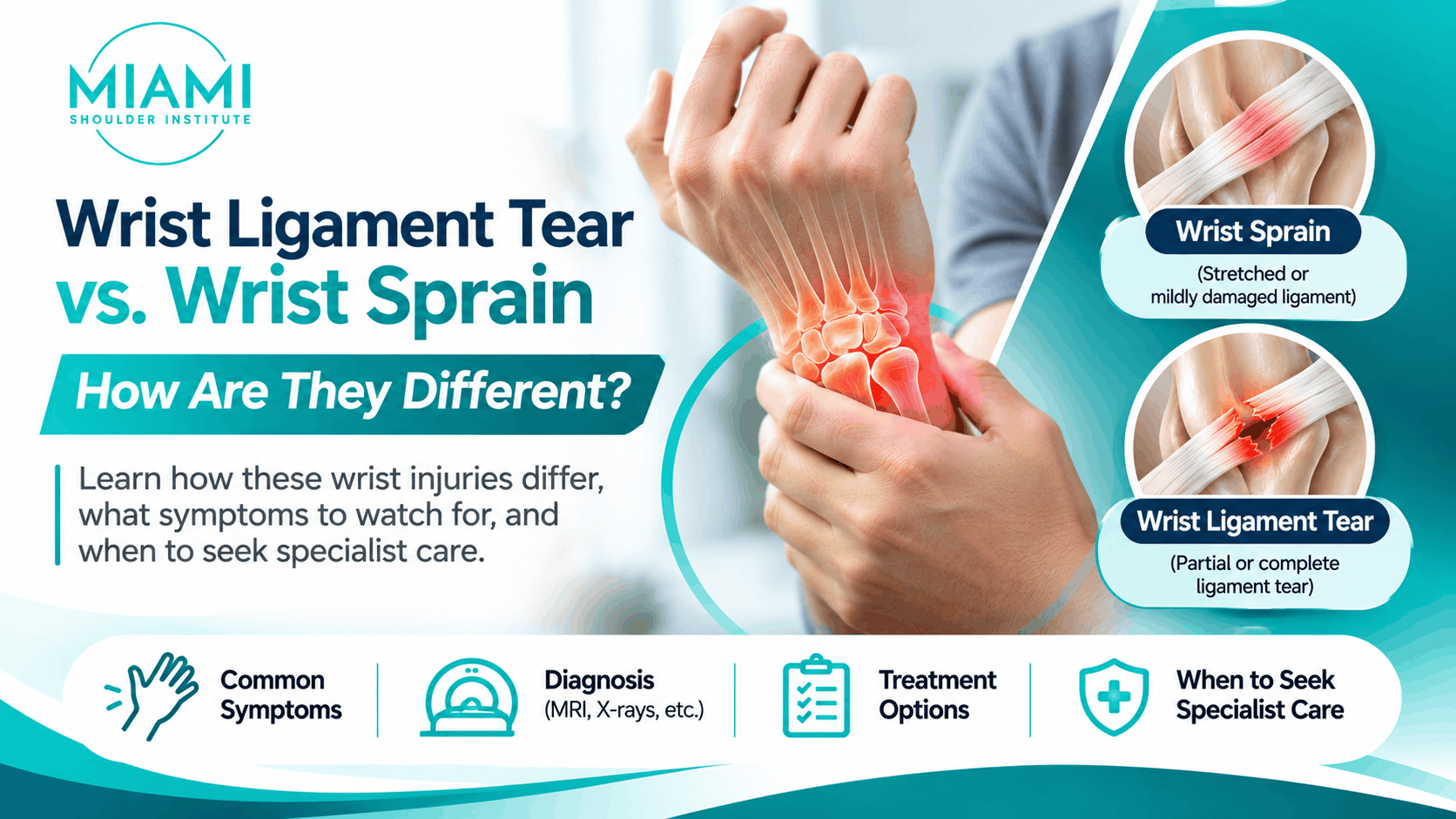
A wrist ligament tear occurs when some or all of the fibres within a ligament become disrupted.
Ligament tears can affect the wrist’s ability to maintain normal alignment and coordinated movement. This is particularly important because the wrist relies on several small bones and supporting ligaments working together.
A partial tear involves damage to some of the ligament fibres while part of the structure remains intact. A complete tear involves disruption across the full thickness of the ligament.
Depending on the affected structure, a significant tear may cause pain, reduced grip strength, clicking, or wrist instability.
Scapholunate ligament
The scapholunate ligament connects the scaphoid and lunate bones. It helps these two bones move together and maintain normal wrist alignment.
An injury may cause pain around the back or thumb side of the wrist, particularly when pushing through the hand, gripping, or extending the wrist.
A significant tear can allow the bones to move abnormally relative to one another.
Lunotriquetral ligament
The lunotriquetral ligament connects the lunate and triquetrum bones. It contributes to stability within the proximal row of carpal bones.
An injury may cause pain on the little-finger side of the wrist, reduced grip strength, or discomfort during certain wrist movements.
Triangular fibrocartilage complex (TFCC)
The TFCC is a group of structures on the little-finger side of the wrist. It helps stabilise the distal radioulnar joint and supports load distribution through the wrist.
Although it is not a single ligament, TFCC injuries are an important cause of ulnar-sided wrist pain and can occur alongside other ligament injuries.
Symptoms may include pain during forearm rotation, clicking, and discomfort when gripping objects.
Read More – Shoulder Fracture Surgery in Miami: Expert Orthopedic Care
The terms wrist sprain and wrist ligament tear are often used interchangeably. Understanding the extent of ligament damage helps explain differences in severity and treatment.
| Feature | Mild wrist sprain | Significant wrist ligament tear |
| Tissue damage | Stretching or microscopic fibre damage | Partial or complete disruption of ligament fibres |
| Pain | Often mild to moderate | May be moderate or severe |
| Swelling | Usually limited or moderate | May be more noticeable |
| Wrist movement | Often preserved, although uncomfortable | May be restricted or painful |
| Grip strength | May be temporarily reduced | Can be significantly affected |
| Stability | Usually maintained | May be compromised |
| Treatment | Often conservative | May require specialist assessment and, in selected cases, surgery |
| Recovery | Often shorter | Can take longer, depending on the ligament and severity |
Important distinction: A ligament tear is not necessarily a completely separate injury from a sprain. A complete ligament rupture is a severe form of sprain. The exact terminology and injury grade depend on the clinical assessment.
Wrist sprain symptoms vary depending on which ligament is affected and how much damage has occurred.
Some people experience mild discomfort that improves with rest, while others develop persistent pain and difficulty using their hands.
1. Pain Around the Wrist Joint
Pain is one of the most common symptoms. It may be concentrated around the injured ligament or spread across part of the wrist.
Discomfort may become more noticeable when bending the wrist, lifting objects, twisting the hand, or putting pressure through the palm.
2. Swelling and Bruising
Swelling can develop shortly after an injury. Bruising may also appear around the wrist or hand, depending on the force involved.
The amount of swelling does not always reflect the severity of ligament damage. A significant injury may sometimes produce relatively limited external swelling.
3. Tenderness When Touching the Wrist
The affected area may feel painful when pressed. The location of tenderness can provide useful information about which ligament or surrounding structure may be involved.
4. Reduced Wrist Movement
A sprain can make it uncomfortable to bend the wrist forwards or backwards, rotate the forearm, or move the hand from side to side.
Some people avoid certain movements because they trigger pain.
5. Weak Grip
Ligament pain can interfere with the wrist’s ability to support force during gripping activities.
You may notice difficulty opening jars, holding heavy objects, carrying shopping bags, or using tools.
Also Read More – Wrist Ligament Surgery in Miami: Treatment for Severe Wrist Injuries
A significant wrist ligament injury may cause symptoms that continue beyond the initial period of pain and swelling.
Certain signs may indicate that the injury has affected wrist stability rather than causing only temporary discomfort.
Clicking, Popping, or Grinding
Some people notice clicking or popping when moving the wrist. This can occur when injured structures affect the normal movement of the carpal bones.
You might notice clicking when:
Not every wrist click indicates instability. Painless clicking can also occur in healthy wrists.
However, clicking accompanied by pain, weakness, or a feeling of instability deserves assessment.
Wrist Instability
Wrist instability occurs when the supporting structures do not adequately control the movement or alignment of the wrist bones.
You may experience:
These symptoms may occur with certain significant ligament injuries, particularly when the scapholunate ligament is affected.
Persistent Pain After an Apparent Sprain
A wrist injury initially diagnosed as a sprain may continue to cause pain despite rest and basic treatment.
If discomfort persists, it is important to consider whether a more significant ligament injury, an associated fracture, or another wrist condition has been overlooked.
Wrist ligament injuries can occur through sudden trauma or repeated stress.
Falling Onto an Outstretched Hand
This is one of the common mechanisms of wrist ligament injury. When someone falls and attempts to break the fall with an extended hand, the wrist may bend backwards under the impact.
The force can stretch or tear the supporting ligaments.
Sports-Related Injuries
Activities such as gymnastics, basketball, tennis, cycling, and weightlifting can expose the wrist to sudden or repeated loading.
A fall, awkward landing, or forceful twisting movement may injure the ligaments.
Heavy Lifting and Forceful Gripping
Lifting heavy objects or placing excessive force through the wrist can strain supporting structures, particularly when the wrist is already positioned awkwardly.
Repetitive Wrist Movements
Repeated loading over time may contribute to irritation or gradual damage in some wrist structures.
However, persistent wrist pain should not automatically be attributed to repetitive use. A proper assessment is needed to determine the underlying cause.
Read More – Wrist Pain Treatment in Miami
Accurate wrist diagnosis is important because a ligament injury may resemble a simple sprain, fracture, tendon injury, or another condition.
The assessment generally combines the patient’s injury history, physical examination, and appropriate imaging.
1. Medical History and Physical Examination
The clinician may ask:
The physical examination may involve checking tenderness, swelling, range of motion, grip strength, and wrist stability.
Specific examination techniques may help assess individual ligaments. These tests should be performed by a trained healthcare professional rather than attempted forcefully at home.
2. X-Rays
X-rays are commonly used to assess wrist injuries.
Although standard X-rays do not directly show most ligaments, they can reveal:
Some ligament injuries are not visible on ordinary X-rays, especially during the early stages.
3. MRI Scan
An MRI provides detailed images of soft tissues, including many wrist ligaments.
It may help identify the location and extent of a ligament injury and assess surrounding structures.
MRI is particularly useful when symptoms suggest ligament damage but standard X-rays do not explain the problem.
4. MR Arthrogram
In selected cases, a clinician may recommend an MR arthrogram. This involves injecting contrast material into the wrist joint before MRI imaging.
The contrast can help reveal certain ligament or cartilage abnormalities that may be difficult to assess on conventional imaging.
5. Wrist Arthroscopy
Wrist arthroscopy is a minimally invasive surgical procedure in which a small camera is introduced into the wrist joint.
It allows direct assessment of internal structures, including certain ligaments. It may be considered when symptoms and other investigations suggest a significant injury that requires further clarification or treatment.
The choice of investigation depends on the suspected ligament, clinical findings, and the information needed to guide treatment.
Treatment depends on the extent of damage, the ligament involved, the presence of instability, and the patient’s functional requirements.
Not every ligament tear requires surgery. Many mild and selected partial injuries can be managed without an operation.
Treatment for a Mild Wrist Sprain
Conservative treatment may include:
The aim is to protect the injured tissue while allowing appropriate movement and recovery.
Treatment for a Partial Ligament Tear
A partial tear may require a longer period of protection than a mild sprain.
A clinician may recommend a wrist brace, splint, or temporary immobilisation, followed by a structured rehabilitation programme.
The exact approach depends on which ligament is injured and whether the wrist remains stable.
Treatment for a Complete Ligament Tear
A complete tear requires careful assessment because the ligament may no longer provide sufficient support.
Depending on the injury, treatment may involve immobilisation, rehabilitation, surgical repair, or reconstruction.
Surgery may be considered when the injury causes significant instability, when the ligament is completely disrupted, or when symptoms and functional limitations persist despite appropriate non-surgical treatment.
The timing of diagnosis can influence available treatment options, so persistent symptoms after an apparent sprain should not be ignored.
Yes. Certain significant ligament tears can lead to wrist instability if the damaged structures do not heal adequately.
The scapholunate ligament is particularly important because it helps maintain the coordinated relationship between the scaphoid and lunate bones.
When this ligament is severely disrupted, the bones may gradually move out of their normal alignment.
Over time, abnormal movement can increase stress on the joint surfaces and contribute to cartilage damage and degenerative changes.
One recognised long-term complication is scapholunate advanced collapse (SLAC), a pattern of wrist arthritis associated with chronic scapholunate instability.
Not every ligament injury progresses to instability or arthritis. The risk depends on the location and severity of the tear, the stability of the wrist, and whether the injury receives appropriate treatment.
Recovery varies according to the severity of the injury and the ligament involved.
A mild sprain may improve over a few weeks, while more significant injuries can take several months to recover. Complete tears requiring surgery may involve a longer rehabilitation period.
| Injury severity | General recovery considerations |
| Mild sprain | Often improves over several weeks with appropriate care |
| Moderate sprain or partial tear | May require several weeks or longer, depending on stability and treatment |
| Complete ligament tear | May need specialist treatment and a longer recovery period |
| Injury requiring surgery | Recovery may extend over several months, including rehabilitation |
These are broad estimates rather than guaranteed timelines.
Pain reduction does not always mean that a ligament has regained its full strength or that the wrist is stable enough for demanding activities.
Returning to sports, heavy lifting, or weight-bearing exercises should be guided by clinical assessment.
Appropriate rehabilitation can help restore movement, strength, and coordination after a wrist ligament injury.
However, the exercise programme should match the injury. Exercises suitable for a mild sprain may not be appropriate for an unstable complete tear.
Gentle Wrist Mobility
When permitted, controlled wrist movements can help reduce stiffness and maintain flexibility.
These may include gentle wrist bending, forearm rotation, and finger movement.
Avoid forcing the wrist into painful positions.
Gradual Grip Strengthening
Grip-strengthening exercises may be introduced when the injured ligament can safely tolerate additional load.
A therapist may recommend light gripping exercises before progressing to resistance-based activities.
Improving Wrist Stability
Rehabilitation may include exercises that improve coordination and control around the wrist.
The goal is to help the muscles work together to support the joint during everyday movements.
Gradual Return to Normal Activities
Start with manageable tasks and increase activity as symptoms and function improve.
Avoid returning too quickly to heavy lifting, push-ups, contact sports, or activities that place substantial pressure through the wrist.
Not every wrist sprain requires specialist treatment, but some symptoms suggest that further assessment is important.
Arrange a medical evaluation if you experience:
Seek urgent medical attention if you have severe pain, obvious deformity, an open injury, rapidly increasing swelling, new numbness, or fingers that become pale, blue, or cold.
Early wrist diagnosis can help distinguish a mild sprain from a more significant ligament injury or an associated fracture.
Also Read More – Carpal Tunnel Surgery in Miami: When Wrist Pain Requires Surgery
Persistent wrist pain, weakness, and instability can affect everyday activities, from gripping objects to lifting and exercising.
At Miami Shoulder Institute, patients with ongoing wrist and hand concerns can seek an assessment to discuss their symptoms, the circumstances of the injury, and whether additional diagnostic evaluation may be appropriate.
An evaluation may consider the original injury, the location of pain, wrist movement, grip strength, and signs of instability. Depending on the findings, additional imaging may be recommended to assess the ligaments and surrounding structures.
Treatment recommendations depend on the specific injury. Some patients may benefit from conservative care and rehabilitation, while others with significant structural damage may need a surgical evaluation.
The objective is to identify the factors contributing to ongoing symptoms and help guide an appropriate treatment plan.
Understanding the difference between a wrist ligament tear and a wrist sprain helps explain why some wrist injuries recover quickly while others cause persistent pain and instability.
A wrist sprain describes a spectrum of ligament damage, ranging from mild stretching to complete tearing. More significant ligament injuries can affect the normal alignment and movement of the wrist bones, potentially leading to ongoing weakness, clicking, and instability.
Accurate wrist diagnosis is important because symptoms alone cannot reliably establish the extent of ligament damage. Clinical examination and appropriate imaging help determine whether conservative treatment, rehabilitation, or surgical evaluation is necessary.
If wrist pain, weakness, or instability continues after an injury, seek an appropriate medical assessment rather than assuming it is a minor sprain.
1. Is a wrist sprain the same as a ligament tear?
A wrist sprain is an injury to one or more ligaments. It can range from mild stretching to partial or complete tearing. Therefore, a ligament tear is a form of sprain, with the extent of damage determining its severity.
2. How do I know if I have a wrist ligament tear?
Possible symptoms include persistent pain, swelling, tenderness, weakness, clicking, reduced grip strength, and a feeling of instability. However, these symptoms can also occur with other wrist injuries. A clinical examination and appropriate imaging may be needed to confirm the diagnosis.
3. Can a wrist ligament tear heal without surgery?
Yes. Some partial tears and selected stable ligament injuries can improve with immobilisation, activity modification, and rehabilitation. Complete tears associated with significant instability may require surgical treatment, depending on the ligament and injury characteristics.
4. What does wrist instability feel like?
Wrist instability may feel like the joint is shifting, clicking, clunking, or giving way during movement. Some people experience pain when pushing through the palm, lifting objects, or performing weight-bearing exercises.
5. Can an X-ray detect a wrist ligament tear?
An X-ray usually cannot show the ligament itself. However, it can identify fractures and abnormal alignment or spacing between wrist bones that may suggest ligament damage. MRI or other investigations may be recommended when further soft-tissue assessment is needed.
6. How long does a wrist sprain take to heal?
Mild wrist sprains may improve over a few weeks, while moderate or severe injuries can take several months. Recovery depends on the extent of ligament damage, the affected structure, and the treatment provided.
7. What is the most commonly injured wrist ligament?
The scapholunate ligament is an important wrist ligament frequently involved in traumatic wrist injuries. It connects the scaphoid and lunate bones and helps maintain normal wrist stability.
8. Can a wrist ligament tear cause permanent damage?
Some significant ligament injuries can lead to chronic instability, reduced function, and degenerative arthritis if they are not recognised and appropriately managed. However, outcomes vary, and not every tear causes permanent damage.
9. Why does my wrist click after an injury?
Clicking may occur because of changes in how the wrist structures move after an injury. It can also have causes unrelated to ligament damage. Painful clicking, particularly when accompanied by weakness or instability, should be assessed.
10. Should I wear a wrist brace for a ligament injury?
A brace or splint may help protect an injured ligament and reduce painful movement. However, the type and duration of immobilisation depend on the injury. Prolonged or unnecessary immobilisation can contribute to stiffness, so follow individual medical advice.
Read More – 8 Possible Reasons Your Shoulder Pops or Cracks During Workouts
Shoulder Surgery in Miami: Cost, Insurance, and What to Expect