

 EN EN
EN EN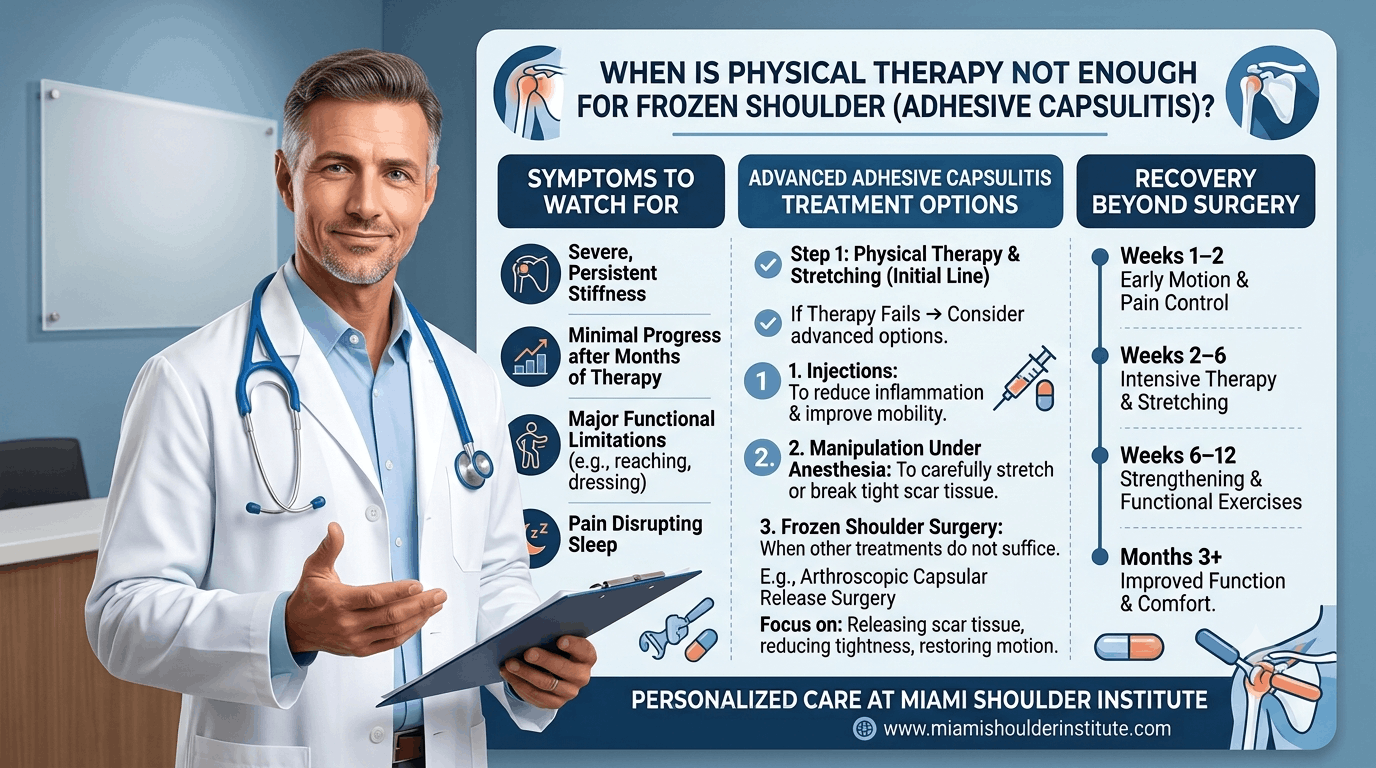
Physical therapy is often the first-line treatment for frozen shoulder, also known as adhesive capsulitis. Many patients improve with stretching, guided rehabilitation, and time. However, not every case responds well to conservative care. When severe pain, persistent stiffness, or major functional limitations continue despite months of therapy, more advanced frozen shoulder treatment may be needed.
In these cases, options such as injections, manipulation under anesthesia, or frozen shoulder surgery may be considered. At Miami Shoulder Institute, treatment plans are personalized based on symptom severity, recovery progress, and how much the condition affects daily life.
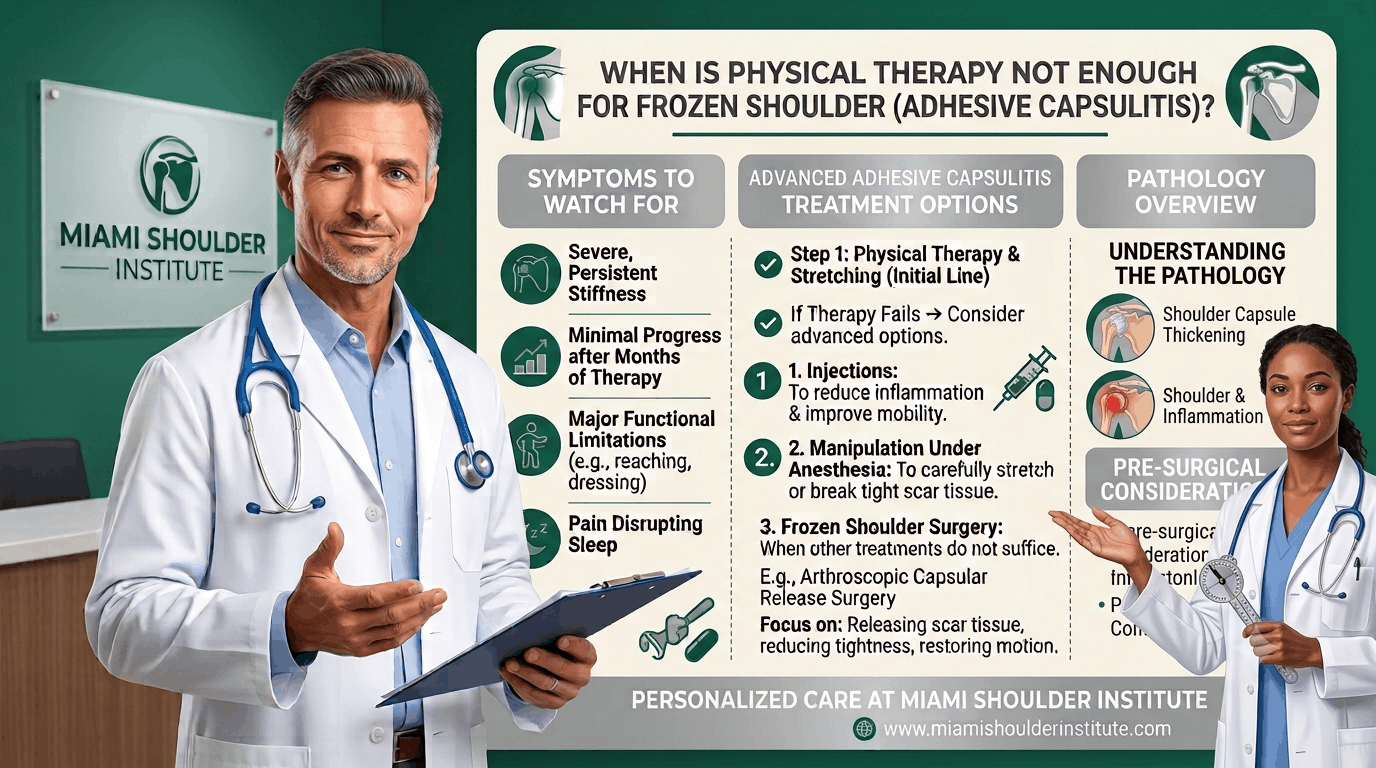
Frozen shoulder, medically known as adhesive capsulitis, is a condition where the shoulder capsule becomes inflamed, thickened, and tight. Over time, this leads to pain and a major reduction in shoulder mobility.
The shoulder capsule is a connective tissue structure surrounding the joint. Normally, it allows smooth shoulder movement. In frozen shoulder, this capsule becomes stiff and contracted, restricting motion.
Patients often struggle with simple activities such as:
This condition can significantly affect quality of life.
Read More – Shoulder Surgery in Miami: Cost, Insurance, and What to Expect
The exact cause is not always clear, but several factors increase risk.
Common risk factors include:
Sometimes frozen shoulder develops without an obvious cause.
Understanding the stages helps explain why recovery can take time.
Stage 1: Freezing Phase
This is the painful stage.
Symptoms include:
Pain worsens while motion starts decreasing.
This stage may last several months.
Stage 2: Frozen Phase
Pain may improve slightly, but stiffness becomes severe.
Patients often notice:
This is often the most frustrating phase.
Stage 3: Thawing Phase
The shoulder slowly begins improving.
Patients experience:
Recovery can still take months.
Read More –Frozen Shoulder Recovery Time in Miami: What to Expect
Patients seeking adhesive capsulitis treatment commonly report:
The defining symptom is stiffness—not just pain.
At Miami Shoulder Institute, diagnosis begins with a comprehensive evaluation.
Medical History
A frozen shoulder specialist will review:
Physical Examination
Key evaluation points include:
Loss of both active and passive motion strongly suggests frozen shoulder.
Imaging
Imaging may include:
X-rays
Used to rule out arthritis or fractures.
MRI
May help rule out rotator cuff tears or other structural injuries.
Diagnosis is often clinical.
Most patients start with conservative care.
Physical Therapy
This is the most common first-line frozen shoulder treatment.
Therapy focuses on:
Many patients improve gradually with structured therapy.
Home Stretching Programs
Consistency matters.
Daily stretching helps maintain progress.
Anti-Inflammatory Treatment
This may help reduce:
Pain control often improves therapy participation.
Injections
Selected patients may benefit from injections to reduce inflammation and improve mobility.
Read More – Rotator Cuff Tear vs Frozen Shoulder: How to Tell the Difference
Although many patients improve with therapy, some continue struggling.
Signs conservative treatment may not be enough include:
Severe Persistent Stiffness
Minimal progress after months of therapy.
Pain That Disrupts Sleep
Night pain remains severe.
Major Functional Limitations
Difficulty performing basic daily activities.
Plateau in Progress
Therapy no longer improves mobility.
Symptoms Lasting Many Months
Chronic frozen shoulder may need advanced intervention.
These cases may require more aggressive adhesive capsulitis treatment.
Surgery is not the first option, but frozen shoulder surgery may be appropriate in selected patients.
Surgery may be considered if:
The goal is to restore motion and improve quality of life.
One of the most effective surgical options is capsular release surgery.
This procedure targets the tight shoulder capsule responsible for restricted motion.
The goal is to:
This procedure is often minimally invasive.
Modern capsular release surgery is commonly performed arthroscopically.
This involves:
Benefits may include:
At Miami Shoulder Institute, arthroscopic techniques are used when appropriate.
Another advanced option is manipulation under anesthesia.
During this procedure:
This may improve mobility in selected cases.
Sometimes it is combined with surgery.
Recovery does not end after surgery.
Rehabilitation remains essential.
Week 1–2: Early Motion
Goals include:
Early movement is often encouraged.
Weeks 2–6: Intensive Therapy
Therapy focuses on:
Consistency is critical.
Weeks 6–12: Strengthening
Patients begin:
Months 3+
Patients continue improving in:
Recovery varies between patients.
Read More – Difference Between an Orthopedic Shoulder Specialist and a General Orthopedic Doctor
Recurrence is uncommon but possible.
Risk may increase in:
Some patients may develop frozen shoulder in the opposite shoulder later.
Yes—many cases eventually improve.
However, spontaneous recovery may take:
Not every patient wants to wait that long.
This is why advanced treatment options exist.
Patients can support recovery by:
The earlier treatment begins, the better recovery often becomes.
Miami Shoulder Institute specializes exclusively in diagnosing and treating complex shoulder conditions, including frozen shoulder, rotator cuff injuries, instability, arthritis, fractures, and revision cases.
Whether treatment involves therapy, injections, or capsular release surgery, care is individualized to restore motion, reduce pain, and improve long-term shoulder function.
The goal is not just reducing pain—it is restoring movement and quality of life.
Read More – 8 Possible Reasons Your Shoulder Pops or Cracks During Workouts
1. What is the best frozen shoulder treatment?
Treatment depends on severity but often begins with physical therapy and stretching.
2. Does every frozen shoulder need surgery?
No. Most cases improve without surgery.
3. What is adhesive capsulitis?
Adhesive capsulitis is the medical term for frozen shoulder.
4. When is frozen shoulder surgery needed?
Surgery may be considered when severe stiffness persists despite conservative treatment.
5. What is capsular release surgery?
It is a procedure that releases tight shoulder capsule tissue to improve motion.
6. How long does frozen shoulder recovery take?
Recovery varies from months to over a year depending on severity and treatment.
7. Can physical therapy cure frozen shoulder?
Many patients improve significantly with consistent therapy, though severe cases may require advanced treatment.
Also Read About – Shoulder Cartilage Repair Surgery in Miami: Advanced Joint Preservation
Best Exercises After Shoulder Surgery in Miami