

 EN EN
EN EN
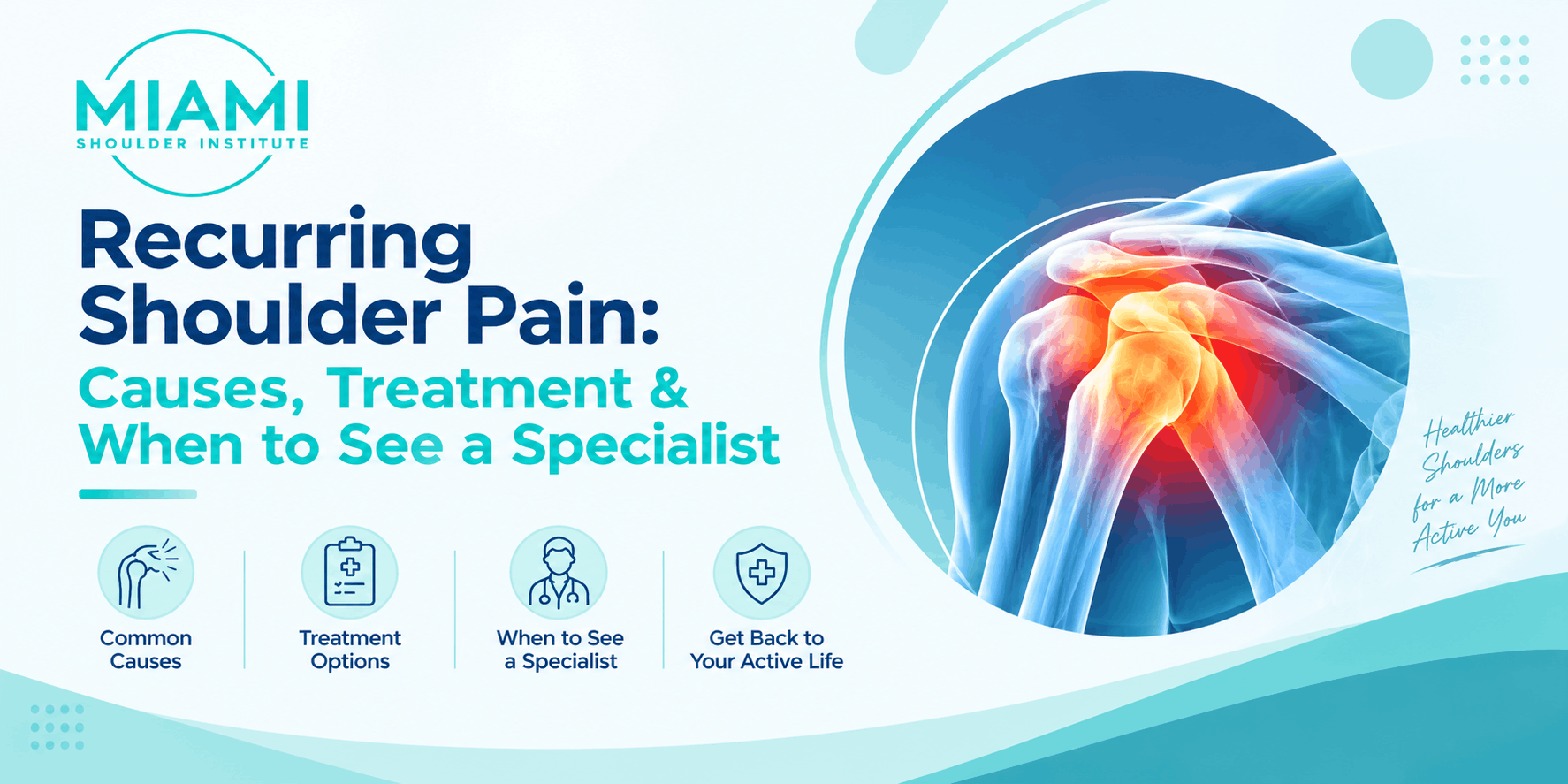
Recurring shoulder pain is often a sign that an underlying shoulder problem has not fully resolved. The pain may temporarily improve with rest or reduced activity but return when you resume certain movements. Common causes include a previous shoulder injury, rotator cuff problems, shoulder instability, inflammation, arthritis, tendon disorders, or repetitive overuse.
Recurrent shoulder pain does not necessarily mean you need surgery. The appropriate treatment depends on why the pain keeps returning, how severe it is, whether there is weakness or instability, and whether the shoulder has sustained structural damage. A proper examination and, when appropriate, imaging can help identify the cause and guide shoulder pain treatment.
If your pain repeatedly returns despite rest, exercise, or previous treatment, the important question is not simply “How can I make the pain stop again?” It is “Why does it keep coming back?”
That distinction can make a significant difference in how the condition is managed.
A shoulder that repeatedly becomes painful may be telling you that the underlying problem has not been completely addressed.
Pain is a symptom rather than a diagnosis. For example, two people can have pain while reaching overhead but have completely different conditions. One may have rotator cuff irritation, while another may have shoulder instability, arthritis or a previous injury.
The shoulder contains bones, cartilage, muscles, tendons, ligaments and bursae that work together to produce a wide range of motion. Problems affecting any of these structures can produce pain.
Shoulder pain may also originate outside the shoulder. Conditions involving the neck or nerves can sometimes cause pain that is felt around the shoulder.
This is why simply treating the pain every time it returns may not address the actual cause.
Read More – Shoulder Surgery in Miami: Cost, Insurance, and What to Expect
One of the most common explanations for recurring shoulder pain is a previous shoulder injury.
You may have injured your shoulder during:
The initial pain may improve enough for you to resume normal activities, but the injured structure may still be vulnerable.
For example, rotator cuff injuries can range from inflammation and tendon irritation to partial or complete tears. Some injuries occur gradually through wear and repetitive activity, while others happen during a specific accident or trauma.
If the shoulder becomes painful every time you return to a particular activity, that pattern deserves attention.
Also Read More – 8 Possible Reasons Your Shoulder Pops or Cracks During Workouts
The rotator cuff is a group of muscles and tendons that helps stabilise the shoulder and allows the arm to move.
Rotator cuff problems can cause:
Rotator cuff problems can develop gradually through tendon degeneration and repetitive use, or they can occur after an acute injury such as a fall.
Some people may also have a rotator cuff tear without experiencing significant pain initially.
However, persistent weakness or pain that repeatedly returns after activity should be evaluated rather than assumed to be ordinary muscle soreness.
Diagnosis may involve a physical examination and, when appropriate, imaging such as an X-ray, ultrasound or MRI. Imaging is particularly useful when the clinician needs to evaluate soft tissues such as tendons.
Does your shoulder ever feel as though it is:
These symptoms can point toward shoulder instability.
The shoulder is designed to provide extensive movement, but that mobility also means it depends heavily on surrounding muscles, tendons, ligaments and other structures for stability.
Instability may develop after a previous dislocation or other injury. Repeated instability episodes can also contribute to additional damage and ongoing pain.
If your shoulder pain is accompanied by a feeling that the joint is unreliable or unstable, simply resting until the pain disappears may not address the underlying problem.
A specialist evaluation can help determine whether the symptoms are related to instability, a labral injury, tendon damage or another condition.
Sometimes the shoulder improves because you stop doing the activity that causes pain.
Then you return to the same activity—and the pain comes back.
This can happen with:
Repeated overhead movements and prolonged heavy lifting can contribute to rotator cuff irritation or injury.
This does not mean you should permanently stop using your shoulder.
Instead, the goal is to understand which movements are aggravating the condition and whether your shoulder has adequate strength, mobility and control to perform those activities safely.
A tailored rehabilitation programme may help restore strength and movement while reducing unnecessary stress on the shoulder.
Not every case of recurrent shoulder pain is caused by an injury.
Arthritis can also cause ongoing symptoms.
Shoulder arthritis may lead to:
Arthritis can develop gradually, but symptoms may fluctuate. Some days may feel relatively manageable while other days are significantly more painful.
Previous trauma can also contribute to changes in the shoulder joint over time.
When arthritis is suspected, treatment depends on the type and severity of the condition, how much movement has been affected and how significantly symptoms interfere with everyday activities.
The shoulder contains several important tendons that can become irritated or damaged.
Biceps tendon problems, for example, can cause pain at the front of the shoulder and may become worse with certain lifting or pulling movements.
Tendon-related pain can sometimes improve with reduced activity but return when the tendon is loaded again.
This pattern is important because repeated symptoms may indicate that the shoulder has not regained adequate strength or that an underlying tendon problem remains.
The right treatment depends on the specific tendon involved and the severity of the injury.
One of the more important clues is weakness.
If your shoulder feels normal at rest but becomes weak or painful when you lift something, reach overhead or perform repetitive movements, the issue may involve the muscles or tendons responsible for shoulder movement and stability.
Rotator cuff problems, in particular, can produce weakness and difficulty performing everyday activities.
Recurring pain combined with progressive weakness deserves more attention than occasional soreness after an unusually demanding activity.
The terms are related, but they describe slightly different patterns.
Recurrent shoulder pain
Recurrent shoulder pain means the symptoms repeatedly return after periods of improvement.
For example:
Your shoulder hurts for several days, improves, and then becomes painful again after returning to exercise.
Chronic shoulder pain
Chronic shoulder pain generally refers to pain that persists for a prolonged period rather than completely resolving.
For example:
Your shoulder has remained painful or uncomfortable for months with little meaningful improvement.
A person can have both recurrent and chronic symptoms.
For example, someone may experience low-level discomfort for months with periodic episodes of more severe pain after physical activity.
The important issue is identifying what is causing the symptoms rather than focusing only on how long the pain has been present.
Recurring pain does not always indicate a serious problem, but certain symptoms should prompt medical evaluation.
Consider seeing a shoulder specialist if you have:
Urgent evaluation is particularly important after an injury if the shoulder looks deformed, you cannot move the arm, there is sudden swelling or the pain is severe.
Finding the cause usually starts with a detailed medical history and physical examination.
Your clinician may ask:
During the physical examination, shoulder movement, strength and areas of tenderness may be assessed.
Depending on the symptoms, imaging may also be recommended.
X-ray
An X-ray can help evaluate bones, alignment, arthritis and certain structural abnormalities.
MRI
An MRI can provide detailed information about soft tissues such as the rotator cuff, cartilage and other structures.
Ultrasound
Ultrasound can be useful for evaluating tendons and can assess certain structures dynamically while the shoulder moves.
The appropriate test depends on the suspected cause rather than simply ordering every available scan.
The right shoulder pain treatment depends on the diagnosis.
There is no single treatment that works for every cause of shoulder pain.
Activity Modification
If a specific movement repeatedly aggravates your shoulder, temporarily modifying that activity may allow irritated tissues to settle.
This does not necessarily mean complete immobilisation.
In many conditions, maintaining appropriate movement is important because prolonged inactivity can contribute to stiffness and weakness.
Physical Therapy
Physical therapy may be recommended to improve:
For many rotator cuff problems, appropriately selected exercises can be an important part of treatment.
Medication
Depending on your medical history and diagnosis, a clinician may recommend medication to help manage pain and inflammation.
Medication should be used according to appropriate medical guidance, particularly if you have other health conditions or take other medicines.
Injections
In selected cases, an injection may be considered when pain significantly interferes with sleep, everyday activities or rehabilitation.
Whether an injection is appropriate depends on the underlying diagnosis.
Surgery
Surgery is not automatically required simply because shoulder pain keeps returning.
However, surgery may become an option when there is a structural problem that has not responded adequately to non-surgical care or when the injury is severe.
For example, some significant rotator cuff injuries or instability-related problems may require surgical consideration.
The decision should be based on the diagnosis, symptoms, activity requirements, overall health and treatment goals.
Read More – How to Find the Best Shoulder Surgeon in Miami: A Patient Guide by Miami Shoulder Institute
One of the biggest mistakes patients can make is repeatedly treating the symptom without understanding the underlying condition.
For example, if your shoulder hurts after exercising, you may stop exercising until the pain disappears.
But if the same movement repeatedly triggers pain, the underlying issue may still be present.
Likewise, repeated instability episodes may cause additional damage to structures within the shoulder. Persistent rotator cuff problems can also result in ongoing weakness or loss of motion in some patients.
That is why an accurate diagnosis can be more valuable than simply trying another temporary pain-relief strategy.
If you are experiencing recurring shoulder pain, keep track of your symptoms.
Note:
If you have previous X-rays, MRI scans or treatment records, bring them to your appointment when possible.
This information can help your specialist understand the pattern of your symptoms and determine whether further evaluation is needed.
You do not necessarily need to see a specialist for every brief episode of shoulder discomfort.
However, recurring shoulder pain deserves evaluation when it continues to return, becomes more severe, limits movement or is associated with weakness or instability.
You should also seek prompt medical attention following a significant injury, especially if you cannot move the arm, the shoulder appears deformed, there is substantial swelling or the pain is severe.
At Miami Shoulder Institute, evaluation focuses on understanding the underlying cause of shoulder symptoms and determining an appropriate treatment pathway based on the individual patient’s condition.
The goal is not simply to manage pain temporarily. It is to understand why the shoulder keeps becoming painful and determine what can be done to restore function and reduce the likelihood of ongoing symptoms.
Read More – Top Orthopedic Shoulder Surgeons in Miami
1. Why does my shoulder pain keep coming back?
Recurring shoulder pain can result from an incompletely healed injury, rotator cuff problems, instability, tendon irritation, arthritis or repetitive overuse. The exact cause needs to be determined through an appropriate clinical evaluation.
2. Is recurrent shoulder pain always serious?
No. Recurrent symptoms do not automatically mean there is a serious injury or that surgery is required. However, repeated pain—especially when combined with weakness, instability or reduced movement—should be evaluated to identify the underlying cause.
3. Can an old shoulder injury cause pain years later?
Yes. Previous injuries can contribute to persistent or recurrent symptoms, particularly if they caused structural damage, instability, arthritis or tendon problems.
4. What is the difference between recurrent shoulder pain and chronic shoulder pain?
Recurrent shoulder pain repeatedly returns after periods of improvement. Chronic shoulder pain persists over an extended period. A person can experience both patterns.
5. Can a rotator cuff problem cause recurring pain?
Yes. Rotator cuff problems can cause pain, weakness and reduced shoulder function. Symptoms may become more noticeable during overhead activity or at night.
6. Can recurring shoulder pain go away without treatment?
Some minor shoulder problems improve with appropriate rest, activity modification and time. However, if pain repeatedly returns, it is important to determine why it keeps happening rather than assuming it will eventually disappear.
7. Do I need an MRI for recurring shoulder pain?
Not necessarily. The need for an MRI depends on your symptoms, examination and suspected diagnosis. X-rays, ultrasound or MRI may be used depending on which structures need to be evaluated.
8. Does recurring shoulder pain mean I need surgery?
No. Many shoulder conditions can initially be managed without surgery. Surgery may be considered when there is significant structural damage, persistent symptoms despite appropriate non-surgical treatment, or certain injuries where surgical repair is appropriate.
9. Can physical therapy help recurrent shoulder pain?
Physical therapy can help many shoulder conditions by improving strength, flexibility, movement and shoulder control. The exercises should be appropriate for the underlying diagnosis rather than simply treating pain without knowing its cause.
10. When should I see a shoulder specialist?
Consider specialist evaluation if your shoulder pain repeatedly returns, is getting worse, causes weakness or instability, limits your movement, interferes with sleep or continues despite appropriate treatment. Immediate evaluation is warranted after certain injuries, particularly when severe pain, deformity, sudden swelling or inability to move the arm occurs.
Recurring shoulder pain is a signal worth paying attention to—not something you necessarily have to live with.
A shoulder that repeatedly hurts after exercise, work, sleep or everyday movement may be dealing with an underlying tendon problem, previous injury, instability, arthritis or another condition.
The most effective approach is to identify the cause rather than repeatedly waiting for the pain to disappear.
If you are experiencing recurrent shoulder pain, chronic shoulder pain or symptoms following a shoulder injury, an appropriate evaluation can help determine the source of the problem and whether conservative care, rehabilitation or another form of shoulder pain treatment is appropriate.
At Miami Shoulder Institute, the focus is on identifying the cause of shoulder symptoms and developing a treatment plan that reflects the patient’s diagnosis, functional needs and goals.
Also Read About – Best Shoulder Doctor in Florida: How to Choose the Right Surgeon