
 EN EN
EN EN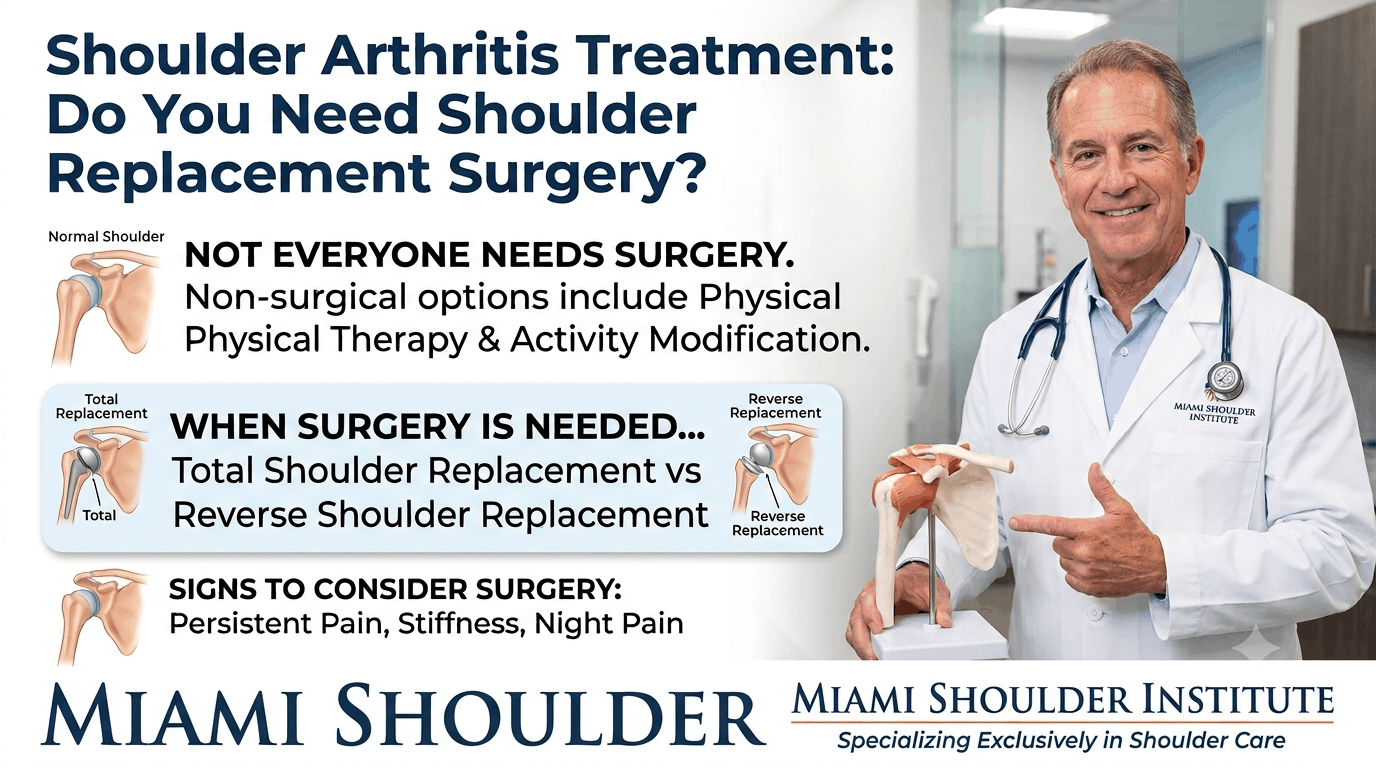
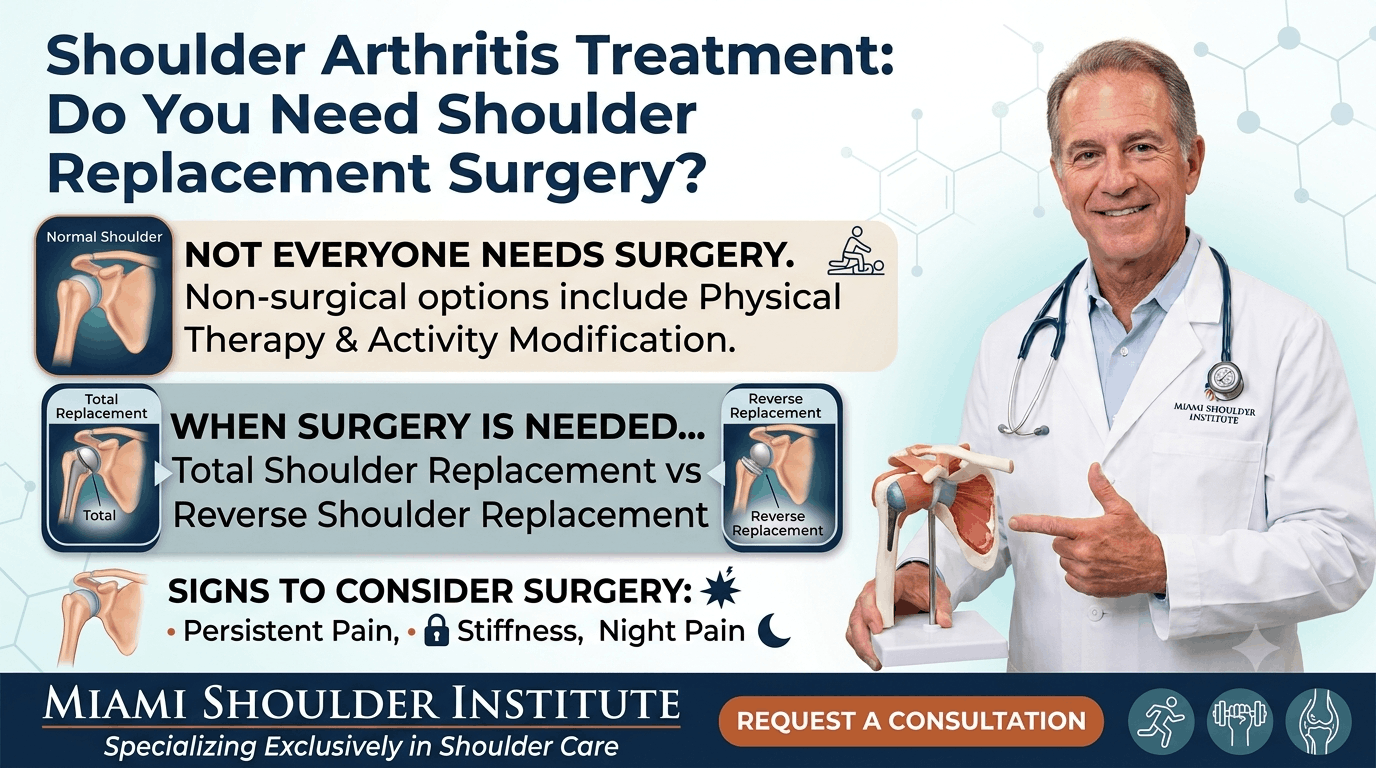
Not every patient with shoulder arthritis needs surgery. Many people find relief with non-surgical shoulder arthritis treatment, including physical therapy, activity modification, anti-inflammatory treatment, and guided rehabilitation. However, when pain becomes severe, motion declines significantly, and daily activities become difficult, shoulder replacement surgery may become the most effective long-term solution.
Patients with advanced joint degeneration, severe cartilage loss, or rotator cuff-related arthritis may be candidates for total shoulder replacement or reverse shoulder replacement. At Miami Shoulder Institute, treatment recommendations are personalized based on the severity of arthritis, shoulder function, and long-term goals.
Shoulder arthritis occurs when the protective cartilage covering the joint surfaces gradually wears away.
Healthy cartilage allows smooth, pain-free movement. When cartilage deteriorates, bone surfaces begin rubbing against each other, causing:
Over time, arthritis can significantly affect daily life.
Also Read More – Shoulder Surgery in Miami: Cost, Insurance, and What to Expect
The shoulder is a ball-and-socket joint made up of:
Smooth cartilage allows these structures to move efficiently.
When arthritis damages cartilage, movement becomes painful and restricted.
Not all arthritis is the same.
Understanding the type helps determine the best shoulder arthritis treatment.
Osteoarthritis
This is the most common form.
It occurs due to age-related wear and tear.
Common in:
Read More – Difference Between an Orthopedic Shoulder Specialist and a General Orthopedic Doctor
Post-Traumatic Arthritis
Develops after previous injuries such as:
Trauma can accelerate joint degeneration.
Rheumatoid Arthritis
An autoimmune condition causing joint inflammation and cartilage damage.
Rotator Cuff Arthropathy
This occurs when severe rotator cuff damage leads to abnormal joint mechanics and arthritis.
This condition commonly influences whether reverse shoulder replacement is needed.
Patients often experience gradually worsening symptoms.
Common symptoms include:
Pain
Pain may occur during:
Night pain is common in advanced arthritis.
Stiffness
Many patients struggle with:
Grinding or Clicking
Patients may feel:
This occurs because joint surfaces become rough.
Reduced Strength
Pain and stiffness often cause weakness.
Loss of Function
Daily activities may become increasingly difficult.
At Miami Shoulder Institute, diagnosis begins with a comprehensive evaluation.
Medical History
A shoulder replacement specialist reviews:
Physical Examination
Assessment includes:
Imaging
Imaging often includes:
X-rays
Usually the first step.
They can show:
MRI
Useful when rotator cuff damage is suspected.
Read More – Frozen Shoulder Surgery in Miami: When Conservative Treatment Fails
Many patients begin with conservative care.
Physical Therapy
Therapy focuses on:
Activity Modification
Reducing aggravating activities may help control symptoms.
Anti-Inflammatory Treatment
This may reduce:
Injections
In selected patients, injections may provide temporary relief.
Rehabilitation Programs
Structured rehabilitation improves joint function and movement quality.
Surgery is typically considered when conservative care no longer provides adequate relief.
Common signs include:
Persistent Pain
Pain continues despite treatment.
Severe Stiffness
Motion becomes significantly restricted.
Night Pain
Pain regularly disrupts sleep.
Major Functional Limitations
Patients struggle with:
Advanced Arthritis on Imaging
Severe cartilage loss often predicts poor response to conservative care.
When these issues become severe, shoulder replacement surgery may offer the best long-term relief.
Shoulder replacement surgery replaces damaged joint surfaces with artificial implants.
The goal is to:
The procedure selected depends on joint condition and rotator cuff health.
Total shoulder replacement is commonly recommended when:
During surgery:
This helps restore smoother joint motion.
Reverse shoulder replacement uses a different implant design.
The ball and socket positions are reversed.
This allows the shoulder to rely more on the deltoid muscle.
This procedure is often used when:
This technique has dramatically improved outcomes for complex shoulder cases.
Read More – Shoulder Pain While Lifting Weights in Miami
Patients often ask which is better.
The answer depends entirely on the diagnosis.
Total Shoulder Replacement
Best when:
Reverse Shoulder Replacement
Best when:
Your shoulder replacement specialist determines the best option based on imaging and function.
Modern shoulder replacement surgery involves:
Procedure details depend on the implant type.
At Miami Shoulder Institute, surgical planning is individualized for each patient.
Recovery happens in stages.
Weeks 1–2: Early Recovery
Goals include:
A sling may be used.
Weeks 3–6: Early Motion
Patients begin:
Weeks 6–12: Strengthening
Therapy progresses toward:
Months 3–6: Functional Recovery
Most patients continue improving in:
Full recovery may continue beyond six months.
Shoulder replacement has high satisfaction rates in properly selected patients.
Most patients report improvement in:
Success depends on:
Read More – Finding the Best Shoulder Surgeon in Miami: What Patients Should Look For
Some patients tolerate arthritis for years.
However, delaying surgery may lead to:
The decision depends on symptom severity and goals.
Before surgery, ask:
A thorough consultation helps set realistic expectations.
Miami Shoulder Institute specializes exclusively in shoulder care, including arthritis, rotator cuff injuries, instability, fractures, revision surgery, and advanced joint replacement.
Whether treatment involves conservative shoulder arthritis treatment, total shoulder replacement, or reverse shoulder replacement, care is individualized to reduce pain, restore movement, and improve long-term function.
The goal is not simply replacing a joint—it is restoring quality of life.
1. What is the best shoulder arthritis treatment?
Treatment depends on severity and may include therapy, medications, injections, or surgery.
2. When do I need shoulder replacement surgery?
Surgery is often considered when pain, stiffness, and function worsen despite conservative care.
3. What is reverse shoulder replacement?
It is a specialized shoulder replacement used when the rotator cuff is severely damaged.
4. What is total shoulder replacement?
It replaces damaged joint surfaces while preserving normal joint mechanics.
5. Is shoulder replacement painful?
Postoperative discomfort is expected, but most patients experience significant long-term pain relief.
6. How long is recovery after shoulder replacement?
Recovery typically takes several months depending on procedure and rehabilitation.
7. How do I know which replacement is right for me?
A shoulder replacement specialist determines the best option based on imaging, symptoms, and shoulder function.
Also Read More – After Shoulder Surgery Therapy in Miami: Best Practices for a Smooth Recovery