
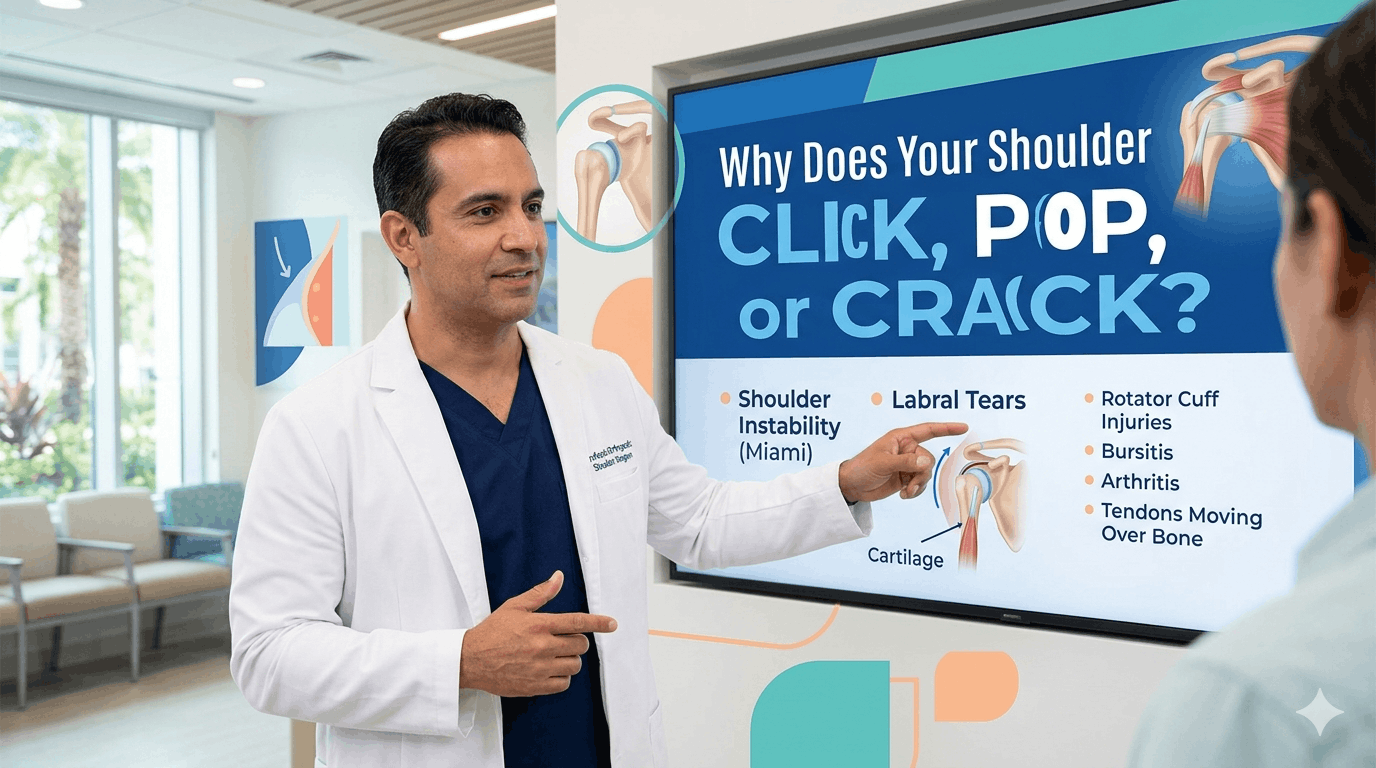
Hearing or feeling a clicking, popping, or cracking sensation in your shoulder can be concerning. The good news is that not every shoulder noise indicates a serious problem. In many cases, occasional shoulder sounds occur naturally as tendons move over bones or small gas bubbles shift within the joint.
However, when shoulder clicking Miami patients experience is accompanied by pain, weakness, instability, reduced range of motion, or a feeling that the shoulder is slipping out of place, it may indicate an underlying condition that requires evaluation.
Common causes include shoulder instability, labral tears, rotator cuff injuries, bursitis, arthritis, and shoulder impingement. Understanding the source of the clicking is the first step toward effective treatment.
At Miami Shoulder Institute, patients receive comprehensive evaluations designed to identify the exact cause of shoulder symptoms and determine the most appropriate treatment plan.
Many people notice occasional sounds coming from their shoulders during movement.
You may hear:
Not all shoulder sounds are dangerous.
In fact, some shoulder noises occur in completely healthy joints.
The key question is not whether your shoulder clicks, but whether the clicking is associated with:
When these symptoms occur together, further evaluation may be warranted.
Read More- Best Shoulder Surgeon in Miami: Diagnosis, Treatment & Recovery Explained
The shoulder is the most mobile joint in the body.
It consists of:
Because multiple structures move simultaneously during shoulder motion, occasional sounds can occur even in a healthy shoulder.
However, abnormal movement patterns can also create clicking sensations.
1. Tendons Moving Over Bone
One of the most common and harmless causes of shoulder clicking occurs when tendons glide over nearby bones.
This may happen during:
If the clicking is painless and does not affect function, it is often not a cause for concern.
2. Shoulder Instability
A major cause of persistent clicking is shoulder instability Miami patients frequently experience.
Shoulder instability occurs when the structures responsible for keeping the joint centered become damaged or stretched.
Symptoms may include:
Athletes and individuals with previous shoulder injuries are particularly susceptible.
3. Labral Tears
The labrum is a ring of cartilage that helps stabilize the shoulder joint.
When torn, it may cause:
Many patients describe the sensation as something moving or catching inside the shoulder.
Labral tears are common among:
4. Rotator Cuff Injuries
The rotator cuff helps control shoulder movement and stability.
When damaged, symptoms may include:
Rotator cuff injuries are among the most common causes of shoulder pain Miami patients seek treatment for.
5. Shoulder Impingement
Shoulder impingement occurs when tendons become compressed within the shoulder during movement.
This may lead to:
Impingement often develops gradually and may worsen if left untreated.
6. Shoulder Arthritis
As cartilage wears down over time, the joint surfaces become less smooth.
This can create:
Arthritic changes are more common with aging but may also occur following injury.
7. Bursitis
The shoulder contains small fluid-filled sacs called bursae.
Inflammation of these structures may cause:
Bursitis often develops alongside rotator cuff problems or impingement.

While occasional clicking is often harmless, certain symptoms should not be ignored.
Seek evaluation if clicking occurs alongside:
Pain
Painful clicking is more likely to indicate an underlying problem.
Weakness
Difficulty lifting the arm or carrying objects may signal tendon injury.
Instability
A feeling that the shoulder is slipping or shifting should be evaluated promptly.
Limited Motion
Progressive stiffness or loss of mobility may indicate structural damage.
Recurrent Dislocations
Repeated instability episodes can lead to long-term joint damage.
Read More – Difference Between an Orthopedic Shoulder Specialist and a General Orthopedic Doctor
Many patients notice clicking during:
Possible causes include:
Improving shoulder mechanics often reduces symptoms.
Yes.
Many people experience painless clicking that does not require treatment.
Examples include:
If clicking is not accompanied by other symptoms, it may simply be a normal finding.
However, persistent changes in symptoms should still be monitored.
At Miami Shoulder Institute, diagnosis begins with a comprehensive evaluation.
Medical History
Understanding:
Physical Examination
Assessment of:
Imaging Studies
Depending on symptoms, imaging may include:
The goal is to identify the underlying cause rather than simply treating the noise itself.
Read More – Top Shoulder Surgeons in Miami Offering Advanced Orthopedic Care
Treatment depends on the diagnosis.
Physical Therapy
Improves strength, stability, and movement patterns.
Activity Modification
Reduces stress on irritated tissues.
Rehabilitation Programs
Correct muscle imbalances and improve shoulder mechanics.
Anti-Inflammatory Treatment
May help manage associated pain.
Surgical Treatment
In selected cases involving instability, labral tears, or significant structural injuries, surgery may be recommended.
Healthy shoulder habits can reduce the risk of symptoms worsening.
Consider:
Prevention is often easier than treatment.
Read More – Types of Shoulder Surgery: Which Procedure Is Right for Your Condition?
Miami Shoulder Institute focuses exclusively on shoulder conditions, providing specialized care for instability, rotator cuff injuries, labral tears, arthritis, impingement, and other complex shoulder problems.
Patients receive individualized treatment plans designed to restore comfort, stability, and long-term shoulder function.
1. Is shoulder clicking normal?
Occasional painless clicking is often normal and may not require treatment.
2. Why does my shoulder click when I lift weights?
Possible causes include tendon movement, muscle imbalances, shoulder instability, or labral injuries.
3. Can shoulder instability cause clicking?
Yes. Shoulder instability is a common cause of clicking and popping sensations.
4. Should I worry if my shoulder clicks but doesn’t hurt?
Not necessarily. Painless clicking is often harmless, but changes in symptoms should be monitored.
5. What causes painful shoulder clicking?
Labral tears, rotator cuff injuries, arthritis, bursitis, and instability are common causes.
6. Can physical therapy help shoulder clicking?
Yes. Therapy often improves shoulder mechanics and reduces symptoms.
7. When should I see a specialist?
If clicking is accompanied by pain, weakness, instability, or limited motion.
Also Read About – Most Common Sports Shoulder Injuries and Their Treatments