

 EN EN
EN EN
Shoulder pain after exercise can be normal muscle soreness, but it can also indicate an underlying shoulder problem. Mild soreness that develops after an unfamiliar or demanding workout and gradually improves may reflect the normal response to exercise. However, sharp or severe pain, sudden weakness, swelling, reduced range of motion, persistent symptoms, or pain that repeatedly occurs during the same movement may indicate a shoulder injury.
Common causes of shoulder pain after exercise include muscle strain, tendon irritation, overuse, bursitis, shoulder impingement, instability and rotator cuff injury. Repetitive overhead movements and heavy lifting can increase stress on the rotator cuff and other shoulder structures.
A useful rule is:
Normal soreness tends to feel like muscle fatigue or aching and improves with recovery. Injury-related pain is more likely to be sharp, localised, associated with weakness or restricted movement, or persistent.
If you cannot confidently tell the difference, or your symptoms are getting worse, a shoulder specialist can assess the shoulder and determine whether further testing or treatment is necessary.
Exercise places stress on muscles, tendons, joints and connective tissues. Some degree of muscle fatigue or soreness can be expected, particularly after:
But the shoulder is a complex joint with a very large range of motion. It relies on muscles, tendons, ligaments and other structures to maintain stability while the arm moves.
That means pain after exercise should be interpreted based on how the pain started, what it feels like, how long it lasts and whether other symptoms are present.
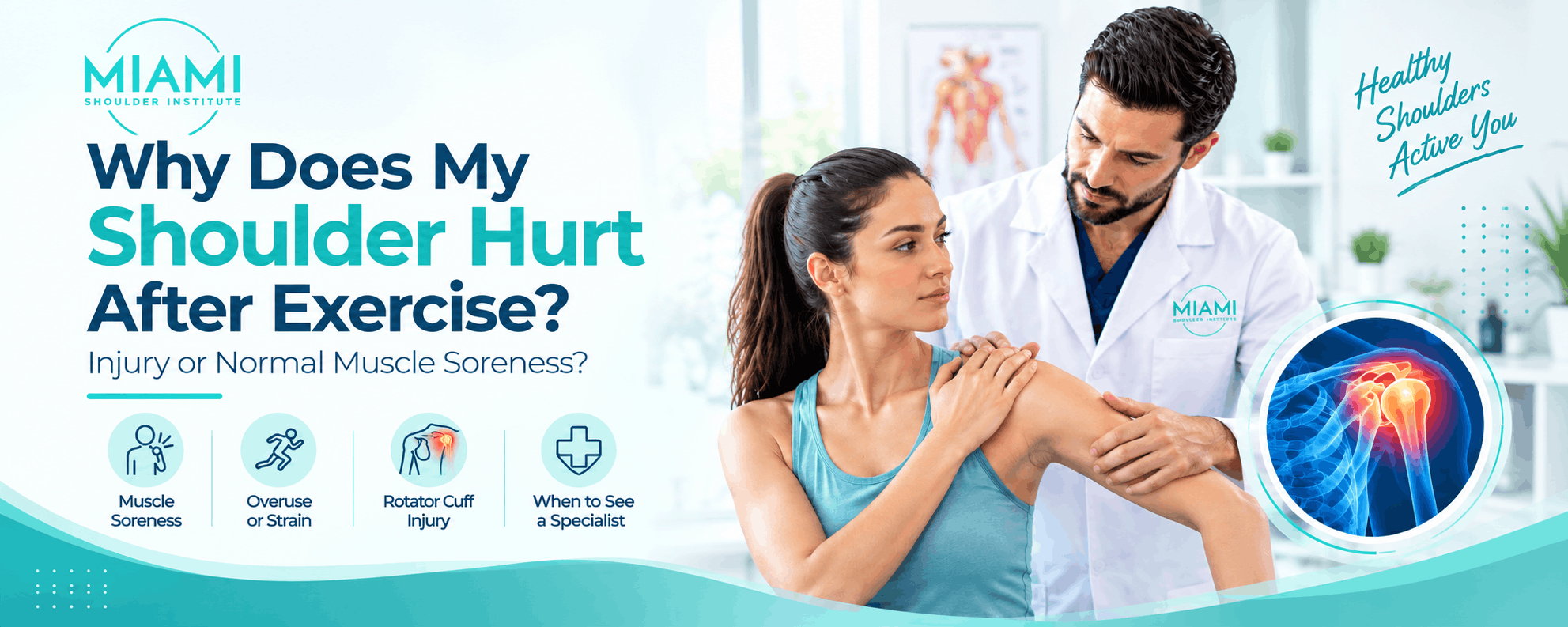
Normal muscle soreness usually develops after exercise that is harder or different from what your body is accustomed to.
You may notice:
For example, if you perform a new shoulder-strengthening workout after several months away from the gym, your shoulder muscles may feel tired or sore afterwards.
This does not automatically mean that you have injured the shoulder.
However, soreness should generally trend towards improvement rather than progressively becoming more painful.
Also Read More – Shoulder Surgery in Miami: Cost, Insurance, and What to Expect
A shoulder injury may produce symptoms that are different from ordinary post-workout soreness.
Potential warning signs include:
Rotator cuff problems, for example, may cause pain, weakness and reduced range of motion. Repetitive overhead activity and heavy lifting can irritate or damage the rotator cuff.
The important point is that pain alone cannot tell you exactly what has happened.
Several shoulder conditions can produce similar symptoms.
1. You Increased Your Workout Too Quickly
One of the simplest explanations for workout shoulder pain is doing too much too soon.
You may have:
Your muscles and connective tissues need time to adapt to increased loads.
A sudden increase in training demand can place more stress on the shoulder than it is currently prepared to handle.
Reducing the provoking activity and allowing adequate recovery may be appropriate for minor symptoms.
2. Muscle Strain
The muscles around the shoulder can become strained when they are exposed to excessive or unfamiliar loads.
A mild strain may cause:
However, a more significant strain can cause substantial pain and weakness.
If the symptoms are severe, do not improve with appropriate rest, or prevent normal shoulder movement, an evaluation may be appropriate.
3. Rotator Cuff Irritation or Injury
The rotator cuff consists of muscles and tendons that help move and stabilise the shoulder.
Weightlifting, swimming, throwing sports and other activities involving repetitive overhead movement can place substantial demands on the rotator cuff.
A rotator cuff injury can occur gradually through repetitive stress or suddenly through an acute event. Symptoms may include:
Some rotator cuff injuries can be managed with non-surgical treatment, while more significant injuries may require additional evaluation and, in selected cases, surgery.
If you experience sudden weakness immediately after lifting a heavy weight or performing a forceful movement, do not assume it is ordinary soreness.
An acute rotator cuff injury can sometimes occur during a sudden forceful event and may require prompt medical assessment.
4. Shoulder Impingement or Tendon Irritation
Certain movements can narrow or irritate the space around shoulder tendons.
Pain may become noticeable during:
The pain may be mild initially and become more noticeable as the workout continues.
If the same exercise repeatedly causes pain, changing technique or temporarily modifying the exercise may help, but persistent symptoms should not simply be ignored.
The shoulder’s mobility comes with a trade-off: it depends heavily on surrounding structures for stability.
If your shoulder feels like it is:
you may have instability rather than ordinary muscle soreness.
Instability can sometimes develop after a previous dislocation or shoulder injury.
Continuing to load an unstable shoulder without understanding the cause may increase the risk of further problems.
6. Biceps Tendon Problems
The biceps tendon connects the biceps muscle to structures around the shoulder.
Exercises involving pulling, curling or overhead movements can sometimes aggravate this area.
Pain from biceps tendon problems may be felt toward the front of the shoulder.
Because several shoulder conditions can produce similar symptoms, the location of pain is useful information but does not by itself establish the diagnosis.
7. Previous Shoulder Injury
If you have previously injured your shoulder, you may be more likely to experience symptoms when returning to demanding exercise.
A previous injury may have affected:
Returning to exercise before strength and movement have adequately recovered can sometimes bring symptoms back.
If your shoulder consistently hurts whenever you resume training, that pattern deserves attention.
There is no perfect home test, but the following comparison can help you understand the pattern.
| Feature | More Consistent With Muscle Soreness | More Concerning for Injury |
| Pain quality | Dull or aching | Sharp, severe or localised |
| Timing | Develops after unfamiliar exercise | May occur during a specific movement |
| Strength | Usually preserved | May be noticeably reduced |
| Movement | Generally possible | May be restricted or painful |
| Swelling | Usually absent | May occur |
| Recovery | Gradually improves | Persists or worsens |
| Exercise pattern | General muscle soreness | Same movement repeatedly causes pain |
| Sudden onset | Less typical | Can occur with an acute injury |
| Weakness | Usually mild or absent | Can be significant |
This distinction is not a substitute for a medical examination.
A person can have a shoulder injury with relatively mild pain, while another person can have significant soreness without structural damage.
That depends on the type and severity of pain.
If an exercise causes pain, do not simply push through it because you believe pain means the exercise is working.
Consider stopping or modifying the specific movement that causes pain.
For minor symptoms, reducing the activity that triggered the discomfort and allowing recovery may be reasonable. Conservative care for certain rotator cuff problems can include activity modification, rest, ice and physical therapy.
However, continuing to perform a painful movement repeatedly can make it difficult to determine whether the shoulder is recovering.
A better approach is to understand the cause of the pain and gradually return to exercise when appropriate.
Almost any exercise can cause problems if performed with excessive load, poor technique, inadequate recovery or an inappropriate progression.
Exercises that can place significant demands on the shoulder include:
This does not mean these exercises are inherently dangerous.
The same exercise may be appropriate for one person and unsuitable during another person’s recovery from a shoulder condition.
Exercise selection should take into account your current strength, mobility, injury history and symptoms.
Read More – 8 Possible Reasons Your Shoulder Pops or Cracks During Workouts
If the pain appears mild and there are no warning signs, you can initially consider reducing the activity that caused it.
Useful steps may include:
1. Stop the painful movement
Do not repeatedly test the same painful exercise.
2. Allow recovery
Give the shoulder time to settle rather than immediately repeating the workout.
3. Avoid heavy overhead loading
If overhead activity clearly increases your pain, temporarily reduce or avoid it until the symptoms improve.
4. Use ice if appropriate
Ice may help relieve discomfort from certain minor shoulder injuries or irritation.
5. Gradually return to activity
When symptoms improve, return to exercise progressively rather than immediately returning to your previous training volume.
6. Seek assessment if symptoms persist
If pain continues, worsens or is accompanied by weakness or restricted movement, a medical assessment can help determine the cause.
You may want to consult a shoulder specialist if:
A specialist may begin with a medical history and physical examination. Depending on the suspected condition, imaging such as X-rays, ultrasound or MRI may be used.
Some symptoms require prompt medical attention.
Seek urgent assessment if shoulder pain follows an injury and you have:
Shoulder pain accompanied by chest pressure, difficulty breathing, sweating or other concerning symptoms can sometimes represent a non-shoulder medical emergency and requires immediate emergency care.
A diagnosis generally begins with understanding the circumstances surrounding the pain.
A clinician may ask:
The shoulder may then be assessed for:
Imaging may be recommended when clinically appropriate.
An X-ray can evaluate bones and certain joint changes. Ultrasound can assess soft tissues such as tendons, while MRI provides detailed images of shoulder structures.
Treatment depends on the diagnosis.
Activity Modification
Changing or temporarily avoiding movements that aggravate the shoulder can reduce stress on irritated tissues.
Physical Therapy
A tailored rehabilitation programme may focus on:
Physical therapy is commonly used as an initial treatment for many rotator cuff problems.
Medication
Depending on your health history and diagnosis, a healthcare professional may recommend medication for pain or inflammation.
Injections
In selected cases, an injection may be considered when symptoms significantly interfere with daily activities, sleep or rehabilitation. The risks and benefits should be discussed with a healthcare professional.
Surgery
Surgery is not automatically required simply because your shoulder hurts after exercise.
However, some significant tears or structural injuries may require surgical evaluation, particularly when symptoms are substantial or conservative treatment has not provided adequate improvement.
You cannot prevent every shoulder injury, but sensible training habits can reduce unnecessary stress.
Warm up properly
Prepare the shoulder and surrounding muscles before demanding exercise.
Increase training gradually
Avoid suddenly doubling your training volume or weight.
Focus on technique
Poor movement patterns can increase stress on certain shoulder structures.
Strengthen the supporting muscles
A balanced programme should include exercises that support shoulder stability and control.
Allow recovery
Muscles and tendons need adequate recovery between demanding sessions.
Do not ignore persistent pain
Temporary soreness and persistent exercise-related pain are not the same thing.
If the shoulder repeatedly hurts during a particular movement, investigate the cause rather than continually increasing the workload.
Not every case of shoulder pain after exercise represents serious damage.
However, persistent pain combined with weakness or loss of movement can sometimes indicate a structural problem.
For example, rotator cuff injuries can range from tendon irritation to partial or complete tears. Some injuries respond well to non-surgical treatment, while more severe injuries may require additional intervention.
Getting the right diagnosis can therefore help you understand:
At Miami Shoulder Institute, the goal is to identify the underlying cause of exercise-related shoulder symptoms and develop a treatment approach based on the individual’s condition, activity level and functional goals.
Is shoulder pain after exercise normal?
Mild muscle soreness after an unfamiliar or intense workout can be normal. However, sharp pain, significant weakness, restricted movement, swelling or persistent symptoms may indicate an injury and should be evaluated.
How long should shoulder soreness last after a workout?
Recovery varies depending on the exercise and individual. Mild soreness should generally improve rather than progressively worsen. If pain persists, repeatedly returns or interferes with normal movement, consider seeking medical advice.
How do I know if workout shoulder pain is an injury?
Pain that occurs suddenly during exercise, is sharp or severe, causes weakness, limits movement or continues despite rest is more concerning for a shoulder injury than ordinary post-workout soreness.
Can exercise cause a rotator cuff injury?
Yes. Repetitive overhead movements and heavy lifting can irritate or damage the rotator cuff. A rotator cuff injury can also occur from a sudden force or accident.
Should I stop exercising if my shoulder hurts?
If a particular exercise causes pain, it is generally sensible to stop or modify that movement rather than repeatedly pushing through the pain. Persistent or worsening symptoms should be assessed.
Can I exercise with a rotator cuff injury?
The answer depends on the type and severity of the injury. Some people can continue modified activity under appropriate guidance, while others may need to temporarily avoid certain movements.
When should I see a shoulder specialist for exercise pain?
Consider seeing a shoulder specialist if pain persists, repeatedly returns, causes weakness, limits movement, interferes with sleep or follows a significant injury.
Does shoulder pain always mean I have a tear?
No. Shoulder pain can result from many conditions, including muscle strains, tendon irritation, bursitis, arthritis, instability and rotator cuff problems. An examination is needed to determine the cause.
Can a rotator cuff injury heal without surgery?
Many rotator cuff problems can initially be treated without surgery using activity modification, physical therapy and other appropriate conservative measures. Some severe injuries may require surgical consideration.
What tests are used to diagnose a shoulder injury?
Depending on the suspected condition, a clinician may use a physical examination along with X-rays, ultrasound or MRI. Each test provides different information about the bones and soft tissues of the shoulder.
Shoulder pain after exercise is not always a sign of injury—but it should not automatically be dismissed as normal soreness either.
Mild, generalised muscle soreness that gradually improves after a demanding workout is different from sharp pain, sudden weakness, restricted movement or pain that repeatedly occurs during the same exercise.
A shoulder injury, including a rotator cuff injury, may require a different approach to normal post-workout soreness.
If your workout shoulder pain continues, keeps returning or affects your strength and ability to move the arm, consider evaluation by a shoulder specialist. Identifying the cause can help determine whether you need activity modification, rehabilitation, additional testing or another form of treatment.
At Miami Shoulder Institute, shoulder symptoms are evaluated with the aim of identifying the underlying problem and determining an appropriate treatment pathway based on the patient’s individual condition and goals.
Also Read About – Best Exercises After Shoulder Surgery in Miami
Shoulder Fracture Surgery in Miami: Expert Orthopedic Care
Night Shoulder Pain in Miami: Why It Gets Worse in Bed