
 EN EN
EN EN
Many patients feel uncertain before their first appointment with a shoulder specialist. They often wonder what questions will be asked, whether imaging is needed, and if surgery will be recommended.
The good news is that a first shoulder consultation Miami patients attend is primarily focused on understanding symptoms, identifying the underlying cause of shoulder pain, and creating a personalized treatment plan. In most cases, the appointment includes a medical history review, physical examination, imaging evaluation if necessary, and a discussion of treatment options.
At Miami Shoulder Institute, the goal is not simply to treat pain but to determine why the pain is occurring and develop the most effective path toward recovery.
Shoulder pain is one of the most common musculoskeletal complaints among adults.
Because the shoulder is the most mobile joint in the body, it is vulnerable to a wide range of injuries and conditions.
Patients often seek care for:
A shoulder specialist Miami patients trust has advanced training and experience in diagnosing and treating these conditions.
Read More – Difference Between an Orthopedic Shoulder Specialist and a General Orthopedic Doctor
Many shoulder problems improve with rest and conservative treatment.
However, it may be time for a shoulder consultation Miami patients frequently seek if you experience:
Early evaluation often leads to faster diagnosis and more treatment options.
Preparing before your visit can help maximize the value of your consultation.
Consider gathering:
Previous Imaging
If you have undergone:
bring copies when possible.
Medical Records
Previous treatment information may be helpful.
Medication List
Provide information about current medications and supplements.
Symptom Timeline
Think about:
The appointment typically begins with a discussion about your symptoms.
A shoulder specialist Miami provider may ask:
Where Is the Pain Located?
Examples include:
The location often provides important diagnostic clues.
When Did Symptoms Begin?
Shoulder pain may result from:
What Activities Cause Pain?
Understanding symptom triggers helps narrow potential diagnoses.
Have You Tried Treatment Already?
Previous treatments may include:
This information helps guide future recommendations.
The physical examination is one of the most important parts of the appointment.
Even when imaging is available, hands-on evaluation provides critical information.
Range of Motion Assessment
The specialist evaluates how well the shoulder moves.
You may be asked to:
Restricted motion may suggest:
Strength Testing
Strength testing helps identify:
Comparing both shoulders often provides useful information.
Stability Testing
If instability is suspected, the provider may evaluate whether the shoulder feels loose or prone to slipping.
This assessment can help diagnose:
Pain Reproduction Tests
Specific movements may be used to reproduce symptoms.
These tests help identify:
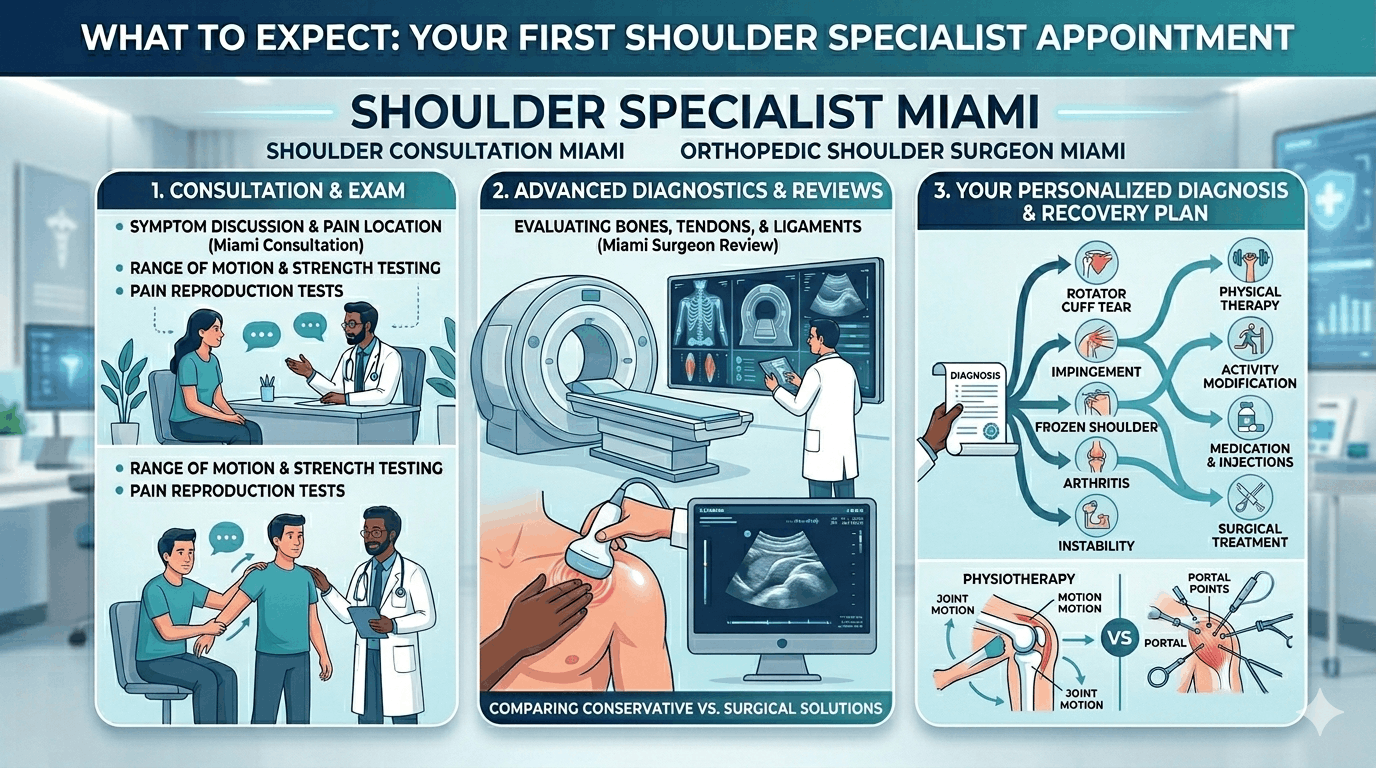
Imaging is not always necessary during the first visit, but it is often useful when symptoms persist.
X-Rays
X-rays help evaluate:
MRI
MRI provides detailed images of:
MRI is particularly valuable for soft tissue injuries.
Ultrasound
In some cases, ultrasound may help evaluate tendon conditions dynamically.
CT Scans
CT imaging is occasionally used for complex fractures or surgical planning.
After reviewing your history, examination findings, and imaging, the specialist will discuss the most likely diagnosis.
Common diagnoses include:
A common source of shoulder pain and weakness.
Compression of tendons during movement.
Painful stiffness and restricted motion.
Cartilage injuries affecting shoulder stability.
Degenerative joint changes causing pain and stiffness.
Excessive movement within the joint.
Understanding the diagnosis is essential for choosing the right treatment.
Many patients worry that visiting an orthopedic shoulder surgeon Miami patients consult automatically means surgery.
In reality, surgery is only one of many treatment options.
Physical Therapy
Often recommended as a first-line treatment.
Benefits include:
Activity Modification
Reducing aggravating activities may help symptoms improve.
Medication Management
Anti-inflammatory treatments may reduce pain and swelling.
Injections
Selected patients may benefit from injections to reduce inflammation and facilitate rehabilitation.
Surgical Treatment
If conservative treatment is unlikely to provide adequate relief, surgery may be discussed.
The decision is based on:
Patients often benefit from asking:
A good consultation should leave you with a clear understanding of your condition and treatment plan.
Read More – 8 Possible Reasons Your Shoulder Pops or Cracks During Workouts
The next steps depend on your diagnosis.
Possible recommendations include:
Starting Physical Therapy
A customized rehabilitation plan may be provided.
Additional Imaging
Further testing may be necessary.
Follow-Up Evaluation
Progress is monitored and treatment adjusted as needed.
Surgical Planning
If surgery is recommended, a detailed discussion about risks, benefits, and recovery occurs.
Many shoulder conditions respond better when treated early.
Prompt assessment can:
Waiting too long may allow certain injuries to progress.
Miami Shoulder Institute focuses exclusively on shoulder care. Patients receive comprehensive evaluations, advanced diagnostic expertise, and personalized treatment plans designed to restore function and improve quality of life.
Whether symptoms require rehabilitation, injections, or surgical treatment, the focus remains on helping patients return to the activities they enjoy.
1. What happens during a shoulder consultation?
A consultation typically includes a medical history review, physical examination, and discussion of treatment options.
2. Do I need an MRI before seeing a shoulder specialist?
Not necessarily. Imaging recommendations are often made after the initial evaluation.
3. Will I need surgery?
Many shoulder conditions improve without surgery. Treatment recommendations depend on your diagnosis.
4. How long does a shoulder specialist appointment take?
The length varies but generally allows enough time for evaluation and discussion of treatment options.
5. Should I bring previous imaging?
Yes. Existing MRI scans, X-rays, and reports can be very helpful.
6. What if I have shoulder pain but no injury?
Many shoulder conditions develop gradually and still benefit from specialist evaluation.
7. When should I see an orthopedic shoulder surgeon?
If shoulder pain, weakness, instability, or loss of motion persists despite conservative treatment.
Also Read More – Top Orthopedic Shoulder Surgeons in Miami