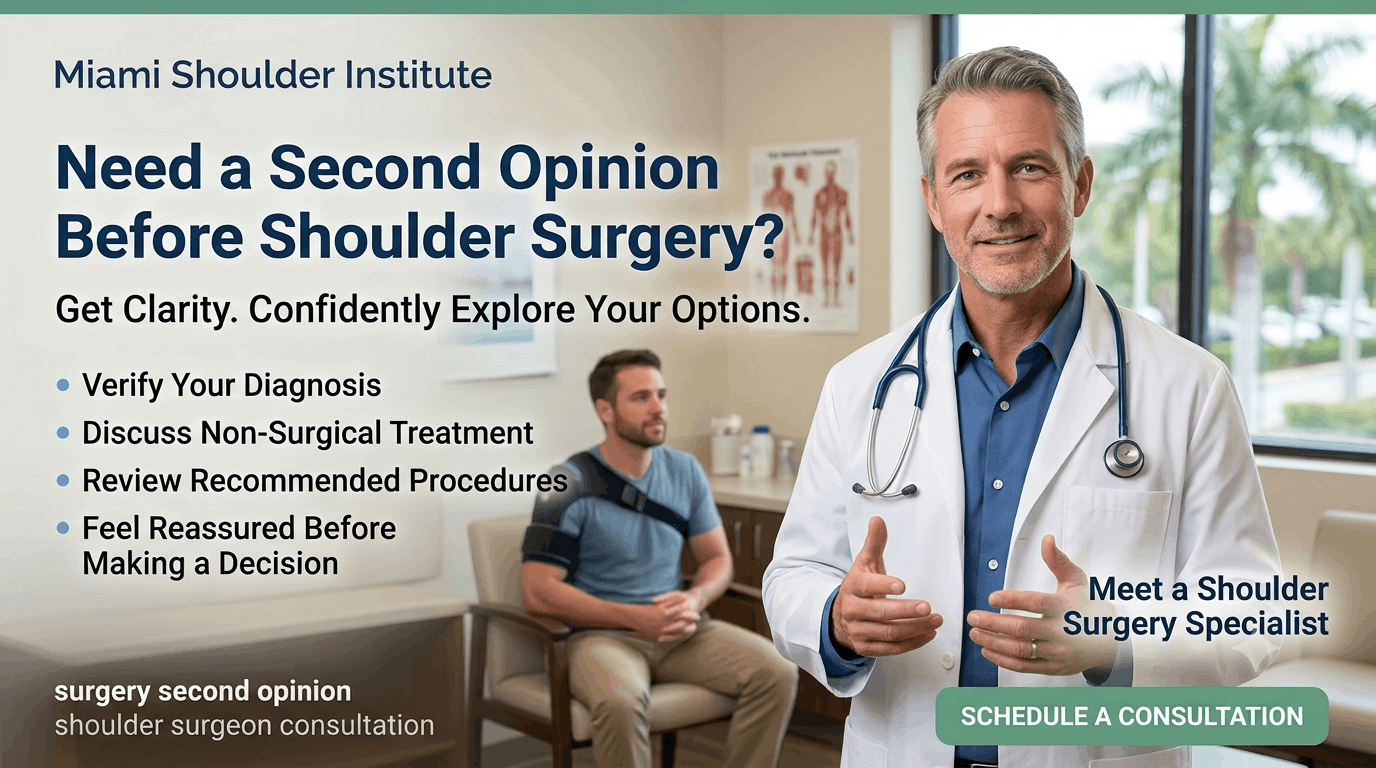
Yes—getting a surgery second opinion is often a smart and responsible step before undergoing shoulder surgery. A second opinion can confirm your diagnosis, help you understand all available treatment options, and ensure that surgery is truly the best choice for your condition. In many cases, a second opinion provides reassurance. In others, it may identify additional non-surgical treatments or recommend a different surgical approach.
At Miami Shoulder Institute, patients are encouraged to fully understand their diagnosis and treatment options before making a decision. A thorough shoulder surgeon consultation allows you to ask questions, review imaging, discuss expected outcomes, and feel confident about your care plan.
Shoulder surgery is an important decision that can affect your mobility, work, sports participation, and quality of life. Because many shoulder conditions can be treated in different ways, confirming the diagnosis and treatment plan is often worthwhile.
Seeking a surgery second opinion does not mean you distrust your current physician. Instead, it helps ensure that you are making an informed decision based on the best available information.
A second opinion can:
Many patients feel more comfortable moving forward once they have received independent confirmation of the treatment plan.
Absolutely.
Patients commonly seek second opinions before:
A second opinion is considered a normal part of making an informed healthcare decision.
Read More – Shoulder Surgery in Miami: Cost, Insurance, and What to Expect

Although every patient is different, certain situations make a second opinion especially valuable.
Surgery Was Recommended Immediately
If surgery is recommended during your first visit without discussing other treatment options, another evaluation may help confirm whether surgery is truly necessary.
You Still Have Questions
You should understand:
If important questions remain unanswered, another shoulder surgeon consultation may provide greater clarity.
Also Read More – Most Common Sports Shoulder Injuries and Their Treatments
You Have Been Told You Need a Complex Procedure
Complex operations such as:
often benefit from evaluation by a shoulder surgery specialist.
Symptoms Do Not Match the Diagnosis
If imaging and symptoms seem inconsistent, another expert review may help clarify the cause of your pain.
Conservative Treatment Has Not Been Fully Explored
Many shoulder conditions improve without surgery.
Before proceeding, you may want to understand whether treatments such as:
have been adequately considered.
Common shoulder conditions include:
Many of these conditions have both surgical and non-surgical treatment options.
A comprehensive shoulder surgeon consultation should include more than simply reviewing an MRI.
At Miami Shoulder Institute, the consultation focuses on understanding both the patient and the condition.
Medical History
Your specialist will ask about:
Physical Examination
The examination evaluates:
Specialized shoulder tests help identify the injured structures.
Imaging studies may include:
X-rays
Useful for evaluating:
MRI
MRI provides detailed evaluation of:
CT Scan
Sometimes recommended for complex fractures or previous surgeries.
Read More – Difference Between an Orthopedic Shoulder Specialist and a General Orthopedic Doctor
A successful consultation involves open communication.
Consider asking the following questions.
1. Do I Definitely Need Surgery?
Not every shoulder condition requires surgery.
Ask:
2. What Is My Exact Diagnosis?
Make sure you understand:
3. Are There Non-Surgical Options?
Ask whether treatments such as:
could still be effective.
4. Which Surgical Procedure Is Recommended?
Understanding the procedure helps set expectations.
Ask:
5. What Are the Risks?
Every operation carries risks.
Your surgeon should discuss:
6. What Results Should I Expect?
Ask about:
Realistic expectations improve satisfaction.
7. How Long Is Recovery?
Recovery varies depending on the procedure.
Ask about:
8. Will I Need Physical Therapy?
For most shoulder procedures, rehabilitation is a critical part of recovery.
Understanding the rehabilitation process is just as important as understanding the surgery itself.
Choosing the best shoulder surgeon in Miami involves more than reading online reviews.
Look for a surgeon who:
A surgeon who focuses primarily on shoulder disorders often has extensive experience with complex cases.
Complex shoulder problems may involve:
An experienced shoulder surgery specialist understands how these conditions interact and can tailor treatment accordingly.
Experience also contributes to:
Patients often search for a top rated shoulder surgeon when considering surgery.
While ratings may be helpful, other important factors include:
The best surgeon is one who recommends the treatment that is most appropriate—not necessarily surgery.
Yes.
In some cases, a second opinion may:
This does not necessarily mean the original recommendation was incorrect.
Different specialists may reasonably recommend different approaches depending on patient goals and clinical findings.
Read More – Top Shoulder Surgeons in Miami Offering Advanced Orthopedic Care
Patients who seek a surgery second opinion often gain:
Making an informed decision is one of the most important steps in achieving a successful outcome.
Miami Shoulder Institute is dedicated exclusively to the diagnosis and treatment of shoulder conditions, including rotator cuff tears, labral injuries, arthritis, instability, fractures, tendon injuries, frozen shoulder, and revision surgery.
Whether you are seeking a shoulder surgeon consultation, exploring treatment options, or obtaining a surgery second opinion, every evaluation is personalized to help you fully understand your diagnosis and make confident treatment decisions.
The focus is not simply recommending surgery—it is ensuring every patient receives the right treatment at the right time.
1. Should I get a second opinion before shoulder surgery?
Yes. A second opinion can confirm the diagnosis, review treatment options, and help you make an informed decision.
2. Will my surgeon be offended if I ask for a second opinion?
No. Seeking a second opinion is common and is considered a responsible part of healthcare decision-making.
3. What should I bring to a second opinion appointment?
Bring your imaging studies, medical records, previous treatment history, and a list of questions.
4. What happens during a shoulder surgeon consultation?
The consultation typically includes a medical history, physical examination, imaging review, diagnosis, and discussion of treatment options.
5. How do I choose the best shoulder surgeon in Miami?
Choose a surgeon with shoulder-specific expertise, extensive experience, clear communication, and individualized treatment planning.
6. Can a second opinion change whether I need surgery?
Yes. In some cases, another specialist may recommend different treatment options or additional conservative care.
7. Why should I see a shoulder surgery specialist?
A shoulder surgery specialist has advanced expertise in diagnosing and treating complex shoulder conditions using both surgical and non-surgical approaches.
Also Read About- Best Shoulder Surgeon in Miami: Diagnosis, Treatment & Recovery Explained