

 EN EN
EN EN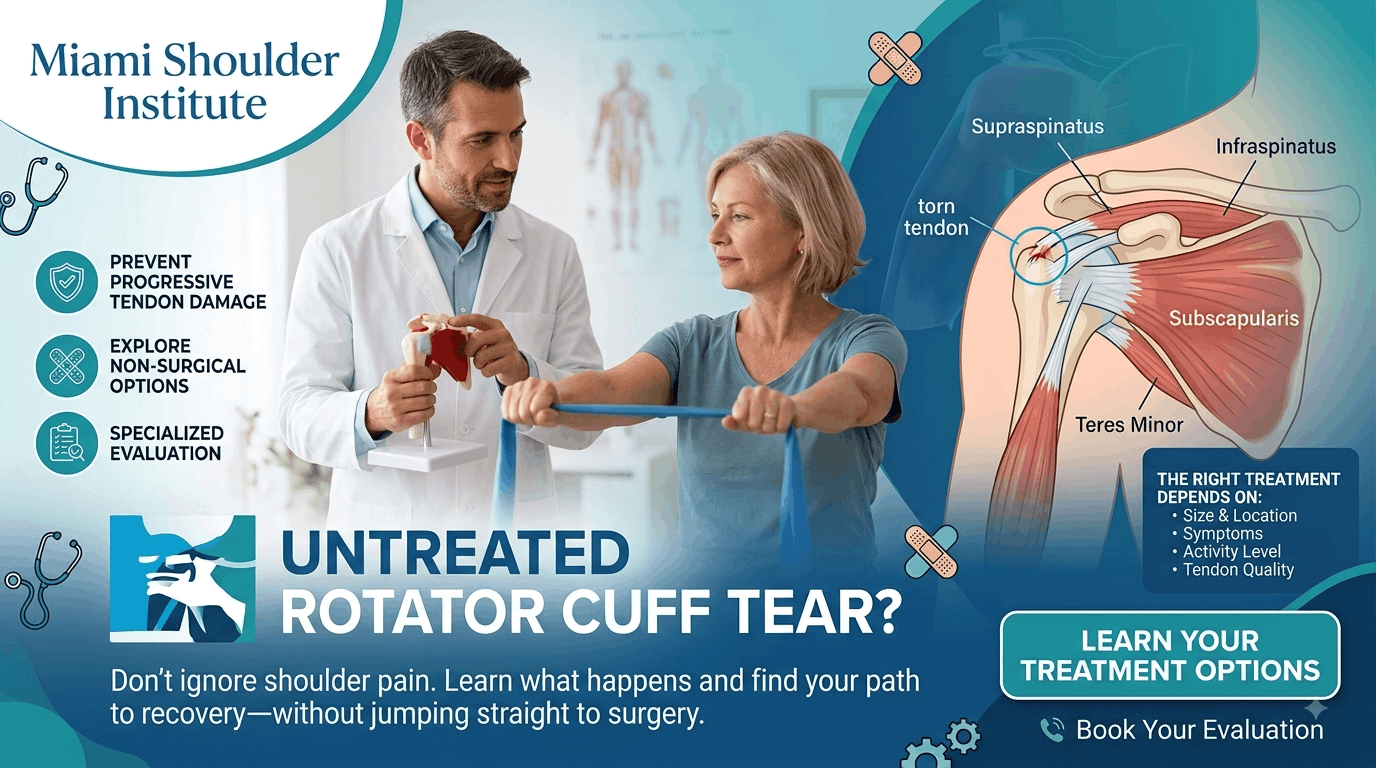
An untreated rotator cuff tear does not always cause permanent problems, but leaving a symptomatic tear without appropriate evaluation can allow pain, weakness, stiffness, or loss of shoulder function to persist or worsen. Some people manage small or degenerative tears successfully with physical therapy and activity modification, while others develop progressive tendon damage.
A rotator cuff tear can become larger over time, particularly when the shoulder continues to experience repetitive stress. Larger tears may be associated with increasing weakness, muscle changes, and more difficult treatment decisions. The American Academy of Orthopaedic Surgeons notes that complete tears can become larger without surgery, although physical therapy can improve symptoms in many patients.
The important point is that not every rotator cuff tear requires rotator cuff surgery. The appropriate rotator cuff tear treatment depends on the tear’s size and location, symptoms, activity level, tendon quality, and whether the injury occurred suddenly or developed gradually.
At Miami Shoulder Institute, evaluation focuses on identifying the cause and severity of the tear before determining whether rehabilitation, activity modification, or surgical treatment is appropriate.
A rotator cuff tear is an injury to one or more of the tendons that stabilize and move the shoulder. If a tear is left untreated, symptoms can remain unchanged, improve with conservative care, or progressively worsen depending on the type and severity of the injury.
Common torn rotator cuff symptoms include shoulder pain, weakness, difficulty lifting the arm, pain at night, and reduced ability to perform overhead activities. Some patients with small tears have relatively mild symptoms, while larger tears can significantly affect daily activities.
An untreated rotator cuff tear may become larger over time. Chronic tears can also be associated with tendon retraction and muscle changes, which may make later repair more challenging. However, this does not mean that every tear requires immediate surgery. The AAOS reports that more than half of patients may obtain symptom relief without surgery, while surgery may be considered for persistent symptoms, large tears, significant weakness, traumatic injuries, or active patients with demanding overhead activities.
If you have persistent shoulder pain or weakness, evaluation by a rotator cuff specialist can help determine what is actually happening and which treatment is appropriate.
The rotator cuff consists of four muscles and their tendons:
These structures work together to stabilize the shoulder and help you:
A tear occurs when one or more of these tendons become partially or completely damaged.
A shoulder tendon tear can develop gradually because of age-related tendon changes or suddenly after an injury.
Rotator cuff tears generally fall into two broad categories.
Degenerative Tears
Over time, tendons can become weaker because of normal aging and repeated use.
Risk may increase with:
A degenerative tear may develop gradually, and some patients do not remember a specific injury.
Traumatic Tears
A sudden injury can cause a rotator cuff tear.
Examples include:
Traumatic tears may cause sudden pain and weakness.
Torn rotator cuff symptoms vary considerably between patients.
Common symptoms include:
Shoulder Pain
Pain may occur at the front, side, or back of the shoulder.
Some patients experience pain primarily during movement, while others have discomfort even at rest.
Night Pain
Rotator cuff injuries commonly cause pain when lying on the affected shoulder.
Night pain may interfere with sleep and become one of the most frustrating symptoms.
Weakness
Patients may struggle to:
Limited Motion
Pain and weakness can make normal shoulder movement difficult.
Clicking or Popping
Some patients notice clicking, catching, or other mechanical sensations.
Difficulty With Everyday Activities
Tasks such as:
may become increasingly difficult.
Also Read More – Rotator Cuff Surgery: Recovery, Care, and Expected Results
The answer depends on the type of tear.
Some tears remain stable and can be managed successfully without surgery. Others may progress.
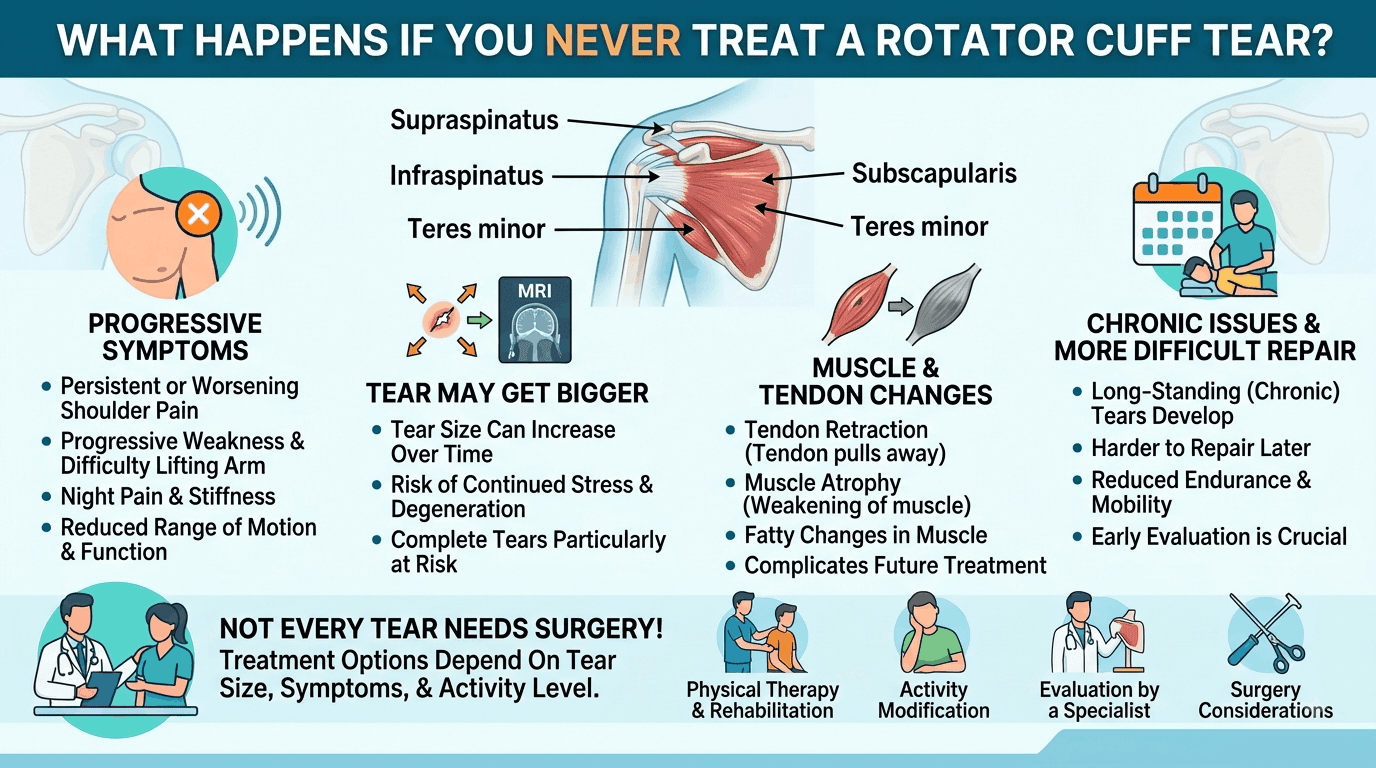
Potential consequences of an untreated tear include:
The AAOS clinical practice guidance states that complete tendon tears can become larger without surgery, although physical therapy may improve symptoms.
This is why monitoring a known tear is important even when immediate surgery is not recommended.
Yes, some rotator cuff tears can progress in size.
The risk depends on factors such as:
A small tear does not automatically become a large tear. However, persistent symptoms or worsening weakness should prompt reassessment.
It can contribute to long-term changes in some patients.
A chronic rotator cuff tear may be associated with:
These changes can affect whether a tendon remains repairable.
This is one reason why patients with persistent symptoms should not simply assume that the pain will eventually disappear.
A chronic rotator cuff tear is a tear that has been present for an extended period.
Chronic tears may develop gradually or may represent an older injury that was never treated.
Symptoms can include:
Some chronic tears can still be managed successfully without surgery. Others may require more complex treatment depending on tendon quality and the condition of the shoulder joint.
Yes.
Pain severity does not always correspond directly to tear size.
Some patients with significant tears experience relatively little pain, while smaller injuries can be very painful.
This is why diagnosis should not be based solely on how much your shoulder hurts.
Strength, movement, physical examination, and imaging all contribute to determining the condition of the rotator cuff.
A proper diagnosis begins with a detailed evaluation.
At Miami Shoulder Institute, assessment may include:
Medical History
Your specialist may ask about:
Physical Examination
The shoulder may be evaluated for:
Specific tests can help determine which structures are contributing to your symptoms.
X-Rays
X-rays do not directly show rotator cuff tendons, but they can identify other conditions such as:
MRI
MRI can provide detailed information about:
MRI can be particularly useful when surgical treatment is being considered.
There is no single treatment for every tear.
The appropriate rotator cuff tear treatment depends on several factors.
Treatment may include:
The AAOS states that more than half of patients may experience symptom relief without surgery, and physical therapy can improve symptoms even in some patients with complete tears.
For many patients, conservative treatment is an appropriate first step.
Activity Modification
Temporarily reducing painful overhead movements can decrease stress on the tendon.
This does not necessarily mean avoiding all shoulder movement.
Physical Therapy
A structured program may focus on:
The goal is to improve the shoulder’s ability to function despite the tendon injury.
Medication
Appropriate pain-relieving or anti-inflammatory medication may be recommended depending on the patient’s circumstances.
Injections
In selected patients, an injection may provide short-term improvement in pain and shoulder function. Corticosteroid injections should be used thoughtfully because they may affect soft-tissue quality in some circumstances.
Not every tear needs surgery.
However, rotator cuff surgery may be considered when:
AAOS patient guidance identifies persistent symptoms, large tears, significant weakness, and traumatic injuries among circumstances in which surgery may be recommended.
Many rotator cuff repairs are performed using arthroscopic techniques.
The surgeon uses small incisions and a camera to visualize the shoulder.
The torn tendon is typically secured back to the bone using specialized anchors and sutures.
Depending on the patient’s condition, associated problems may also be addressed during the same operation.
The exact procedure depends on:
No surgery can guarantee a specific outcome.
Recovery depends on:
The AAOS notes that rehabilitation plays an important role after both surgical and non-surgical treatment, with recovery often taking several months.
Recovery is gradual.
Early Recovery
The shoulder may need protection while the tendon begins healing.
A sling may be used according to the surgeon’s instructions.
Mobility Phase
Physical therapy gradually works on restoring shoulder movement.
Strengthening Phase
Once healing allows, strengthening exercises are introduced progressively.
Return to Activity
Return to sports, heavy lifting, or physically demanding work depends on healing and functional progress.
Patients should follow their individual rehabilitation plan rather than rushing the process.
Sometimes.
Physical therapy can improve pain, strength, and function in many patients.
It may be particularly appropriate when:
However, persistent weakness or worsening symptoms should prompt reassessment.
You should consider seeing a rotator cuff specialist if you have:
A specialist can determine whether your symptoms are actually coming from the rotator cuff or another shoulder structure.
Shoulder pain from rotator cuff tear may feel:
Pain can radiate down the upper arm but generally does not extend all the way to the hand.
Weakness is often an important accompanying symptom.
You may be able to reduce additional stress on the shoulder by:
The AAOS also emphasizes strengthening and flexibility exercises as part of shoulder conditioning, with exercise programs ideally performed under appropriate professional guidance.
The goal of early evaluation is not automatically to recommend surgery.
Instead, it helps answer important questions:
These answers allow treatment to be based on the actual condition rather than assumptions.
Read more- Shoulder Surgery in Miami: Cost, Insurance, and What to Expect
Miami Shoulder Institute focuses on shoulder conditions and provides evaluation and treatment for rotator cuff tears, shoulder instability, arthritis, tendon injuries, fractures, labral conditions, frozen shoulder, and sports-related shoulder problems.
Whether you need conservative rotator cuff tear treatment, rehabilitation, advanced imaging, or consideration of rotator cuff surgery, the treatment approach is individualized according to your symptoms, imaging findings, activity level, and recovery goals.
The objective is not simply to treat a tear seen on an MRI. It is to understand how the injury is affecting your shoulder and determine the safest and most effective path toward restoring function.
1. What happens if you never treat a rotator cuff tear?
An untreated rotator cuff tear may remain stable, improve symptomatically with conservative care, or become larger over time. Some patients may develop progressive weakness, stiffness, or chronic shoulder dysfunction.
2. Can an untreated rotator cuff tear get bigger?
Yes. Some tears can increase in size over time, particularly when symptoms and structural damage continue to progress. AAOS guidance notes that complete tears can become larger without surgery.
3. Does every rotator cuff tear require surgery?
No. Many patients improve with physical therapy and other conservative treatments. Surgery is generally considered when symptoms, weakness, tear characteristics, or activity demands make surgical treatment appropriate.
4. What are the most common torn rotator cuff symptoms?
Common symptoms include shoulder pain, night pain, weakness, difficulty lifting the arm, reduced range of motion, and difficulty with overhead activities.
5. What is a chronic rotator cuff tear?
A chronic rotator cuff tear is an older or long-standing tear. Chronic tears may be associated with tendon retraction and muscle changes, which can influence treatment options.
6. Can a shoulder tendon tear heal without surgery?
Some patients can achieve significant pain relief and functional improvement without surgery, particularly with physical therapy and activity modification. However, the tendon itself may not structurally heal in every case.
7. When is rotator cuff surgery recommended?
Surgery may be considered for persistent symptoms, significant weakness, large tears, traumatic injuries, or patients whose activity demands make surgical repair appropriate.
8. How long does recovery take after rotator cuff surgery?
Recovery commonly takes several months. The exact timeline depends on tear size, repair complexity, tendon healing, and rehabilitation progress.
9. Should I see a rotator cuff specialist for shoulder pain?
If pain persists, weakness develops, or symptoms follow an injury, evaluation by a rotator cuff specialist can help determine the cause and appropriate treatment.
Also Read About- Why Does My Shoulder Click, Pop, or Crack?
Best Shoulder Doctor in Florida: How to Choose the Right Surgeon