

 EN EN
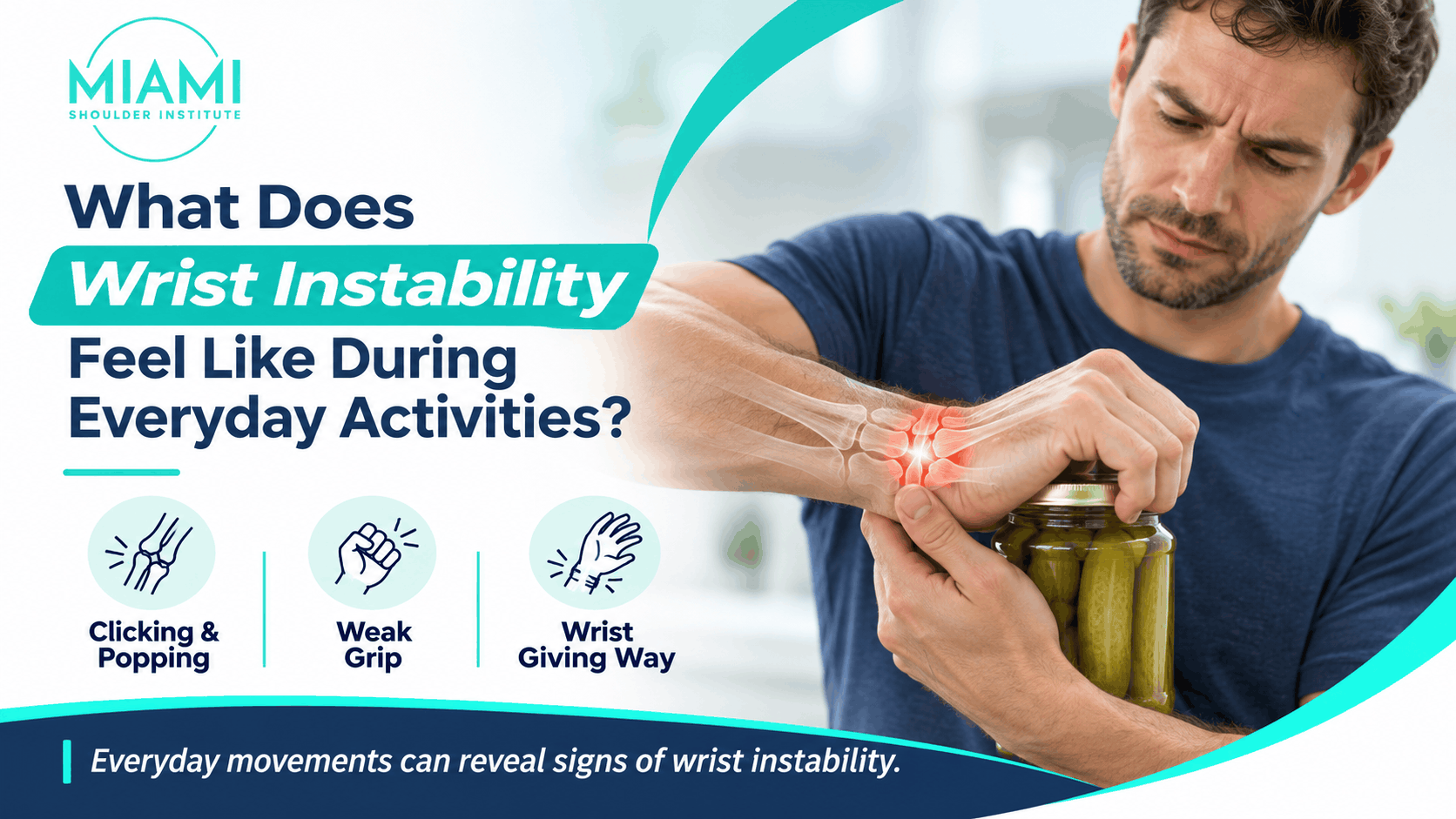
Wrist instability occurs when the bones and supporting structures of the wrist do not maintain their normal alignment and coordinated movement. It can develop after a wrist ligament injury, fracture, or repeated stress on the joint.
Common wrist instability symptoms include clicking, painful popping, reduced grip strength, discomfort when putting weight through the hand, and a sensation that the wrist is shifting or giving way. Everyday activities such as opening jars, lifting a pan, carrying shopping bags, pushing up from a chair, or turning a door handle may become uncomfortable or difficult.
An unstable wrist does not always cause constant pain. Some people experience symptoms only during particular movements or when the wrist is under pressure. Diagnosis may involve a physical examination, X-rays, specialised imaging, or other investigations to assess the supporting structures.
Treatment depends on the underlying cause and severity. Mild or stable injuries may improve with activity modification, splinting, and rehabilitation, while significant ligament damage causing persistent instability may require specialist treatment or surgery.
The wrist is made up of eight small carpal bones that connect the forearm to the hand. These bones work together to provide flexibility, strength, and controlled movement.
Ligaments connect the bones and help maintain their correct position. Muscles and tendons surrounding the wrist also contribute to joint control and stability.
Wrist instability occurs when the normal balance between these structures is disrupted. This can happen when a ligament is stretched or torn, a bone is fractured, or the alignment of the wrist changes following an injury.
In a stable wrist, the small bones move together in a coordinated way. When supporting structures are damaged, some bones may move abnormally relative to one another.
This can produce symptoms such as painful clicking, weakness, reduced grip strength, or a feeling that the wrist is not supporting the hand properly.
Instability can be described in two main ways:
This distinction matters because some people experience symptoms only when performing certain activities, making the condition harder to recognise without an appropriate examination.
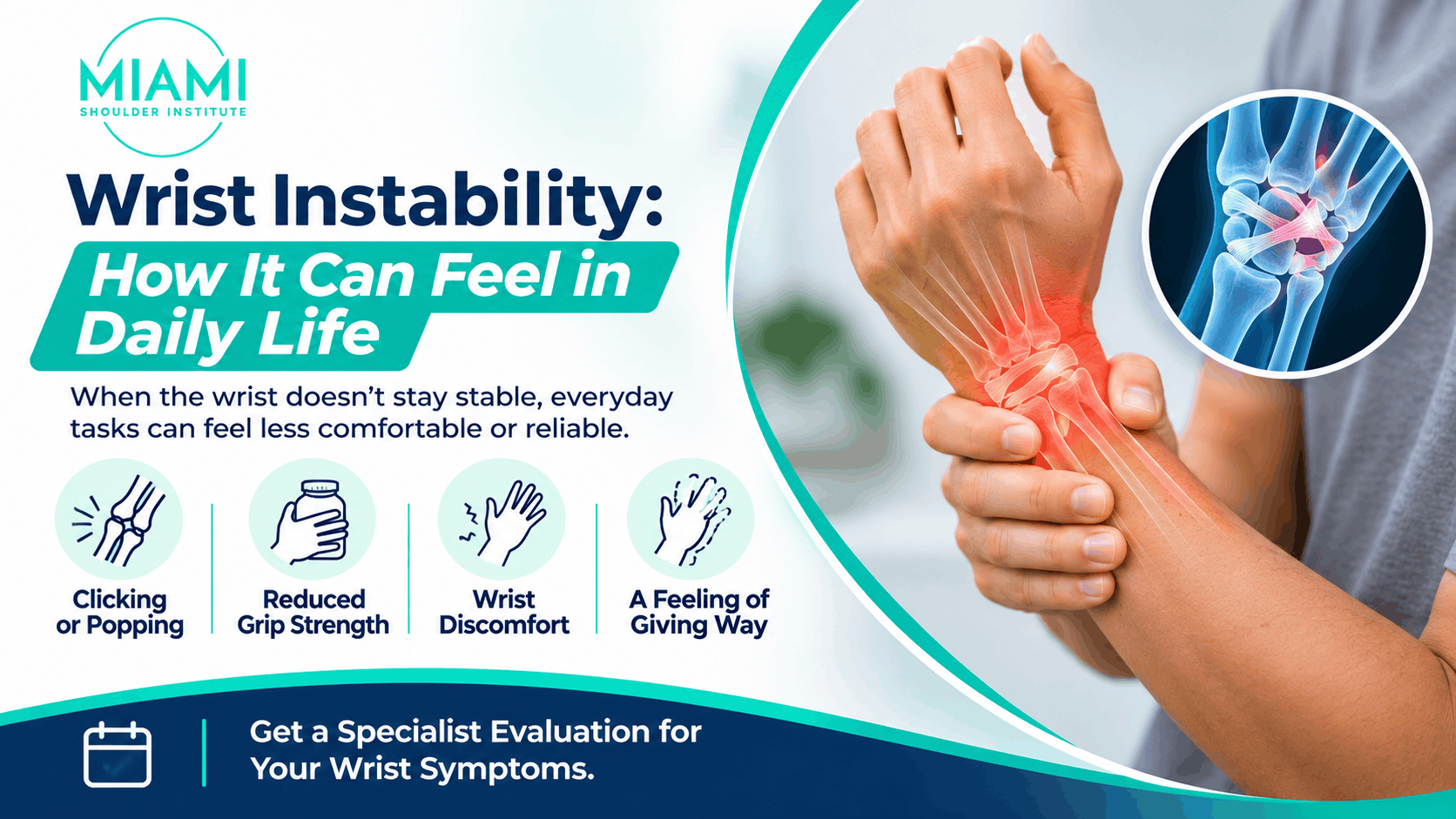
Wrist instability symptoms can vary depending on the affected ligament, the severity of the injury, and how the wrist is being used.
Some people describe their wrist as weak or unreliable. Others notice a clicking sensation, painful movement, or difficulty supporting weight through their hand.
The following symptoms are commonly associated with wrist instability.
1. A Feeling That the Wrist Is Giving Way
One of the most noticeable symptoms is a sensation that the wrist cannot support the hand properly.
You may feel that the joint briefly shifts, buckles, or loses stability when lifting an object or placing pressure through your palm.
For example, while carrying a heavy shopping bag, the wrist may suddenly feel weak or uncomfortable. You may instinctively change your grip or use the other hand to avoid putting additional pressure on it.
This sensation does not necessarily mean the bones are visibly moving out of place. It may reflect pain, weakness, or impaired joint control.
However, repeated episodes of wrist giving way should be assessed, particularly if they began after an injury.
Read More – Wrist Ligament Surgery in Miami: Treatment for Severe Wrist Injuries
2. Clicking or Popping During Movement
An unstable wrist may produce clicking, popping, or clunking sensations when you bend, rotate, or load the joint.
This may happen when the wrist bones do not move together normally because supporting ligaments have been damaged.
You might notice clicking when:
Not every wrist click indicates instability. Painless clicking can occur without an underlying injury.
However, clicking accompanied by wrist pain, weakness, swelling, or a feeling of shifting deserves medical assessment.
3. Weak Grip Strength
Ligament damage can interfere with the wrist’s ability to support force during gripping.
You may find that objects feel heavier than before or that your grip becomes uncomfortable after a short period of use.
For example, you might struggle to:
Reduced grip strength may result from pain, muscle weakness, or structural instability. A clinical examination can help distinguish between these possibilities.
4. Pain When Putting Weight Through the Hand
Some people experience wrist pain mainly when placing weight through their palm.
This can happen during activities such as push-ups, planks, yoga positions, or pushing a heavy door.
The wrist must maintain stability while transferring force between the hand and forearm. If supporting ligaments are damaged, these activities may produce discomfort or a feeling of weakness.
Pain during weight-bearing is particularly worth investigating when it develops after a fall or other wrist injury.
5. Discomfort During Twisting Movements
Turning the wrist and forearm is part of many everyday activities.
You may experience discomfort when:
The location of the pain can provide useful information. For example, some TFCC injuries cause pain on the little-finger side of the wrist, especially during forearm rotation or gripping.
However, twisting-related pain can also arise from tendon, joint, or other soft-tissue problems.
6. Swelling and Tenderness
Some wrist ligament injuries cause swelling around the joint, particularly after a sudden injury.
The wrist may feel tender when touched, and certain movements may become uncomfortable.
Swelling can be more noticeable after activities that place repeated pressure on the wrist.
Persistent or increasing swelling should be evaluated rather than automatically attributed to instability.
An unstable wrist may not interfere with every movement. Some activities may feel completely normal, while others trigger pain, weakness, or clicking.
| Everyday activity | Possible symptoms |
| Opening a jar | Pain, weakness, or clicking while gripping and twisting |
| Carrying shopping bags | Wrist giving way or difficulty maintaining grip |
| Pushing up from a chair | Pain or weakness when transferring body weight through the palm |
| Typing or using a mouse | Discomfort after prolonged use or certain wrist positions |
| Lifting a cooking pan | Reduced grip confidence or wrist pain under load |
| Turning a door handle | Clicking, discomfort, or weakness during rotation |
| Exercising or doing push-ups | Pain during wrist extension and weight-bearing |
| Playing sports | Reduced control, discomfort, or a sensation of instability during gripping |
Opening a jar requires a combination of grip strength, wrist stability, and forearm rotation.
If a supporting ligament is injured, the wrist may struggle to maintain comfortable alignment while force is applied.
This can cause pain or clicking, particularly when twisting against resistance.
Read More – Wrist Pain Treatment in Miami
Carrying bags places sustained force through the fingers and wrist.
The wrist must remain stable while the forearm muscles maintain a firm grip. If the supporting structures are damaged, the activity may cause discomfort or a feeling that the wrist cannot support the load.
Some people begin switching bags between hands or avoiding heavier objects.
Push-ups place the wrist in an extended position while transferring a substantial amount of body weight through the palm.
Certain ligament injuries can become more symptomatic in this position.
People with scapholunate ligament injuries, for example, may experience pain on the back or thumb side of the wrist when loading the joint.
If push-ups consistently cause pain or a feeling of instability, avoid forcing the movement until the underlying problem has been assessed.
Wrist instability can develop following a sudden injury or as a result of gradual damage to the supporting structures.
Wrist Ligament Injury
Ligaments are essential for maintaining the relationship between the small bones of the wrist.
When a ligament is stretched or torn, it may no longer provide sufficient support.
Commonly affected structures include:
Scapholunate ligament: Connects the scaphoid and lunate bones. Injury can lead to abnormal movement between these bones, painful clicking, reduced grip strength, and instability.
Lunotriquetral ligament: Connects the lunate and triquetrum bones. Damage can affect stability within the wrist and cause pain or clicking.
Triangular fibrocartilage complex (TFCC): A group of structures on the little-finger side of the wrist that helps support the distal radioulnar joint. Injury can cause pain during gripping, rotation, and weight-bearing.
Falls and Sports Injuries
A fall onto an outstretched hand is a common cause of wrist ligament damage.
The impact may force the wrist backwards or into an abnormal position, placing excessive stress on the ligaments.
Sports such as gymnastics, basketball, tennis, cycling, and weightlifting can also expose the wrist to sudden forces or repeated loading.
Previous Wrist Fractures
Some fractures can affect the alignment and stability of the wrist.
Even after a fracture has healed, changes in bone position or associated ligament damage may contribute to persistent symptoms.
If wrist instability develops after a fracture, further assessment may be needed to understand the cause.
Repetitive Stress
Repeated wrist loading can contribute to irritation or gradual damage in some supporting structures.
Activities involving forceful gripping, repetitive twisting, or prolonged weight-bearing may aggravate an existing problem.
Repetitive activity does not always cause ligament instability, however. Other conditions, including tendon disorders and joint irritation, can produce similar symptoms.
Read More – Wrist Arthroscopy Surgery in Miami: Minimally Invasive Wrist Treatment
Different ligaments support different parts of the wrist. The location of symptoms can sometimes help identify which structure needs further investigation.
Scapholunate Ligament Injury
The scapholunate ligament connects the scaphoid and lunate bones on the thumb side of the wrist.
A significant tear can allow these bones to move abnormally relative to one another.
Possible symptoms include:
If instability continues over time, abnormal movement may contribute to degenerative changes in the wrist.
Lunotriquetral Ligament Injury
The lunotriquetral ligament connects two small bones on the little-finger side of the proximal carpal row.
An injury may cause discomfort around this area, reduced wrist function, and clicking during selected movements.
The symptoms can overlap with other ulnar-sided wrist conditions, so a clinical examination is important.
TFCC Injury
The TFCC supports the little-finger side of the wrist and contributes to stability during forearm rotation.
Injury may cause:
The TFCC is a complex structure, and not every TFCC injury causes instability. The clinical significance depends on the specific structures involved.
Accurate wrist diagnosis is important because several conditions can produce similar symptoms.
A wrist that feels weak or painful is not necessarily structurally unstable. The assessment should identify whether the problem involves ligament damage, bone alignment, tendon irritation, or another condition.
1. Medical History
The clinician may ask:
The answers help guide the physical examination and determine which structures may need further investigation.
2. Physical Examination
The wrist may be examined for tenderness, swelling, movement, grip strength, and joint stability.
A clinician may perform specific tests to assess the scapholunate ligament, lunotriquetral ligament, or distal radioulnar joint.
These tests should be performed by an appropriately trained professional. Repeatedly forcing the wrist into painful positions at home is not a reliable way to diagnose instability.
3. X-Rays
X-rays help assess the wrist bones and their alignment.
Standard views may reveal fractures, dislocations, or abnormal spacing between carpal bones.
In some cases, additional stress views, such as clenched-fist images, may help reveal instability that is not visible on ordinary X-rays.
A normal X-ray does not always exclude an early or subtle ligament injury.
4. MRI Scan
An MRI can provide detailed images of soft tissues, including many wrist ligaments and the TFCC.
It may be recommended when symptoms suggest a ligament injury but X-rays do not provide a clear explanation.
The results need to be interpreted alongside the examination because imaging findings do not always correspond directly to symptoms.
5. CT Scan
A CT scan provides detailed images of the bones and their alignment.
It may be useful when a fracture, bone deformity, or complex joint alignment problem is suspected.
6. Wrist Arthroscopy
Wrist arthroscopy involves inserting a small camera into the wrist joint to examine its internal structures.
It may be considered in selected cases when the diagnosis remains uncertain or when a ligament injury may require surgical treatment.
It is an invasive procedure and is not necessary for every person with wrist pain or suspected instability.
Treatment depends on the underlying cause, the extent of ligament damage, the presence of abnormal bone movement, and how much symptoms affect daily life.
Activity Modification
Reducing activities that repeatedly aggravate the wrist can help protect the injured structures.
You may need to temporarily avoid:
Activity modification should not mean avoiding all wrist movement indefinitely. The appropriate level of activity depends on the injury.
Wrist Splint or Brace
A brace or splint may help support the wrist and limit movements that aggravate symptoms.
It may be recommended for selected ligament injuries, particularly during the early stages of recovery.
The type and duration of support should be determined by a healthcare professional. Prolonged immobilisation without a clear indication can contribute to stiffness and weakness.
Wrist Rehabilitation
A structured rehabilitation programme may help improve strength, coordination, and control around the wrist.
Depending on the injury, exercises may focus on:
Exercises should be selected according to the affected ligament and the stage of healing. Strengthening an unstable wrist without appropriate assessment may aggravate symptoms.
Medication and Symptom Management
A healthcare professional may recommend appropriate pain-relief or anti-inflammatory medication when suitable.
Medication can help manage symptoms, but it does not repair a torn ligament or correct structural instability.
Surgery
Surgery may be considered when significant ligament damage causes persistent instability, when the wrist bones are not maintaining normal alignment, or when non-surgical treatment has not provided sufficient improvement.
Depending on the injury, procedures may include ligament repair, reconstruction, temporary stabilisation, or other treatments designed to improve joint stability.
Not every ligament injury requires an operation. The decision depends on the affected structures, timing, wrist alignment, cartilage condition, and individual functional needs.
The outcome depends on the cause and severity of the instability.
Some mild injuries improve with appropriate conservative treatment. However, significant untreated ligament injuries can lead to ongoing problems.
Chronic Wrist Pain
Abnormal movement may repeatedly place stress on the injured structures and surrounding joint surfaces.
This can contribute to persistent pain during gripping, lifting, or weight-bearing activities.
Reduced Grip Strength
Pain and instability may make it difficult to apply force through the hand.
Over time, people may avoid activities that require a firm grip, affecting work, exercise, and household tasks.
Progressive Joint Damage
Certain longstanding ligament injuries can allow abnormal movement between carpal bones.
In some cases, this can contribute to cartilage wear and post-traumatic arthritis. A recognised example is scapholunate advanced collapse, which can develop following chronic scapholunate instability.
Not every wrist ligament injury progresses to arthritis. Appropriate assessment helps identify injuries that may require closer monitoring or treatment.
Occasional painless clicking does not necessarily indicate a problem. However, repeated wrist giving way, painful clicking, or reduced grip strength after an injury should not be ignored.
Arrange a medical assessment if you experience:
Seek urgent medical attention if you have severe pain, an obvious deformity, an open injury, rapidly increasing swelling, new numbness, or fingers that become pale, blue, or cold.
Early evaluation can help distinguish a ligament injury from a fracture, tendon condition, or other cause of wrist pain.
Read More – Wrist Fracture Surgery in Miami: When Casting Is Not Enough
An unstable wrist can make everyday activities unexpectedly difficult. Tasks that once felt simple, such as carrying bags, opening containers, or pushing up from a chair, may become uncomfortable or unreliable.
At Miami Shoulder Institute, patients experiencing persistent wrist pain, clicking, weakness, or wrist giving way can seek an assessment to understand the possible cause of their symptoms.
An evaluation may include a review of the injury history, examination of wrist movement and stability, and assessment of grip strength and tenderness.
Depending on the findings, further imaging may be recommended to investigate possible ligament damage, bone alignment changes, or other wrist conditions.
Treatment recommendations are based on the individual diagnosis. Some injuries may respond to conservative care and rehabilitation, while significant structural instability may require further specialist evaluation.
The aim is to identify the source of symptoms and guide an appropriate plan to help restore wrist function.
Wrist instability can affect more than just the way your wrist feels. It may interfere with everyday activities such as opening jars, carrying bags, lifting objects, turning handles, and supporting your body weight through your hands.
Common wrist instability symptoms include painful clicking, reduced grip strength, wrist pain, and a sensation of the wrist giving way. These symptoms may be associated with a wrist ligament injury, although fractures, tendon conditions, and other problems can produce similar discomfort.
Accurate wrist diagnosis is important because treatment depends on the underlying cause and the degree of structural damage. Some injuries improve with activity modification and rehabilitation, while more significant ligament injuries may need specialist treatment.
If your wrist repeatedly feels unstable or continues to cause pain after an injury, arrange a clinical assessment rather than assuming it is simply weakness or a minor sprain.
1. What are the most common wrist instability symptoms?
Common symptoms include painful clicking, popping, reduced grip strength, wrist pain during weight-bearing, and a sensation that the wrist is shifting or giving way. Some people experience symptoms only during specific movements.
2. What does an unstable wrist feel like?
An unstable wrist may feel weak, unreliable, or as though it briefly shifts during movement. You may notice discomfort when lifting objects, twisting a handle, carrying bags, or pushing yourself up from a chair.
3. Can wrist instability happen without pain?
Yes. Some people experience clicking, weakness, or a feeling of abnormal movement without constant pain. However, persistent or repeated instability should be assessed, even when discomfort is mild.
4. Why does my wrist give way when carrying something?
Carrying objects places force through the wrist and requires coordinated support from muscles, tendons, bones, and ligaments. If a supporting structure is injured, the wrist may feel weak or unreliable under load. Pain-related muscle inhibition can also create a similar sensation.
5. Can a wrist ligament injury cause clicking?
Yes. Damage to certain ligaments can change how the small wrist bones move relative to each other, resulting in clicking or clunking. Painless clicking can also occur for other reasons, so the symptom needs to be considered alongside pain and function.
6. Can an X-ray show wrist instability?
X-rays can reveal abnormal bone alignment, fractures, and changes in spacing between carpal bones. Additional stress views may help identify dynamic instability. MRI or other investigations may be needed to assess the ligaments themselves.
7. Can wrist instability heal without surgery?
Some stable or less severe injuries improve with activity modification, splinting, and rehabilitation. However, significant ligament tears associated with structural instability may require surgical treatment. The appropriate approach depends on the specific injury.
8. Why does my wrist hurt during push-ups?
Push-ups place substantial pressure through an extended wrist. This can aggravate an injured ligament or other wrist structure. Persistent pain, particularly after an injury or when accompanied by clicking or weakness, should be evaluated.
9. Is wrist instability the same as wrist weakness?
No. Wrist weakness describes reduced strength or force production. Wrist instability describes a problem with the joint’s ability to maintain normal movement and alignment. They can occur together, but weakness does not automatically mean the wrist is structurally unstable.
10. Can untreated wrist instability lead to arthritis?
Certain significant ligament injuries can cause abnormal movement between wrist bones. Over time, this may contribute to cartilage damage and post-traumatic arthritis. This is not inevitable, but persistent instability warrants appropriate assessment.