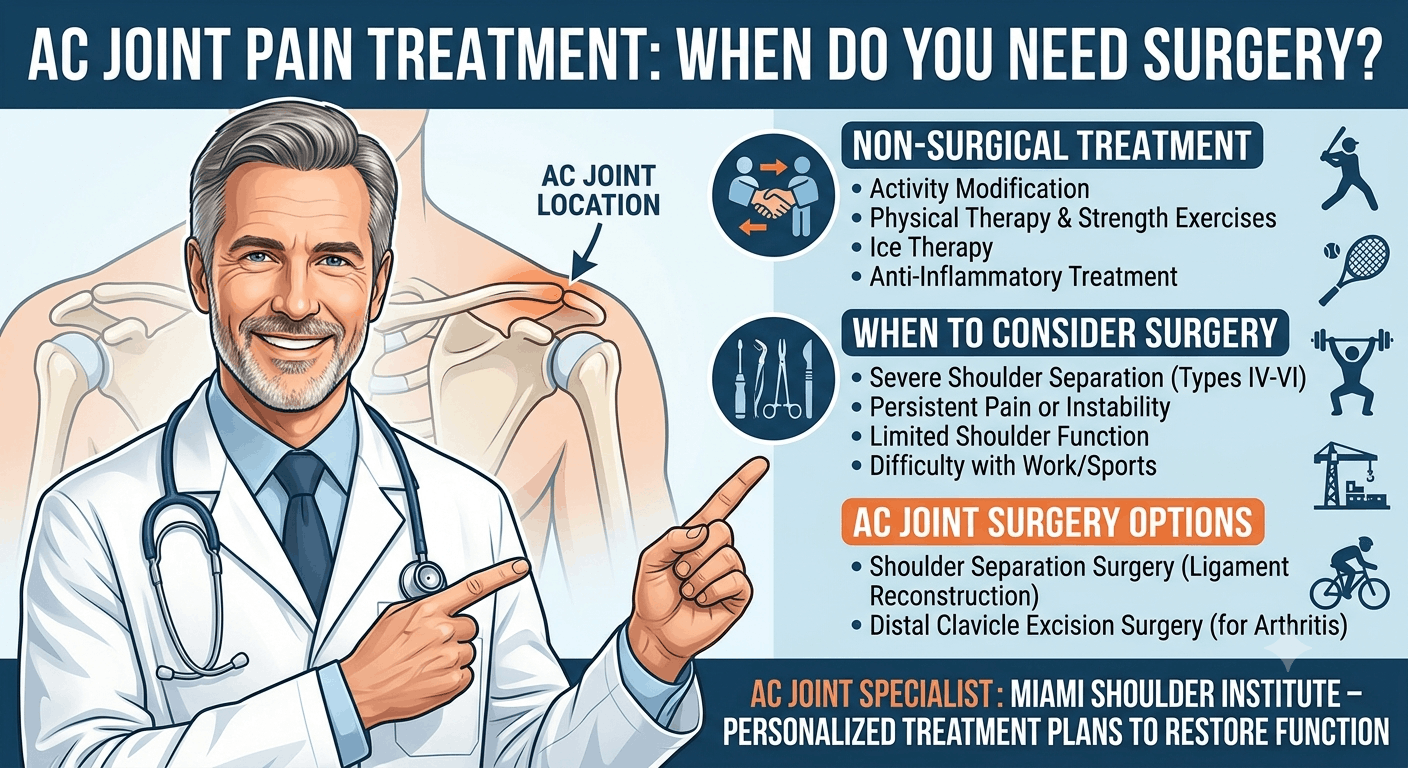
The acromioclavicular (AC) joint is a small but important joint located at the top of the shoulder, where the collarbone (clavicle) meets the acromion of the shoulder blade. AC joint injuries commonly occur after falls, contact sports, cycling accidents, or repetitive overhead activities. While many patients recover successfully with conservative AC joint pain treatment, surgery may be recommended when pain persists, instability is severe, or shoulder function remains significantly limited.
Procedures such as AC joint surgery, shoulder separation surgery, or distal clavicle excision surgery may be considered depending on the cause of the symptoms. At Miami Shoulder Institute, treatment plans are personalized to relieve pain, restore shoulder stability, and help patients safely return to daily activities, work, and sports.
The AC (acromioclavicular) joint connects:
Although relatively small, this joint plays an essential role in shoulder movement and upper body function.
The AC joint allows:
Because it absorbs significant forces, it is vulnerable to both injury and arthritis.
Several conditions can affect the AC joint.
The most common include:
Shoulder Separation
A shoulder separation occurs when the ligaments supporting the AC joint become stretched or torn.
Unlike a shoulder dislocation, the ball-and-socket joint remains in place.
AC Joint Arthritis
Over time, cartilage within the AC joint may wear away, leading to pain and stiffness.
Repetitive Overuse
Frequent overhead activities may irritate the joint.
Common in:
Direct Trauma
A fall directly onto the shoulder is one of the most common causes of AC joint injury.
Read More – Effective Shoulder Repair May Require Backwards Approach
Patients commonly report:
Pain on Top of the Shoulder
Pain is usually localized directly over the AC joint.
Pain With Cross-Body Motion
Crossing the arm across the chest often increases discomfort.
Pain During Overhead Activities
Activities such as reaching or lifting may become difficult.
Swelling
Acute injuries often produce swelling around the joint.
Visible Bump
Moderate or severe shoulder separations may create a noticeable bump on top of the shoulder.
Weakness
Pain often limits strength during lifting and pushing.
A shoulder separation occurs when the ligaments connecting the clavicle to the acromion are injured.
The severity ranges from mild stretching to complete ligament rupture.
Unlike shoulder dislocations, shoulder separations involve the AC joint rather than the ball-and-socket joint.
Shoulder separations are commonly graded from Type I to Type VI.
Type I
Usually treated without surgery.
Type II
Often treated conservatively.
Type III
Treatment depends on symptoms, activity level, and patient goals.
Type IV–VI
These are severe injuries with significant displacement.
They frequently require shoulder separation surgery.
At Miami Shoulder Institute, diagnosis begins with a comprehensive evaluation.
Medical History
Your provider will ask about:
Physical Examination
The evaluation includes:
These findings help identify AC joint pathology.
X-rays
Usually the first imaging study.
They help identify:
MRI
MRI may be used if additional soft tissue injuries are suspected.
Treatment focuses on:
Every treatment plan is individualized.
Read More – Shoulder Fracture Surgery in Miami: Expert Orthopedic Care
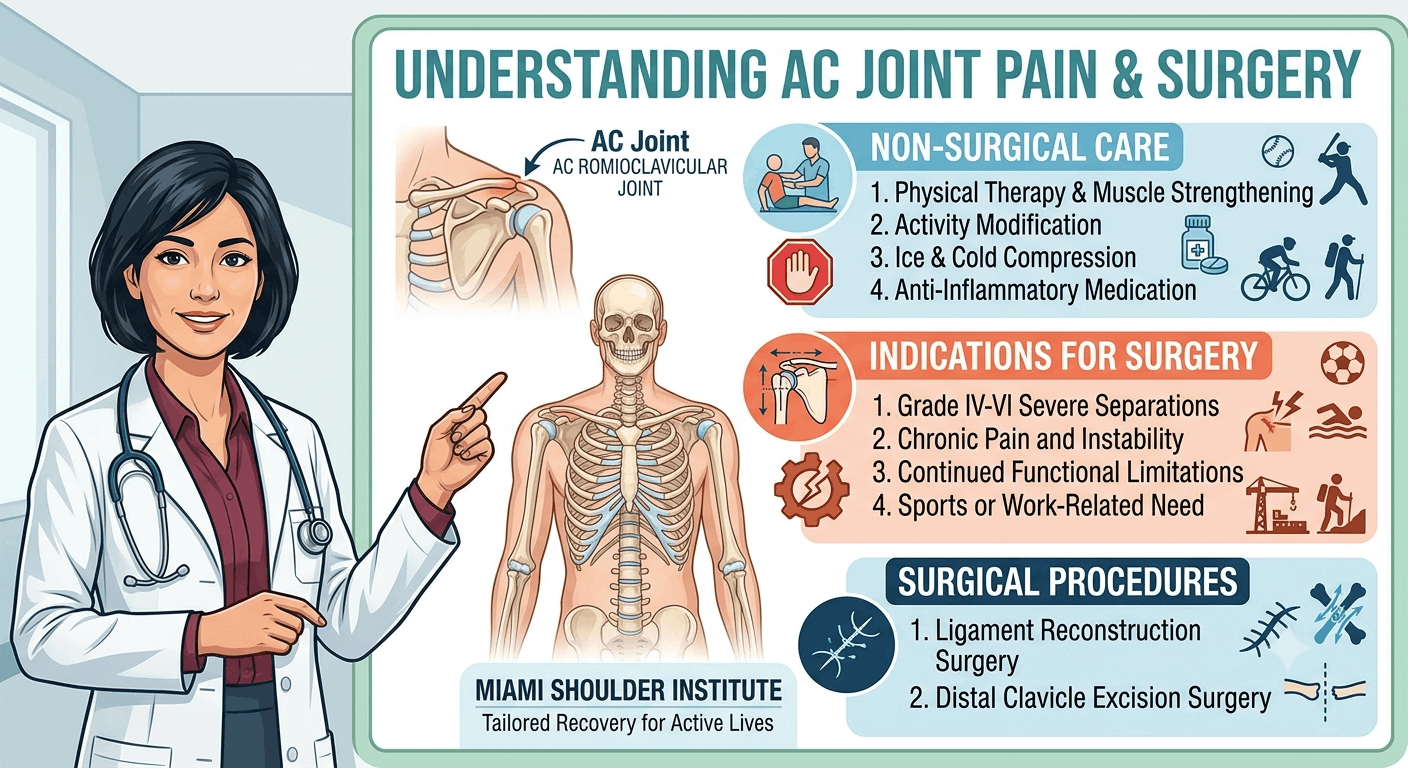
Most patients recover successfully without surgery.
Conservative treatment may include:
Activity Modification
Limiting painful activities allows healing.
Physical Therapy
Therapy focuses on:
Ice Therapy
Helpful during the early stages after injury.
Anti-Inflammatory Treatment
May reduce pain and inflammation.
Rehabilitation Programs
Progressive rehabilitation restores shoulder mechanics.
Injections
Selected patients with chronic AC joint arthritis may benefit from therapeutic injections.
Most AC joint injuries improve without surgery.
However, AC joint surgery may be recommended if:
Surgical decisions depend on injury severity and patient goals.
Shoulder separation surgery restores stability to the AC joint by reconstructing or repairing damaged ligaments.
The goals are to:
Several surgical techniques are available depending on injury severity.
Read More – Shoulder Replacement Surgery in Miami: Relief for Advanced Shoulder Arthritis
Distal clavicle excision surgery is commonly performed for chronic AC joint arthritis rather than acute separations.
During the procedure, a small portion of the end of the collarbone is removed.
This creates space within the joint and reduces painful bone-on-bone contact.
The procedure may help relieve:
Many modern AC joint procedures are performed arthroscopically.
This minimally invasive technique uses:
Potential benefits include:
At Miami Shoulder Institute, minimally invasive techniques are used whenever appropriate.
Recovery occurs gradually.
Weeks 1–2
Focus on:
Weeks 2–6
Patients begin:
Weeks 6–12
Therapy progresses toward:
Months 3–6
Patients gradually return to:
Recovery varies depending on the procedure performed.
Most patients experience significant improvement after appropriate treatment.
However, persistent symptoms may occur if:
Long-term shoulder health depends on maintaining strength and mobility.
Although not every injury is preventable, risk may be reduced by:
Healthy shoulder mechanics reduce stress on the AC joint.
Consult an AC joint specialist if you experience:
Early evaluation may prevent long-term complications.
Read More – Hand Fracture Surgery in Miami: Advanced Microsurgical Treatment
Miami Shoulder Institute specializes exclusively in shoulder care, providing advanced diagnosis and treatment for AC joint injuries, shoulder separations, arthritis, rotator cuff tears, instability, fractures, and sports-related conditions.
Whether treatment involves rehabilitation, AC joint surgery, shoulder separation surgery, or distal clavicle excision surgery, care is tailored to restore shoulder stability, relieve pain, and help patients return to active lifestyles.
The goal is not only to heal the injury but also to restore long-term shoulder function and confidence.
1. What is the best AC joint pain treatment?
Most patients improve with physical therapy, rehabilitation, and activity modification before surgery is considered.
2. When is AC joint surgery recommended?
Surgery may be appropriate for severe shoulder separations, chronic pain, or persistent instability.
3. What is shoulder separation surgery?
It is a procedure that repairs or reconstructs damaged AC joint ligaments to restore stability.
4. What is distal clavicle excision surgery?
It removes a small portion of the collarbone to relieve pain caused by AC joint arthritis.
5. How long does recovery take after AC joint surgery?
Recovery varies but generally takes several months with structured rehabilitation.
6. Can shoulder separation heal without surgery?
Yes. Many mild and moderate injuries recover successfully with conservative treatment.
7. When should I see an AC joint specialist?
Persistent shoulder pain, instability, or deformity after an injury should be evaluated by a specialist.