

 EN EN
EN EN
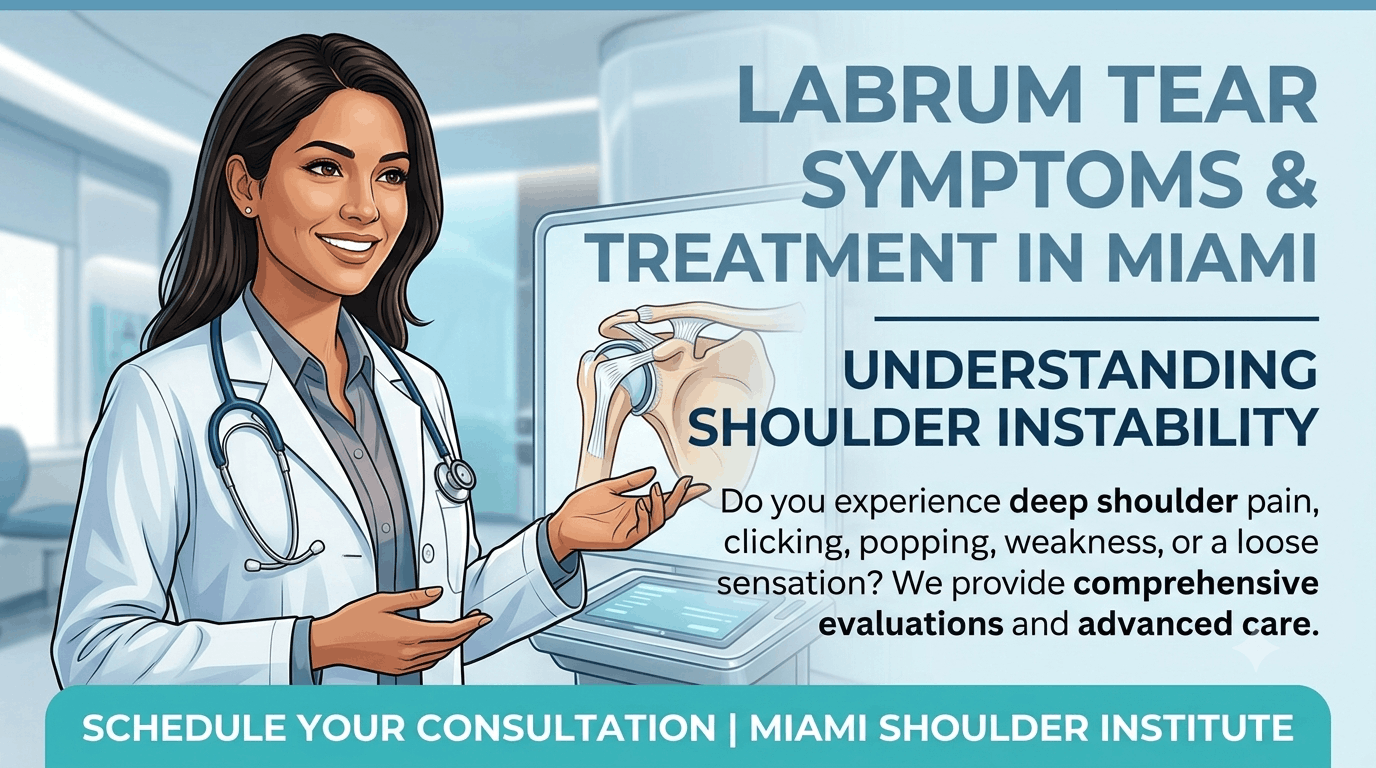
A labrum tear is one of the most common causes of shoulder instability, especially in athletes, weightlifters, and individuals with a history of shoulder dislocation. The labrum is a ring of cartilage around the shoulder socket that helps stabilize the joint. When this cartilage tears, the shoulder may become painful, weak, unstable, or prone to slipping out of place.
Common labrum tear symptoms Miami patients report include deep shoulder pain, clicking or popping, weakness, reduced performance, limited range of motion, and a feeling that the shoulder is loose or unstable. In more severe cases, recurrent dislocations may occur.
At Miami Shoulder Institute, patients experiencing shoulder instability Miami symptoms receive comprehensive evaluations to determine whether conservative care or labrum surgery Miami may be the best treatment option.
The shoulder is a ball-and-socket joint.
The “ball” is the top of the upper arm bone (humerus), while the “socket” is part of the shoulder blade (glenoid). Unlike the hip, the shoulder socket is relatively shallow. This design gives the shoulder exceptional mobility but less natural stability.
The labrum is a ring of cartilage surrounding the socket that helps:
Without a healthy labrum, the shoulder becomes more vulnerable to instability and injury.
Read More – Shoulder Surgery in Miami: Cost, Insurance, and What to Expect
A labrum tear occurs when the cartilage around the shoulder socket becomes damaged.
This injury may involve:
The severity varies depending on the injury mechanism and patient activity level.
Labral injuries can develop suddenly or gradually.
Traumatic Shoulder Dislocation
One of the most common causes of shoulder instability Miami patients experience is a dislocation.
When the shoulder pops out of the socket, the labrum can tear.
This is especially common in:
Repetitive Overhead Motion
Repeated overhead stress can gradually damage the labrum.
Common in:
Heavy Lifting
Lifting heavy weights with poor mechanics can place stress on the shoulder.
Falls
Landing on an outstretched arm may injure the labrum.
Degenerative Wear
Age-related wear can weaken cartilage over time.
Recognizing symptoms early can help prevent worsening instability.
1. Deep Shoulder Pain
Pain from a labral tear is often described as:
This is one of the most common labrum tear symptoms Miami patients report.
2. Clicking, Popping, or Catching
Many patients notice mechanical symptoms.
Examples include:
This may occur because damaged cartilage interferes with smooth joint motion.
A major symptom of labral injury is instability.
Patients may feel:
This is especially common during overhead motion or external rotation.
4. Recurrent Dislocations or Subluxations
Some patients experience repeated instability episodes.
These may involve:
Repeated instability can worsen labral damage.
Read More – Difference Between an Orthopedic Shoulder Specialist and a General Orthopedic Doctor
5. Weakness
Weakness may develop because the shoulder loses stability.
Patients may struggle with:
Performance often declines in active individuals.
6. Reduced Range of Motion
Some patients experience stiffness or guarded movement due to pain and instability.
This can affect:
7. Pain During Sports or Exercise
Athletes often notice symptoms during:
Performance may decline gradually.
Not all tears are identical.
SLAP Tears
SLAP stands for:
Superior Labrum Anterior to Posterior
These tears occur at the top of the labrum.
Often seen in:
Bankart Tears
These commonly occur after shoulder dislocations.
A Bankart tear affects the lower front portion of the labrum and is strongly associated with instability.
Posterior Labral Tears
Less common but may occur in athletes or after trauma.
The labrum helps keep the shoulder centered during movement.
When torn:
This explains why shoulder instability Miami symptoms often accompany labral injuries.
You should consider evaluation if symptoms include:
Early diagnosis may prevent worsening damage.
Read More- What Is the Success Rate of Shoulder Replacement Surgery?
At Miami Shoulder Institute, diagnosis begins with a comprehensive evaluation.
Medical History
The provider will ask about:
Physical Examination
Assessment includes:
Specific tests may reproduce labral symptoms.
Imaging
Imaging may include:
X-rays
Useful for bone evaluation.
MRI
Often best for soft tissue evaluation.
MRI helps assess:
Not every labrum tear requires surgery.
Many patients improve with conservative care.
Physical Therapy
Therapy focuses on:
Activity Modification
Avoiding aggravating activities may help healing.
Rehabilitation Programs
Structured rehab improves function and control.
Anti-Inflammatory Treatment
May help reduce symptoms.
Labrum surgery Miami may be recommended when:
Surgery often focuses on repairing and stabilizing the torn labrum.
Modern labrum surgery Miami procedures are commonly performed arthroscopically.
This involves:
Benefits may include:
Recovery occurs in phases.
Early Recovery
Focuses on:
Rehabilitation Phase
Includes:
Return to Activity
Athletes gradually progress toward:
Following rehabilitation is critical for long-term success.
Some labral tears become manageable without surgery.
Success depends on:
Athletes with repeated instability often require surgical stabilization.
Read More – Preparing for Shoulder Surgery: Checklist and Tips from Miami’s Top Surgeons
Miami Shoulder Institute specializes exclusively in shoulder care, helping patients accurately diagnose and treat instability, labral injuries, rotator cuff conditions, arthritis, and sports-related shoulder problems.
Whether treatment involves rehabilitation or labrum surgery Miami, care is individualized to restore stability, reduce pain, and help patients return to daily activities and sports.
1. What are the most common labrum tear symptoms?
Deep shoulder pain, clicking, instability, weakness, and recurrent dislocations are common symptoms.
2. Can a labrum tear heal on its own?
Some tears become manageable without surgery, but significant instability may require repair.
3. Does every labrum tear need surgery?
No. Many patients improve with physical therapy and rehabilitation.
4. What causes shoulder instability?
Common causes include dislocations, ligament injury, labral tears, and repetitive overhead stress.
5. How is a labrum tear diagnosed?
Diagnosis usually involves physical examination and imaging such as MRI.
6. Is labrum surgery painful?
Postoperative discomfort is expected but typically manageable during recovery.
7. How long is recovery after labrum surgery?
Recovery varies but usually involves several months of rehabilitation.
Also Read About – How to Find the Best Shoulder Doctor Near You: Step-by-Step Guide