
Shoulder impingement is one of the most common causes of shoulder pain, especially in people who frequently lift, throw, swim, or perform repetitive overhead activities. Most patients improve with conservative shoulder impingement treatment, including physical therapy, activity modification, and anti-inflammatory care. However, when pain persists for several months, limits daily activities, or fails to improve despite structured rehabilitation, surgery may be considered.
Shoulder decompression surgery, also called subacromial decompression surgery, is designed to create more space for the rotator cuff tendons by removing structures that contribute to compression. At Miami Shoulder Institute, surgery is recommended only after a comprehensive evaluation confirms that non-surgical treatment has not provided adequate relief.
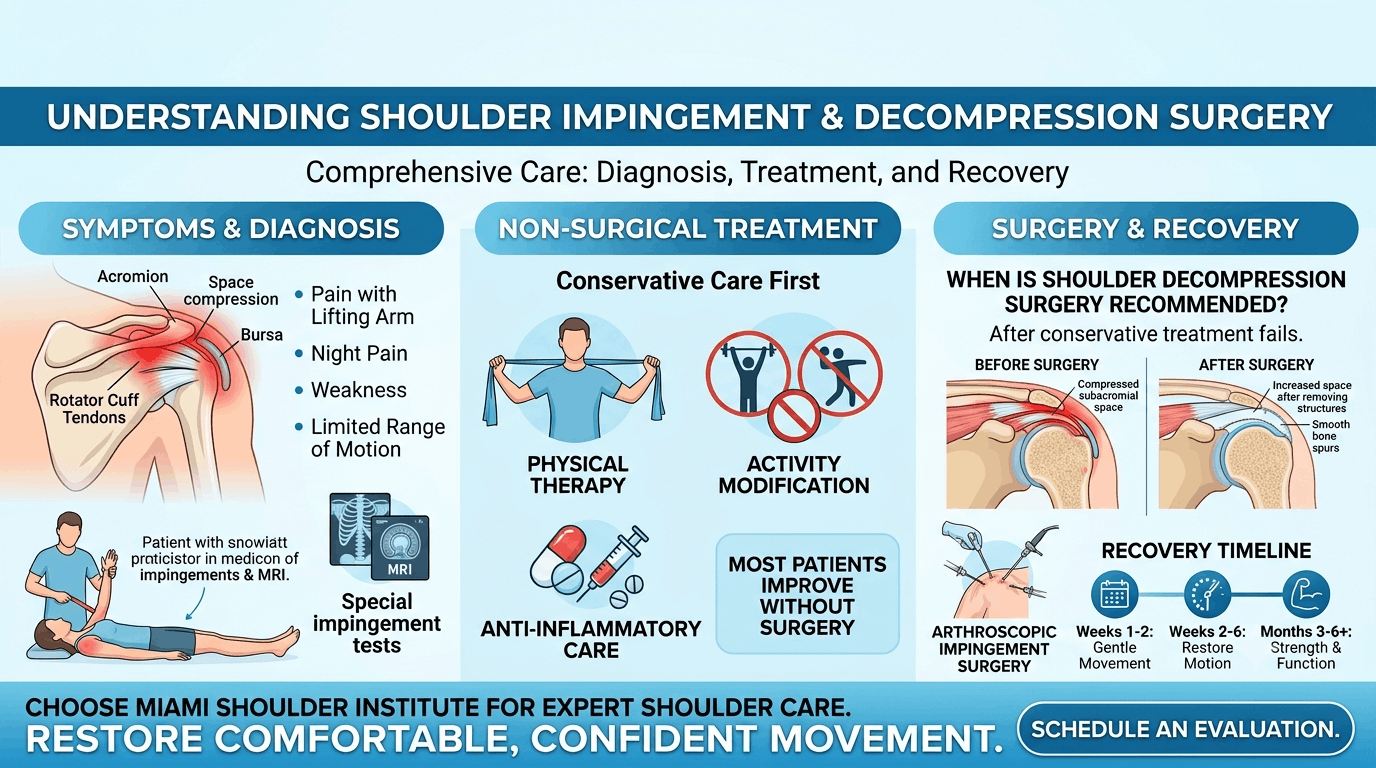
Shoulder impingement occurs when the rotator cuff tendons and surrounding soft tissues become compressed between the upper arm bone (humerus) and the acromion, a part of the shoulder blade.
Repeated compression can lead to:
If untreated, chronic impingement may contribute to rotator cuff tears over time.
Also Read More – Shoulder Surgery in Miami: Cost, Insurance, and What to Expect
The shoulder is a highly mobile ball-and-socket joint composed of:
The rotator cuff tendons pass through a narrow space beneath the acromion, known as the subacromial space.
When this space becomes narrowed, tendon irritation may occur.
Several factors can contribute to impingement.
Repetitive Overhead Activities
Frequent overhead motion increases tendon stress.
Common among:
Bone Spurs
Extra bone growth beneath the acromion can reduce available space.
Rotator Cuff Inflammation
Inflamed tendons occupy more space and become more easily compressed.
Poor Shoulder Mechanics
Weak muscles or poor posture may alter shoulder movement patterns.
Shoulder Instability
Abnormal joint movement can contribute to repeated impingement.
Read More – Shoulder MRI vs X-Ray: Which Test Do You Need?
Patients commonly experience:
Pain When Raising the Arm
Especially during:
Night Pain
Pain often becomes worse while lying on the affected shoulder.
Weakness
Many patients notice reduced strength during lifting or overhead activities.
Limited Range of Motion
The shoulder may become stiff due to pain.
Clicking or Catching
Mechanical symptoms may develop as inflammation progresses.
At Miami Shoulder Institute, diagnosis begins with a thorough evaluation.
Medical History
Your provider will ask about:
Physical Examination
The evaluation includes:
These maneuvers help identify the source of pain.
X-rays
Useful for identifying:
MRI
MRI evaluates:
It also helps determine whether a rotator cuff tear is present.
Read More – Best Exercises After Shoulder Surgery in Miami
The primary goals are to:
Treatment should address both symptoms and the underlying cause.
Most patients improve without surgery.
Conservative care remains the first step.
Physical Therapy
Physical therapy focuses on:
This is one of the most effective forms of shoulder impingement treatment.
Activity Modification
Reducing aggravating movements allows irritated tissues to recover.
Examples include limiting:
Reducing inflammation often improves comfort and mobility.
Guided Rehabilitation
A structured rehabilitation program helps restore proper shoulder movement patterns.
Injections
Some patients may benefit from injections to decrease inflammation and facilitate rehabilitation.
Most patients do not require surgery.
However, shoulder decompression surgery may be recommended if:
A careful evaluation helps determine whether surgery is appropriate.
Shoulder decompression surgery is designed to increase the space beneath the acromion and reduce pressure on the rotator cuff tendons.
The goals include:
The exact procedure depends on the patient’s anatomy and associated shoulder conditions.
Read More – Wrist Arthroscopy Surgery in Miami: Minimally Invasive Wrist Treatment
Subacromial decompression surgery is one of the most commonly performed procedures for mechanical shoulder impingement.
During surgery, the surgeon may:
This helps create a healthier environment for tendon movement.
Most modern impingement surgery shoulder procedures are performed arthroscopically.
This minimally invasive technique uses:
Potential advantages include:
At Miami Shoulder Institute, arthroscopic techniques are used whenever appropriate.
Yes.
Long-term compression may gradually weaken the rotator cuff.
Over time, chronic impingement can contribute to:
Early treatment may reduce this risk.
Recovery progresses through several stages.
Weeks 1–2
Goals include:
Many patients begin early mobility exercises.
Weeks 2–6
Therapy focuses on:
Weeks 6–12
Patients gradually begin:
Months 3–6
Most patients continue improving in:
Return to sports depends on recovery progress.
Read More – Preparing for Shoulder Surgery: Checklist and Tips from Miami’s Top Surgeons
Ignoring persistent symptoms may increase the risk of:
Early evaluation helps identify the most appropriate treatment.
While not every case is preventable, you can reduce your risk by:
Healthy shoulder mechanics reduce tendon stress.
Consult a shoulder impingement specialist if you experience:
Early evaluation may help avoid progression to more serious injuries.
Miami Shoulder Institute specializes exclusively in shoulder care, offering advanced diagnosis and treatment for shoulder impingement, rotator cuff injuries, instability, arthritis, fractures, and sports-related conditions.
Whether treatment involves rehabilitation or subacromial decompression surgery, patients receive individualized care designed to relieve pain, restore function, and support long-term shoulder health.
The goal is not simply reducing pain—it is restoring comfortable, confident movement.
1. What is the best shoulder impingement treatment?
Most patients improve with physical therapy, rehabilitation, and activity modification before surgery is considered.
2. When is shoulder decompression surgery necessary?
Surgery may be recommended when symptoms persist despite months of conservative treatment.
3. What is subacromial decompression surgery?
It is a procedure that increases the space beneath the acromion to reduce pressure on the rotator cuff tendons.
4. Is shoulder impingement surgery performed arthroscopically?
Yes. Most modern procedures are performed using minimally invasive arthroscopic techniques.
5. How long is recovery after decompression surgery?
Recovery typically takes several months depending on rehabilitation and individual healing.
6. Can untreated shoulder impingement cause rotator cuff tears?
Yes. Chronic tendon compression may contribute to progressive tendon damage.
7. Should I see a shoulder impingement specialist for persistent shoulder pain?
Yes. Persistent pain, weakness, or limited motion should be evaluated by a specialist.
Also Read About – Finding the Best Shoulder Surgeon in Miami: What Patients Should Look For