

 EN EN
EN EN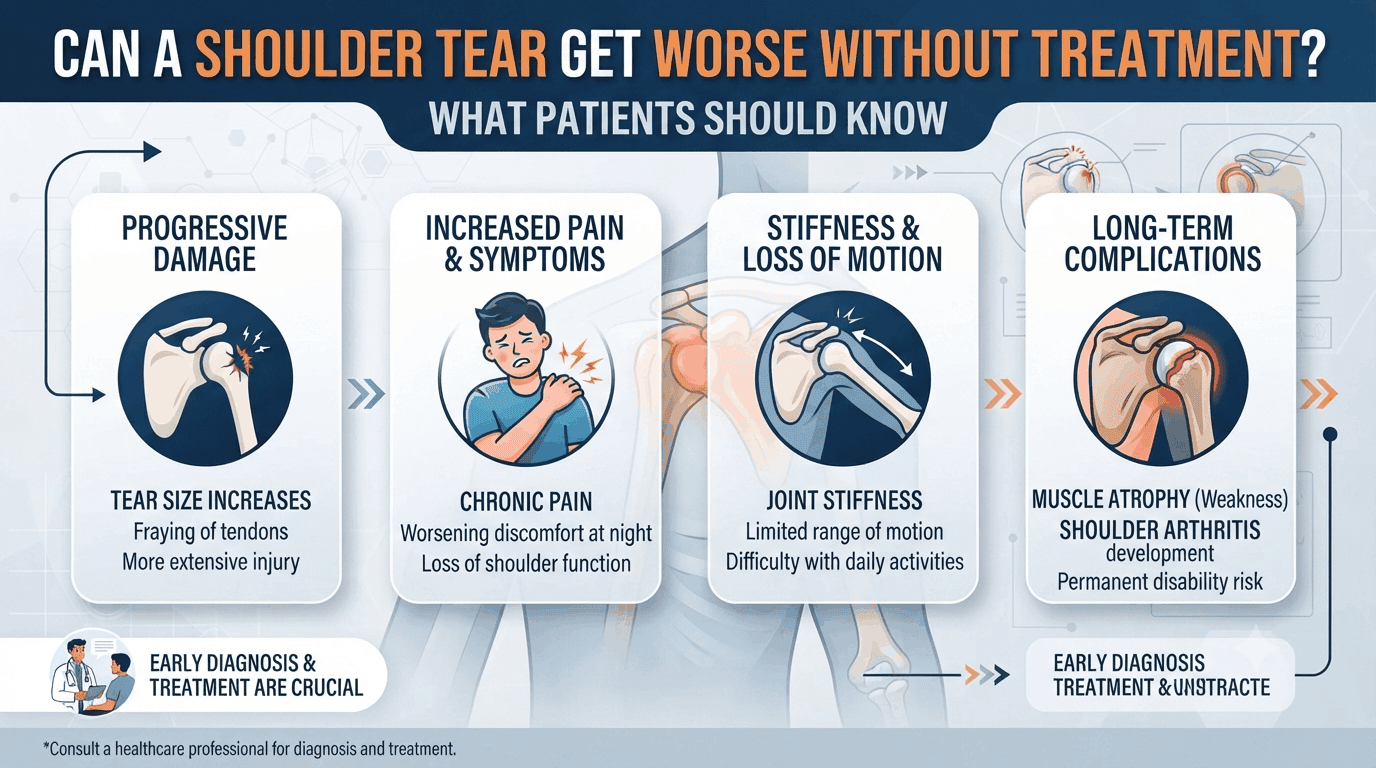
Yes, a shoulder tear can get worse without treatment, but the risk depends on the type of tear, its size, cause, location, tissue quality, activity level, and individual circumstances. Not every shoulder tear automatically progresses or requires surgery. Some smaller or degenerative tears can remain stable and may be managed successfully with non-surgical treatment.
However, an untreated shoulder tear can sometimes lead to persistent pain, increasing weakness, reduced shoulder function, or progression of structural damage. A rotator cuff tear, particularly one associated with trauma or significant weakness, may require closer evaluation.
The best approach is not to assume that every tear will worsen—or that every tear needs surgery. Instead, a shoulder specialist can assess the injury, review appropriate imaging, evaluate strength and motion, and determine the most suitable shoulder tear treatment.
At Miami Shoulder Institute, treatment decisions are based on the individual’s diagnosis, symptoms, functional limitations, and goals.
A shoulder tear can sometimes become larger or cause increasing symptoms when left untreated, but progression is not inevitable.
The term “shoulder tear” can describe different injuries involving structures such as the rotator cuff, labrum, tendons, or other soft tissues. Each behaves differently.
The likelihood of a shoulder tear getting worse depends on several factors:
Some tears remain relatively stable for years. Others can progress, particularly when associated with ongoing mechanical stress or significant tendon damage.
This is why an untreated shoulder tear should not simply be assumed to be harmless.
A shoulder tear occurs when a tissue within or around the shoulder becomes partially or completely damaged.
The term can refer to several different injuries.
The rotator cuff contains four tendons that help move and stabilize the shoulder.
A tear may be:
The labrum is a ring of cartilage surrounding the shoulder socket. It contributes to joint stability.
Labral injuries can occur following trauma, dislocation, repetitive overhead activity, or other mechanisms.
Other tendons around the shoulder can also be injured.
The symptoms and treatment options depend on which structure is affected.
Because “shoulder tear” is a broad term, determining the exact diagnosis is an important first step.
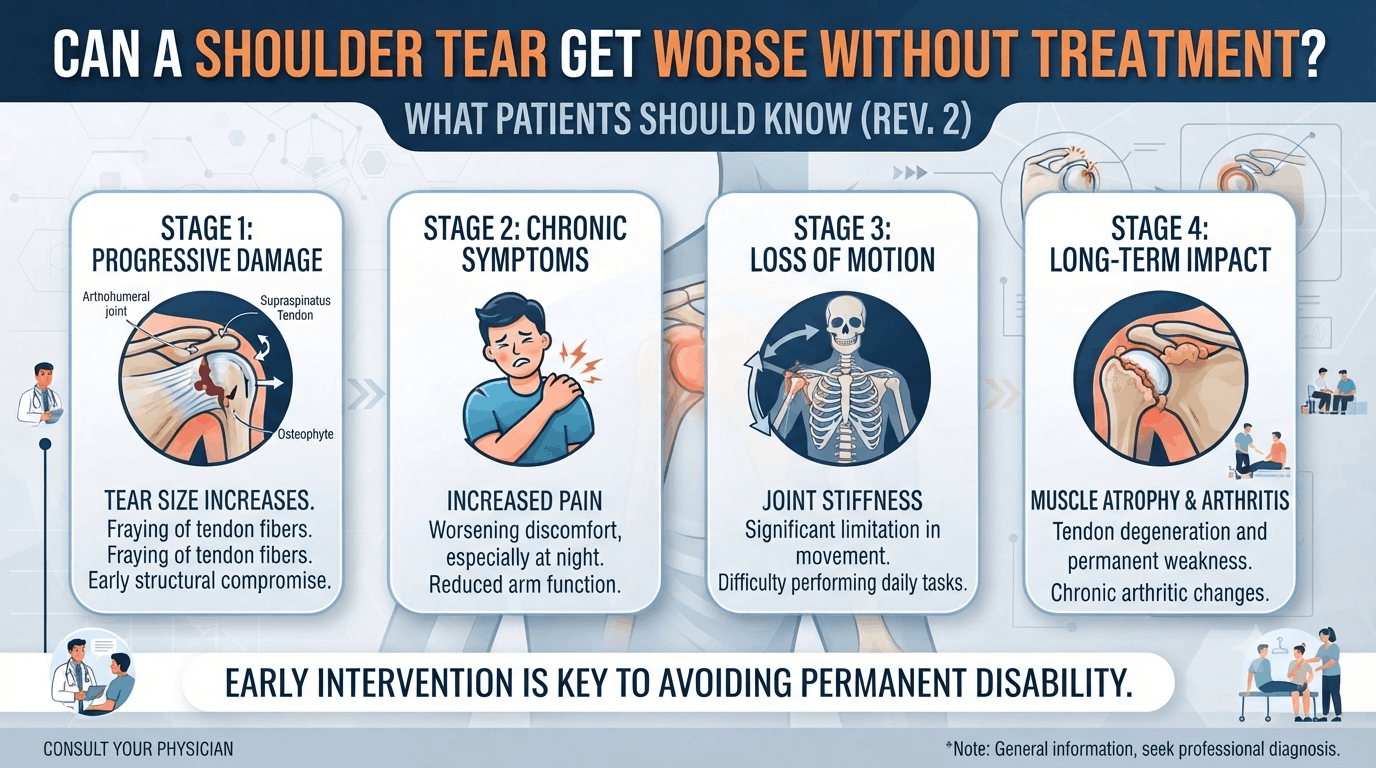
1. The Tear May Increase in Size
One concern with some shoulder tears is structural progression.
A small tear may remain stable, but in certain circumstances it can become larger.
This is particularly relevant with some rotator cuff injuries.
A larger tear can potentially involve more tendon tissue and make the shoulder less effective at generating force.
However, progression varies considerably between individuals.
A larger tear on imaging does not necessarily mean that surgery is required.
2. Shoulder Weakness Can Increase
A tear can interfere with the normal function of the affected tendon or muscle.
You may begin noticing:
If weakness progressively increases, it is worth reassessing the shoulder.
Pain can also cause people to stop using the arm normally, which can contribute to deconditioning.
3. Pain May Become Persistent
Some tears cause little pain, while others produce ongoing discomfort.
Pain may become particularly noticeable during:
Persistent pain does not necessarily mean that the tear is getting larger.
However, continuing symptoms are a reason to reassess the condition and review shoulder tear treatment options.
4. Shoulder Function Can Decline
An untreated injury may gradually change how you use your shoulder.
You may stop performing activities because they hurt.
Over time, you may notice difficulty:
The goal of treatment is not simply to eliminate pain. Preserving useful shoulder function is also important.
5. Stiffness Can Develop
Pain often causes people to move their shoulder less.
Reduced movement can contribute to stiffness.
In some situations, prolonged shoulder stiffness can become an additional problem that needs treatment.
This is one reason persistent shoulder symptoms should not simply be ignored.
6. Muscle Changes May Develop With Some Rotator Cuff Tears
A chronic rotator cuff tear can sometimes be associated with changes in the affected muscles over time.
These changes can include muscle atrophy and fatty degeneration.
Such changes may affect shoulder function and can influence the options available for treatment.
This does not mean that every chronic tear becomes irreparable.
It does mean that the characteristics of a tear matter when evaluating long-term treatment options.
7. The Underlying Cause May Continue
Some tears happen because of a specific traumatic event.
Others develop because of repeated stress and degenerative changes.
If the activities or mechanical factors contributing to the injury continue, symptoms may persist.
For example, repeatedly performing painful overhead activity without modifying the activity may continue to stress the shoulder.
Understanding why the tear occurred can therefore be as important as identifying the tear itself.
Read about – How to Find the Best Shoulder Doctor Near You: Step-by-Step Guide
No.
This is an important distinction.
A tear does not automatically become larger simply because it is not surgically repaired.
Some people have tears that remain stable and continue to function well with appropriate non-surgical management.
Others develop progressive symptoms or structural changes.
The natural history depends on:
Therefore, the right question is not simply:
“Will my tear get worse?”
A more useful question is:
“What is the likely behavior of my specific tear, and what treatment gives me the best chance of maintaining shoulder function?”
That is something a shoulder specialist can help determine.
The outcome of an untreated shoulder tear varies significantly.
Some patients may have:
Others may develop:
This variation is why treatment should be individualized.
A rotator cuff tear deserves particular attention because the rotator cuff plays a central role in shoulder movement and stability.
Rotator cuff tears can occur because of:
Symptoms can include:
Some people have a rotator cuff tear without significant symptoms.
Others experience substantial functional limitations.
In some patients, yes.
Some rotator cuff tears can enlarge over time, although progression is not guaranteed.
The likelihood depends on the characteristics of the tear and individual patient factors.
This is one reason a confirmed tear should be evaluated rather than automatically ignored.
A specialist can consider whether observation, rehabilitation, additional imaging, or another treatment approach is appropriate.
Tendons have limited healing capacity, and a complete tendon tear does not simply reconnect in the same way a minor muscle strain might recover.
However, symptoms and function can improve without surgical repair in many patients.
Non-surgical treatment may help improve:
Importantly, symptom improvement does not necessarily mean that the tendon has structurally healed.
That distinction should be discussed with a specialist when relevant.
Treatment timing depends on the injury.
An evaluation may be particularly important when:
A timely evaluation does not automatically mean surgery.
It means understanding the injury and making an informed decision.
Shoulder tear treatment depends on the specific structure involved and the severity of the injury.
Potential approaches include:
Activity Modification
Temporarily changing painful activities can reduce stress on the injured tissue.
Physical Therapy
A structured rehabilitation program may improve strength, mobility, stability, and shoulder mechanics.
Medication
Medication may sometimes be used to manage pain or inflammation when medically appropriate.
Injections
Selected patients may benefit from injections depending on the diagnosis and treatment goals.
Observation
Some tears can be monitored when symptoms are minimal and function remains good.
Surgery
Surgery may be considered when a significant structural injury causes persistent symptoms or functional limitations and non-surgical care has not provided adequate improvement.
No.
This is one of the most common misconceptions.
The presence of a tear on an MRI does not automatically mean that surgical repair is required.
A specialist may consider:
For some patients, non-surgical management provides good function and symptom control.
For others, surgical treatment may be appropriate.
Watch for changes such as:
Increasing Pain
Pain becomes more frequent, more intense, or begins interfering with sleep.
Increasing Weakness
You cannot lift or carry objects that were previously easy.
Reduced Range of Motion
You are increasingly unable to reach overhead or behind your back.
Reduced Function
Normal work, sports, or household activities become difficult.
Recurrent Symptoms
The shoulder repeatedly becomes painful after activity.
New Instability
The shoulder begins feeling like it is slipping or giving way.
These changes do not prove that the tear has progressed structurally.
But they are reasons to seek reassessment.
Yes.
Pain severity does not always correspond to the size of a tear.
Some people have structural tears with relatively mild symptoms.
Others may experience significant pain from conditions without a major tear.
This is why treatment decisions should not be based on pain alone.
Strength, function, examination findings, and imaging all contribute to the overall assessment.
Consider seeing a shoulder specialist if:
A specialist can determine whether the tear requires treatment, observation, rehabilitation, or surgical consideration.
Read More – Rotator Cuff Tear vs Frozen Shoulder: How to Tell the Difference
Your evaluation may begin with questions about:
The physical examination may evaluate:
Imaging may be reviewed or ordered when clinically appropriate.
It depends on the tear and the type of exercise.
You should not assume that complete inactivity is always the best approach.
However, continuing activities that significantly increase pain or weakness may not be appropriate.
A structured rehabilitation plan can help identify:
Your exercise plan should reflect the actual diagnosis.
A minimally symptomatic tear may not require immediate surgery.
However, if you know you have a tear, it is still useful to understand its characteristics and monitor your shoulder function.
A specialist can help determine whether observation or active treatment is appropriate.
The absence of severe pain does not necessarily mean the shoulder should be ignored.
In some cases, chronic structural changes can affect treatment options.
For example, certain chronic rotator cuff tears may be associated with:
These factors can influence whether a tendon can be repaired and the expected outcome.
This does not mean everyone with a tear needs immediate surgery.
It means that patients with significant injuries should understand their diagnosis rather than delaying evaluation indefinitely.
It is important to separate early evaluation from early surgery.
Getting evaluated early gives you information.
It can help determine:
In many cases, the best decision may be continued non-surgical treatment.
The advantage of evaluation is knowing which path makes sense.
Miami Shoulder Institute focuses on evaluating and treating shoulder conditions affecting pain, strength, stability, and movement.
If you are concerned about a shoulder tear getting worse, an evaluation can help clarify the nature of the injury and what options may be appropriate.
The goal is not to assume that every tear requires surgery.
Instead, treatment should be based on the actual diagnosis, symptoms, functional limitations, imaging findings, and individual goals.
Depending on the situation, shoulder tear treatment may involve observation, activity modification, physical therapy, medication, injections, or surgical consideration.
If you have been told that you have a rotator cuff tear, persistent weakness or worsening symptoms are good reasons to discuss your condition with a qualified specialist.
1. Can a shoulder tear get worse without treatment?
Yes, a shoulder tear can get worse in some patients, but progression is not inevitable. The risk depends on the type, size, location, tissue quality, cause, and individual circumstances.
2. What happens if I leave a shoulder tear untreated?
An untreated shoulder tear may remain stable, or it may cause increasing pain, weakness, stiffness, or loss of function. Some tears can also progress structurally.
3. Does every rotator cuff tear require surgery?
No. A rotator cuff tear can sometimes be managed successfully with rehabilitation and other non-surgical treatments. Surgery depends on the individual circumstances.
4. Can a rotator cuff tear get bigger?
Some rotator cuff tears can enlarge over time. However, not every tear progresses. Tear characteristics and patient factors influence the risk.
5. What is the best shoulder tear treatment?
The appropriate shoulder tear treatment depends on the type and severity of the tear, symptoms, strength, functional limitations, and patient goals.
6. Should I see a shoulder specialist for a tear?
Yes, particularly if you have persistent pain, weakness, worsening symptoms, or a tear diagnosed through imaging. A shoulder specialist can help determine the appropriate treatment strategy.
7. Can a shoulder tear heal without surgery?
Some symptoms can improve without surgery, and many patients can regain useful function through non-surgical treatment. However, structural healing varies depending on the type of tear.
8. Does a bigger tear always mean more pain?
No. Tear size and pain do not always correlate directly. Some people with significant tears have relatively mild symptoms.
9. Can physical therapy help a shoulder tear?
Physical therapy can help improve strength, mobility, shoulder mechanics, and function for many patients. Whether it is appropriate depends on the specific injury.
10. When should a shoulder tear be evaluated?
Evaluation is particularly important when symptoms follow an injury, weakness is significant or progressive, pain persists, movement becomes restricted, or daily activities are affected.
Also Read More – Shoulder Surgery in Miami: Cost, Insurance, and What to Expect
8 Possible Reasons Your Shoulder Pops or Cracks During Workouts