

 EN EN
EN EN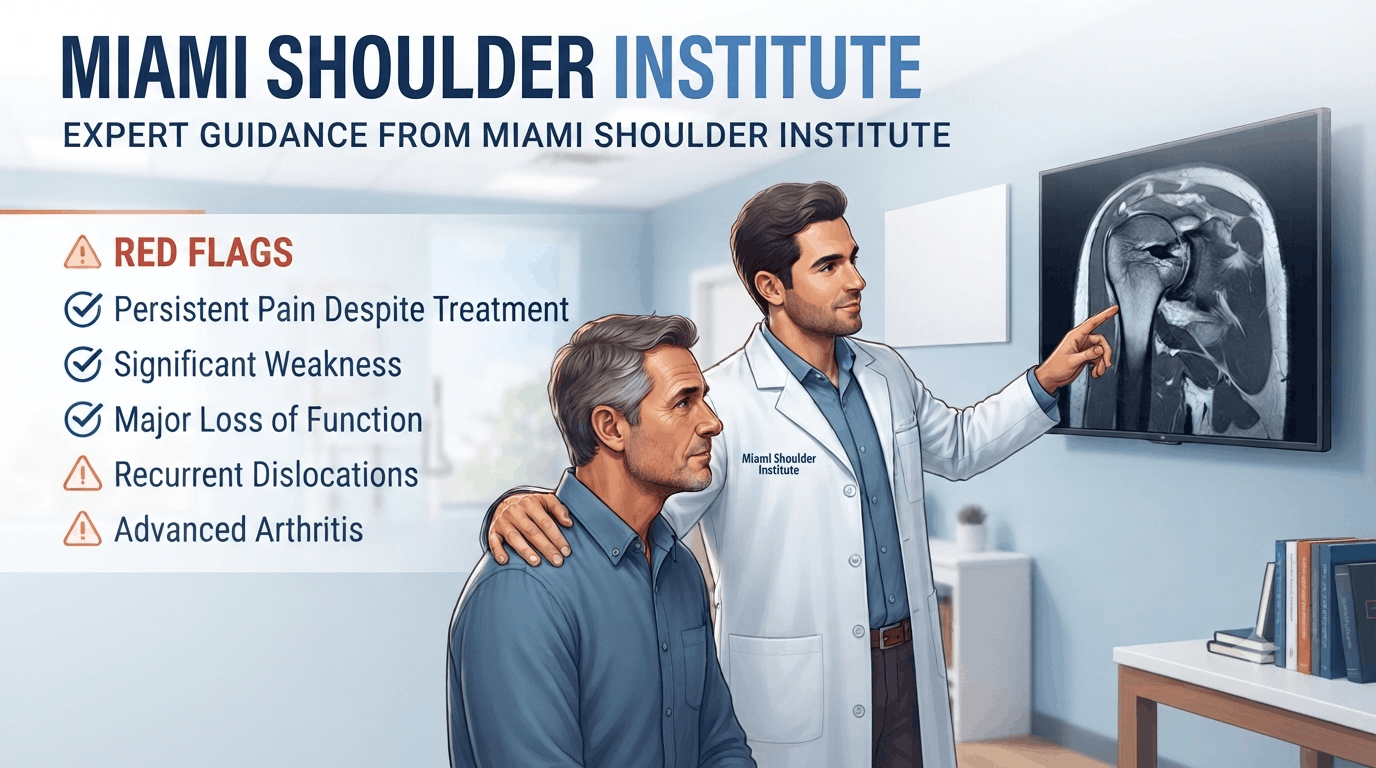
Not every painful shoulder needs an operation. Many shoulder conditions improve with physical therapy, activity modification, medication, injections, or other non-surgical treatments. However, certain symptoms can indicate that a structural problem may require surgical consideration.
The most important signs shoulder pain needs surgery can include persistent pain despite appropriate non-surgical treatment, significant weakness, major loss of shoulder function, recurrent dislocations, certain traumatic tendon tears, or advanced arthritis that substantially affects daily life.
A shoulder specialist can determine whether shoulder surgery is appropriate by considering your symptoms, physical examination, imaging, injury history, activity level, and response to previous treatment.
Surgery may include rotator cuff surgery, shoulder tear surgery, stabilization procedures, or shoulder replacement surgery, depending on the underlying condition. Importantly, having one of these symptoms does not automatically mean surgery is required. It means a detailed evaluation may be appropriate to determine when shoulder surgery is necessary.
At Miami Shoulder Institute, treatment decisions are based on the underlying diagnosis and the individual patient’s symptoms, function, and goals.
Shoulder pain can come from many different conditions, including tendon injuries, arthritis, instability, frozen shoulder, labral injuries, fractures, and inflammation.
Most shoulder pain does not automatically require surgery.
However, surgery may become an option when a significant structural problem causes ongoing pain or loss of function and appropriate non-surgical treatment has not provided adequate improvement.
Common warning signs include:
The decision about when shoulder surgery is necessary should be made after an appropriate evaluation rather than based on pain intensity alone.
1. Your Shoulder Pain Has Not Improved With Appropriate Treatment
One of the most important factors is whether conservative treatment has worked.
Depending on the condition, non-surgical care may include:
If you have followed an appropriate treatment program and your symptoms remain significant, a surgical evaluation may be reasonable.
However, treatment duration varies significantly between conditions.
A patient with a mild shoulder strain should not be treated the same way as someone with a large traumatic tendon tear.
2. You Have Significant or Progressive Shoulder Weakness
Pain can limit strength temporarily.
But true weakness can indicate a structural problem.
You may notice that you:
Sudden weakness following an injury deserves particular attention.
For example, a person who falls and then cannot actively lift the arm may have a significant rotator cuff injury or another structural problem.
A shoulder specialist can determine whether additional imaging is appropriate.
3. A Rotator Cuff Tear Is Causing Persistent Weakness
Rotator cuff tears are among the most common reasons surgical treatment may be considered.
However, not every tear requires rotator cuff surgery.
Treatment depends on factors such as:
Some patients with rotator cuff tears can function well with non-surgical treatment.
Surgery may be considered when symptoms and functional limitations remain significant despite appropriate conservative care, particularly in selected traumatic tears or patients with substantial weakness.
4. You Suffered a Significant Shoulder Injury
A sudden injury can damage the shoulder’s tendons, ligaments, bones, or labrum.
Potential injuries include:
If severe pain or weakness develops immediately after a fall, collision, sports injury, or sudden lifting event, do not assume it is simply a strain.
Prompt evaluation can determine the extent of the injury and whether non-surgical treatment is reasonable.
5. Your Shoulder Keeps Dislocating
A single shoulder dislocation may sometimes be managed without surgery depending on the patient’s circumstances and the extent of the injury.
Repeated dislocations are different.
Recurrent instability can interfere with:
Repeated episodes can also cause additional damage to structures that stabilize the shoulder.
When instability continues despite appropriate treatment, surgical stabilization may be considered.
6. Severe Shoulder Pain Is Affecting Your Quality of Life
Severe shoulder pain is not automatically an indication for surgery.
Pain intensity alone does not determine whether an operation is appropriate.
However, severe pain becomes more concerning when it is accompanied by:
If shoulder pain is preventing you from working, exercising, sleeping, or caring for yourself, a specialist evaluation can help identify the cause.
7. You Have a Significant Shoulder Tear
A confirmed tear does not automatically mean surgery.
But certain tears may require surgical consideration depending on their severity and symptoms.
Examples include:
Shoulder tear surgery may be considered when the injury is producing substantial functional problems and is unlikely to respond adequately to non-surgical treatment alone.
8. Advanced Shoulder Arthritis Is Limiting Daily Life
Shoulder arthritis occurs when the cartilage within the joint becomes damaged or worn.
Symptoms may include:
Early or moderate arthritis can often be managed without surgery.
But when arthritis becomes advanced and pain significantly affects quality of life despite conservative treatment, shoulder replacement surgery may become an option.
The type of replacement depends on the specific condition.
9. You Have Major Loss of Shoulder Function
Pain is only one part of the decision.
Function matters too.
Ask yourself:
A significant decline in function can be a reason to seek a specialist evaluation.
The goal of treatment is not simply to reduce pain—it is also to restore useful shoulder function whenever possible.
10. Your Shoulder Problem Is Progressively Getting Worse
Progressive symptoms should not simply be ignored.
For example, if your shoulder was mildly painful six months ago but you now have:
it may be time for reassessment.
Progression does not automatically mean surgery is necessary, but it may indicate that the condition needs a more detailed evaluation.
No.
This is one of the most important points to understand.
Severe shoulder pain can occur with conditions that respond well to non-surgical treatment.
For example, inflammation or frozen shoulder can sometimes cause substantial pain without requiring an operation.
Conversely, a person with a significant structural tear may experience surprisingly little pain.
Therefore, the decision about when shoulder surgery is necessary cannot be based on pain severity alone.
The diagnosis, functional limitations, examination findings, imaging, and response to treatment all matter.
Rotator cuff surgery may be considered when a rotator cuff tear causes meaningful symptoms or functional limitations and non-surgical treatment is unlikely to provide sufficient improvement.
Factors that may influence the decision include:
Traumatic Tear
A sudden injury followed by significant weakness may require earlier evaluation.
Significant Weakness
Loss of active shoulder strength can be an important factor.
Persistent Symptoms
Pain and functional problems that continue despite appropriate conservative care may lead to surgical discussion.
Patient Goals
Treatment decisions can differ between a competitive athlete, manual worker, and relatively inactive patient.
Tear Characteristics
Imaging can provide information about tear size and other tendon characteristics.
The decision should be individualized rather than based on the MRI report alone.
Read More – Finding the Best Shoulder Surgeon in Miami: What Patients Should Look For
Shoulder tear surgery can refer to procedures used to treat different types of structural injuries.
Surgery may be discussed when:
Not every tear should be repaired surgically.
A shoulder specialist can explain the potential benefits, limitations, risks, and alternatives.
Shoulder replacement surgery is generally considered for selected patients with significant joint damage and persistent symptoms.
Common reasons may include:
Depending on the condition, options may include anatomic total shoulder replacement or reverse shoulder replacement.
The appropriate procedure depends on the condition of the joint, rotator cuff, bones, and other factors.
Both are forms of shoulder replacement surgery, but they are designed for different situations.
Total Shoulder Replacement
In an anatomic total shoulder replacement, the normal shoulder anatomy is more closely reproduced.
It may be appropriate for selected patients with advanced arthritis and a functioning rotator cuff.
Reverse Shoulder Replacement
A reverse shoulder replacement changes the mechanics of the joint.
It may be considered for certain patients with:
The decision depends on the individual’s anatomy and diagnosis.
A shoulder specialist does more than identify where the pain is located.
The evaluation may assess:
The specialist may also consider whether your symptoms are actually originating from another area, such as the neck.
There is no single test that decides whether you need surgery.
Your evaluation may include:
X-Ray
Useful for assessing:
MRI
May provide information about:
CT Scan
Can provide detailed information about bone anatomy, particularly in certain complex conditions.
Ultrasound
Can help assess some tendon problems dynamically.
Testing should be selected based on the clinical question.
Failure to improve with physical therapy does not automatically mean surgery is the next step.
Instead, the diagnosis may need to be reassessed.
Possible explanations include:
If symptoms remain significant after an appropriate rehabilitation program, discussing your options with a shoulder specialist may be appropriate.
Certain symptoms following an injury warrant prompt evaluation.
These include:
These symptoms do not necessarily mean you need surgery, but they may indicate an injury requiring timely assessment.
Read More – Shoulder Surgery in Miami: Cost, Insurance, and What to Expect
The decision is usually based on several factors rather than one symptom.
A specialist may consider:
1. Diagnosis
What exactly is causing the symptoms?
2. Severity
How extensive is the structural problem?
3. Symptoms
How much pain or discomfort are you experiencing?
4. Function
What can and cannot you do?
5. Previous Treatment
What non-surgical treatments have already been tried?
6. Imaging
What does the imaging show?
7. Patient Goals
What level of function do you want to achieve?
8. Overall Health
Can you safely undergo the proposed procedure?
This comprehensive approach helps determine when shoulder surgery is necessary.
If surgery is being discussed, consider asking:
A good consultation should give you a clear understanding of your options.
Not always.
The ideal timing depends on the condition.
Some injuries may benefit from timely intervention, particularly certain traumatic tears or fractures.
Other conditions can be treated conservatively for an extended period before surgery is considered.
Therefore, there is no universal rule that earlier surgery is always better.
The appropriate timing should be determined by the diagnosis and individual circumstances.
Miami Shoulder Institute provides specialized evaluation and treatment for a wide range of shoulder conditions.
If you are experiencing persistent pain, weakness, a suspected tear, instability, or advanced arthritis, an evaluation can help clarify whether surgery is actually appropriate.
The goal is not simply to recommend an operation. The goal is to determine the underlying condition and identify the treatment approach most appropriate for your situation.
Whether the recommended approach is physical therapy, activity modification, medication, injection, monitoring, rotator cuff surgery, shoulder tear surgery, or shoulder replacement surgery, the decision should be based on an individualized assessment.
1. What are the signs shoulder pain needs surgery?
The signs shoulder pain needs surgery may include persistent symptoms despite appropriate treatment, significant weakness, major loss of function, certain traumatic tears, recurrent instability, or advanced arthritis. These signs do not automatically mean surgery is required.
2. Does severe shoulder pain mean I need surgery?
No. Severe shoulder pain can occur with both surgical and non-surgical conditions. The underlying diagnosis and functional impact are more important than pain intensity alone.
3. When is shoulder surgery necessary?
When shoulder surgery is necessary depends on the diagnosis, severity of structural damage, symptoms, functional limitations, previous treatment, imaging, and individual goals.
4. Does every rotator cuff tear require surgery?
No. Some rotator cuff tears can be managed effectively without surgery. Rotator cuff surgery may be considered for selected patients with persistent symptoms, significant weakness, traumatic injuries, or other appropriate indications.
5. When is shoulder tear surgery recommended?
Shoulder tear surgery may be considered when a significant tear causes persistent pain, weakness, or functional limitations, particularly when appropriate non-surgical treatment has not provided adequate improvement.
6. When is shoulder replacement surgery necessary?
Shoulder replacement surgery may be considered for selected patients with advanced joint damage, severe arthritis, or certain complex shoulder conditions when symptoms significantly affect quality of life.
7. Should I see a shoulder specialist before deciding on surgery?
Yes. A shoulder specialist can evaluate the diagnosis, review imaging, discuss non-surgical alternatives, and explain whether surgery is appropriate.
8. Can physical therapy prevent shoulder surgery?
In some cases, yes. Physical therapy can successfully manage many shoulder conditions. However, it cannot repair every structural injury, so the effectiveness depends on the underlying diagnosis.
9. Can I wait if my shoulder pain is getting worse?
Progressively worsening symptoms should be evaluated. Waiting may be reasonable for some conditions but inappropriate for others, particularly when increasing weakness or significant functional loss develops.
10. Does needing a surgical consultation mean I will have surgery?
No. A surgical consultation is an opportunity to understand your options. Surgery may be recommended, but continued non-surgical treatment may also be appropriate.
Also Read More – 8 Possible Reasons Your Shoulder Pops or Cracks During Workouts