
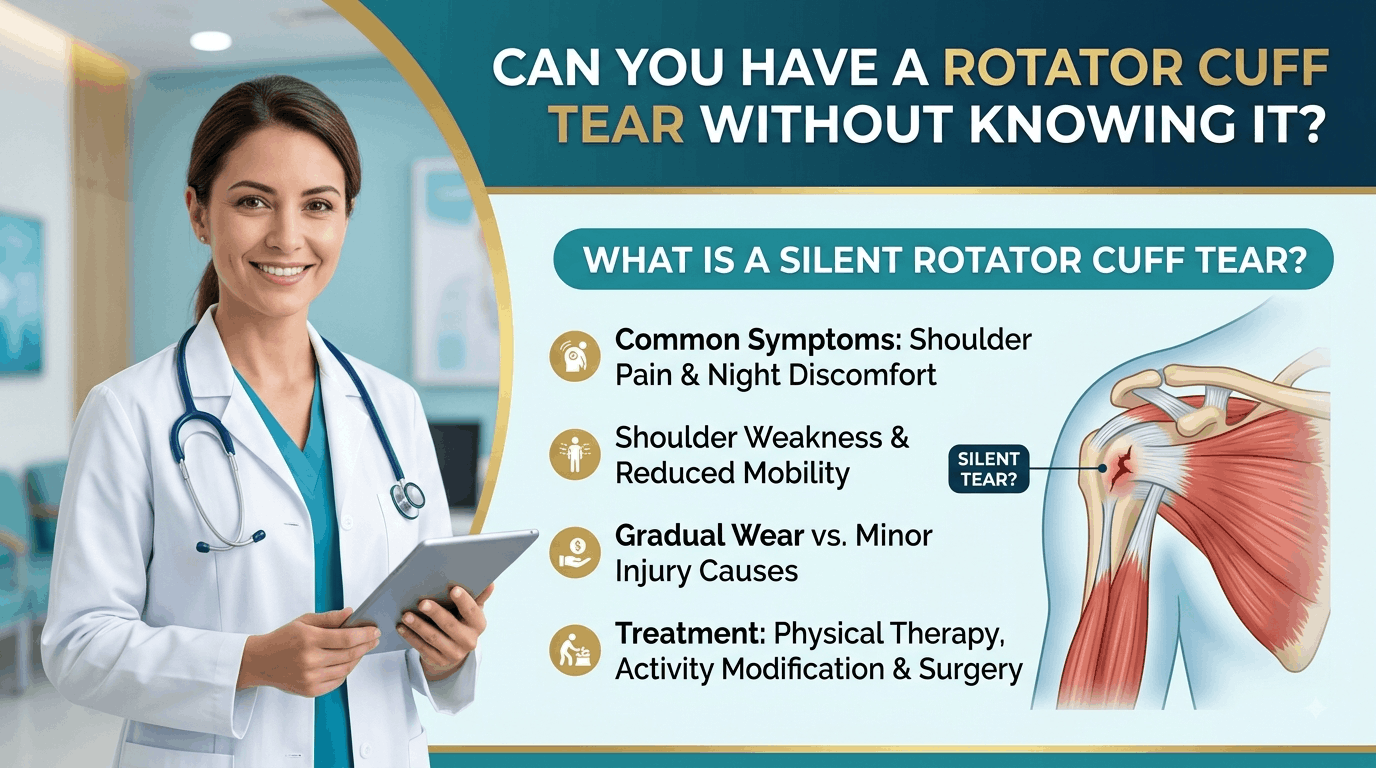
Yes. You can have a rotator cuff tear without realizing it. Some people have a small or degenerative tear with few or no noticeable symptoms, while others develop significant pain and weakness after a relatively minor injury. A silent rotator cuff tear may be discovered incidentally during imaging performed for another shoulder problem.
The absence of severe pain does not necessarily mean that the rotator cuff is healthy. Common rotator cuff tear symptoms include shoulder pain, night discomfort, difficulty lifting the arm, reduced strength, and pain during overhead activities. However, symptoms vary considerably between patients. The American Academy of Orthopaedic Surgeons notes that some people may have little or no pain with a rotator cuff tear, and that clinical examination combined with imaging such as MRI or ultrasound can improve diagnostic accuracy.
At Miami Shoulder Institute, the goal of evaluation is to determine whether a tear is actually responsible for your symptoms and whether treatment is necessary.
A rotator cuff tear can occur gradually from tendon wear or suddenly from an injury. Some tears cause obvious symptoms, while others remain unnoticed for months or years. This is particularly true of smaller or degenerative tears.
A silent rotator cuff tear may not cause significant pain initially. Instead, the first noticeable sign may be shoulder weakness, difficulty reaching overhead, reduced sports performance, or pain that develops later.
A partial rotator cuff tear may also produce subtle symptoms that are easy to attribute to aging, overuse, or a minor strain. In contrast, a larger or traumatic tear may cause sudden pain and significant loss of strength.
Diagnosing a rotator cuff injury typically involves a medical history and physical examination. Depending on the findings, imaging such as a shoulder MRI or ultrasound may be used to identify the location and extent of the tear. AAOS guidance supports MRI, MRA, and ultrasound as useful additions to clinical examination for identifying rotator cuff tears.
Not every tear requires surgery. Treatment depends on the tear’s characteristics, symptoms, activity level, overall health, and response to conservative care.
The rotator cuff is a group of four muscles and their tendons surrounding the shoulder joint.
The four muscles are:
Their tendons attach the muscles to the upper arm bone and help stabilize the shoulder while allowing you to lift and rotate your arm.
The rotator cuff is involved in many everyday movements, including:
Because these tendons are used frequently, they can become irritated, weakened, or torn.
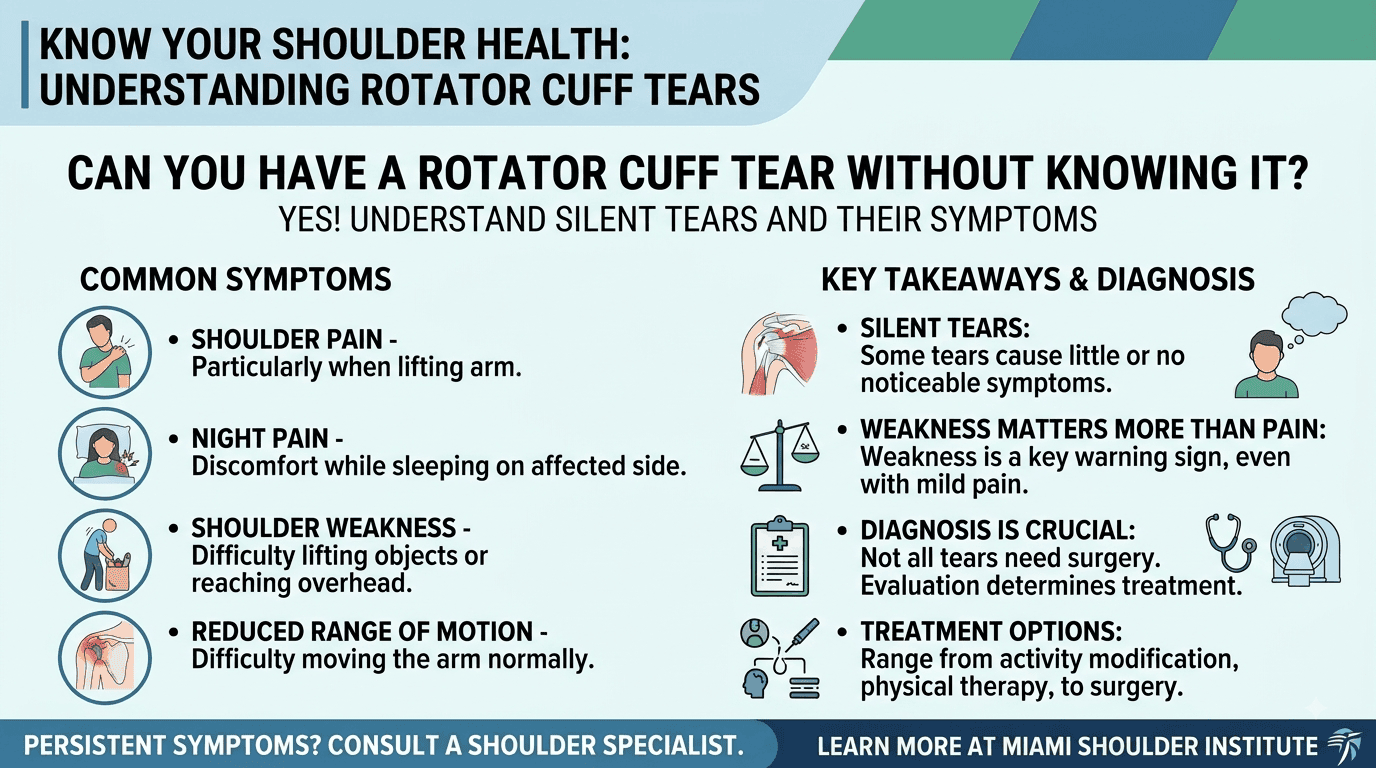
There are two main ways a tear can develop: gradual degeneration and acute injury.
Many rotator cuff tears develop slowly as the tendon changes with age.
Over time, repetitive use and natural degeneration can weaken the tendon. A person may develop a tear without experiencing one specific traumatic event.
AAOS identifies age-related wear as a major contributor to rotator cuff tears and notes that some people may have little or no pain despite having a tear.
Sometimes the tear existed before a person noticed symptoms.
A relatively minor event, such as:
may suddenly make the shoulder painful.
The event may not necessarily be the original cause of the tear. Instead, it may bring attention to a tendon that was already weakened.
Also Read More – Most Common Sports Shoulder Injuries and Their Treatments
A silent rotator cuff tear is a tear that causes little or no noticeable symptoms.
A person may continue:
without realizing that the tendon is damaged.
Some silent tears are discovered incidentally during an MRI or other imaging performed for another reason.
This is one reason imaging findings should always be interpreted alongside symptoms and physical examination. Finding a tear on an MRI does not automatically mean that the tear is the cause of every shoulder symptom or that surgery is necessary.
Not everyone experiences the same symptoms.
The most common rotator cuff tear symptoms include:
1. Shoulder Pain
Pain may occur at the front or side of the shoulder and may become worse when raising the arm.
2. Night Pain
Some people notice pain while sleeping, particularly when lying on the affected side.
Night discomfort can be an important clue when evaluating a rotator cuff injury.
3. Shoulder Weakness
Shoulder weakness is one of the most important symptoms to watch for.
You may notice difficulty:
4. Pain During Overhead Activities
Activities such as:
may aggravate symptoms.
5. Reduced Range of Motion
Pain and weakness may make normal shoulder movement more difficult.
6. Clicking or Popping
Some patients experience clicking, catching, or popping sensations.
These symptoms can also occur with other shoulder conditions, so they should not be used alone to diagnose a tear.
The most important torn rotator cuff signs include:
If these symptoms continue or worsen, a professional evaluation can help determine the cause.
Yes.
A partial rotator cuff tear means the tendon is damaged but not completely separated through its full thickness.
Symptoms may be relatively mild, particularly if the tear developed gradually.
Some patients may experience:
Others may have very few symptoms.
The severity of symptoms does not always correspond directly to the size of a tear.
It can.
Some people have full-thickness tears with surprisingly mild symptoms.
This is one reason that pain alone cannot determine whether a rotator cuff injury exists.
AAOS patient guidance specifically notes that some people may have little or no pain despite having a rotator cuff tear.
However, a painless tear may still affect strength or shoulder mechanics, so persistent weakness deserves evaluation.
Also Read More – How to Sleep Comfortably After Shoulder Surgery
Pain is subjective and can vary considerably between people.
Shoulder weakness, on the other hand, may provide important information about how well the rotator cuff is functioning.
For example, someone might say:
“My shoulder doesn’t hurt much, but I can’t lift my arm like I used to.”
That change in function may warrant evaluation for a rotator cuff injury, nerve problem, or another structural condition.
A physical examination can help distinguish pain-related weakness from true weakness caused by a tendon or neurological problem.
A rotator cuff injury can occur because of either acute trauma or gradual wear.
Traumatic Causes
Examples include:
Degenerative Causes
The tendon can gradually weaken due to:
AAOS describes both injury and wear as major causes of rotator cuff tears.
A proper shoulder pain diagnosis involves more than an imaging scan.
The evaluation generally combines:
This approach helps determine whether the rotator cuff is actually responsible for the symptoms.
Medical History
During an evaluation, your specialist may ask:
These details can help distinguish a rotator cuff problem from other shoulder conditions.
Physical Examination
Your shoulder may be evaluated for:
Specific tests can place controlled stress on different rotator cuff tendons.
AAOS states that clinical examination can help diagnose or stratify patients with rotator cuff tears and that using multiple tests can improve diagnostic accuracy.
No.
A shoulder MRI is not automatically required for every patient with shoulder pain.
Your specialist may first determine whether the symptoms and examination suggest a rotator cuff problem.
MRI may be useful when:
MRI can show the location and extent of a tear and may also identify associated injuries.
A shoulder MRI can provide detailed information about:
This information can help guide treatment decisions.
However, an MRI should not be interpreted in isolation.
A person can have a rotator cuff tear on imaging without having symptoms caused by that tear.
No.
This is one of the most important points for patients to understand.
The presence of a tear does not automatically mean that surgery is required.
Treatment decisions depend on factors such as:
AAOS guidance indicates that not all rotator cuff tears require immediate surgery.
Treatment can range from observation and rehabilitation to surgical repair.
Activity Modification
Reducing movements that repeatedly aggravate the shoulder may allow symptoms to settle.
Physical Therapy
A structured program may focus on:
Physical therapy can improve symptoms and function in appropriate patients.
AAOS guidance supports physical therapy as a treatment option for symptomatic rotator cuff tears.
Medication
Appropriate pain-relieving or anti-inflammatory medication may be used when suitable for the individual patient.
Injections
In selected cases, injections may provide short-term relief that helps a patient participate in rehabilitation.
The decision should be individualized.
Surgery
Surgical repair may be considered when symptoms remain significant, especially when there is substantial weakness, a traumatic tear, or a tear that is unlikely to respond adequately to conservative care.
The 2025 AAOS guideline emphasizes individualized management based on the patient’s condition and clinical circumstances.
Yes.
A tear that previously caused little or no discomfort can become painful after:
However, the appearance of pain does not necessarily mean that the tear has suddenly become much larger.
A clinical evaluation is needed to determine what changed.
Ignoring persistent symptoms can allow an underlying problem to continue without appropriate management.
Depending on the tear, potential concerns include:
AAOS notes that tear size, muscle atrophy, and fatty infiltration may progress over years with non-operative treatment in some patients.
That does not mean every tear will worsen or that every patient needs surgery. It means that a known tear with persistent or changing symptoms should be monitored appropriately.
Read More – SLAP Tear vs Labral Tear: When Should You Consider Surgery?
Consider evaluation by a shoulder specialist if you experience:
Prompt evaluation is particularly important after a significant traumatic injury accompanied by sudden weakness or loss of movement.
Miami Shoulder Institute focuses on the diagnosis and treatment of shoulder conditions, including rotator cuff injuries, tendon tears, shoulder instability, arthritis, labral problems, fractures, and sports-related injuries.
If you have possible rotator cuff tear symptoms, the goal is to determine whether a tear is actually causing your symptoms and understand its severity. Evaluation may include a physical examination and, when appropriate, imaging such as a shoulder MRI.
Treatment is individualized. Depending on the diagnosis, options may include activity modification, physical therapy, rehabilitation, or surgery.
The goal is not to treat an MRI image alone. It is to understand the patient, the injury, and the functional impact of the condition before recommending treatment.
1. Can you tear your rotator cuff without knowing it?
Yes. Some tears cause little or no noticeable symptoms and may only be discovered during imaging performed for another reason.
2. What is a silent rotator cuff tear?
A silent rotator cuff tear is a tear that causes few or no noticeable symptoms. It may be discovered incidentally during an imaging examination.
3. What are the most common rotator cuff tear symptoms?
Common rotator cuff tear symptoms include shoulder pain, night pain, weakness, difficulty lifting the arm, reduced range of motion, and difficulty with overhead activities.
4. Can a partial rotator cuff tear heal without surgery?
Some patients with a partial rotator cuff tear experience significant improvement with physical therapy, activity modification, and other non-surgical treatments. The appropriate approach depends on the tear and symptoms.
5. Is shoulder weakness a sign of a rotator cuff tear?
Yes. Shoulder weakness can be an important sign, particularly when it develops after an injury or makes lifting the arm difficult. However, weakness can have other causes, so professional evaluation is important.
6. Do I need a shoulder MRI to diagnose a rotator cuff tear?
Not necessarily. Diagnosis generally starts with a medical history and physical examination. A shoulder MRI or ultrasound may be used when additional information is needed.
7. Can a rotator cuff tear be painless?
Yes. Some people have rotator cuff tears with little or no pain. A lack of pain does not necessarily mean the tendon is completely healthy.
8. What are the torn rotator cuff signs I should watch for?
Important torn rotator cuff signs include persistent pain, night discomfort, weakness, difficulty lifting the arm, and reduced ability to perform overhead activities.
9. When should I see a shoulder specialist?
See a shoulder specialist when pain or weakness persists, symptoms follow an injury, shoulder function decreases, or conservative measures fail to provide adequate improvement.
Read More – 8 Possible Reasons Your Shoulder Pops or Cracks During Workouts