

 EN EN
EN EN
Having one shoulder higher than the other is relatively common and does not always mean there is a serious problem. Uneven shoulders causes can include differences in posture, muscle tightness or weakness, spinal alignment, previous injuries, shoulder instability, leg-length differences, or structural differences in the bones and joints.
The appearance of uneven shoulders is often related to shoulder asymmetry, which may be more noticeable when standing, sitting, exercising or looking at photographs. In some people, the difference is mainly postural and may change when they adjust their position. In others, persistent asymmetry can be associated with an underlying musculoskeletal condition.
Shoulder posture can influence how the shoulders sit relative to each other. Spending long periods sitting at a desk, frequently using one side of the body, carrying a bag on one shoulder, or adopting a forward-head and rounded-shoulder position can contribute to visible differences.
However, a higher shoulder can sometimes be associated with shoulder instability, muscle imbalance, nerve-related problems or changes following an injury. Pain, weakness, limited movement, repeated dislocation or a noticeable change after trauma are reasons to seek an evaluation from a shoulder specialist.
The most appropriate treatment depends on the underlying cause. Some people may benefit from posture changes and targeted exercises, while others may need physical therapy, imaging or treatment for an underlying shoulder or spinal condition.
If one shoulder appears higher than the other, it means that the position of the two shoulders is not completely symmetrical.
Perfect body symmetry is uncommon. Differences can exist in the shoulders, hips, arms, legs and other parts of the body without causing any symptoms.
The shoulders also do not function independently. Their position is influenced by the:
Because these structures work together, a change in one area can affect how the shoulders appear.
For example, a person with tight muscles on one side may hold that shoulder differently. Someone with a previous shoulder injury may unconsciously protect the painful side. Spinal curvature can also alter the apparent height of the shoulders.
Therefore, the appearance of uneven shoulders alone cannot identify the underlying cause.
Read More – Shoulder Surgery in Miami: Cost, Insurance, and What to Expect
If one shoulder appears higher than the other, it means that the position of the two shoulders is not completely symmetrical.
Perfect body symmetry is uncommon. Differences can exist in the shoulders, hips, arms, legs and other parts of the body without causing any symptoms.
The shoulders also do not function independently. Their position is influenced by the:
Because these structures work together, a change in one area can affect how the shoulders appear.
For example, a person with tight muscles on one side may hold that shoulder differently. Someone with a previous shoulder injury may unconsciously protect the painful side. Spinal curvature can also alter the apparent height of the shoulders.
Therefore, the appearance of uneven shoulders alone cannot identify the underlying cause.
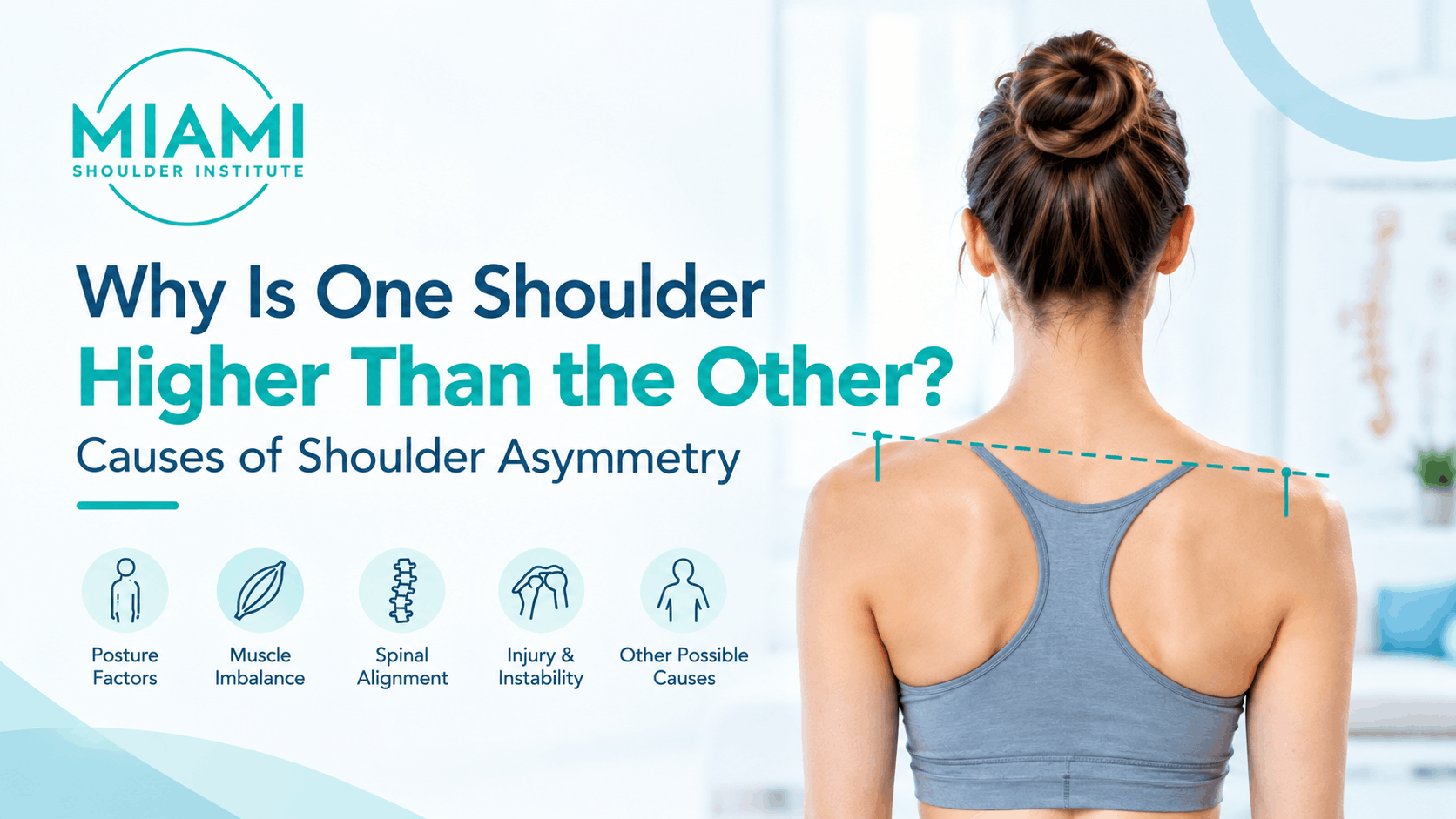
There are several possible explanations for shoulder asymmetry. Some are related to everyday posture, while others may require medical evaluation.
One of the most common reasons for visible shoulder differences is posture.
When sitting or standing, people may naturally favour one side of the body. A prolonged forward-head position or rounded upper back can alter the resting position of the shoulder blades.
For example, spending many hours at a computer may encourage:
These changes can make one shoulder appear higher or more forward than the other.
Improving shoulder posture may help when the asymmetry is primarily positional.
However, posture should not automatically be blamed for every case of uneven shoulders.
Also Read More – 8 Possible Reasons Your Shoulder Pops or Cracks During Workouts
The muscles around the shoulder blade and upper back play an important role in maintaining shoulder position.
Differences in strength, flexibility or muscle activation between the two sides can influence shoulder alignment.
Muscle imbalance may develop from:
For example, someone who repeatedly uses one arm for work or sports may develop different muscular demands on each side.
Targeted rehabilitation can sometimes improve movement patterns when muscle imbalance is contributing to asymmetry.
Regularly carrying a heavy backpack, handbag or work bag on one side can temporarily change shoulder position.
The body may compensate by elevating or depressing one shoulder.
This does not necessarily mean the shoulder has been permanently damaged.
Switching sides, reducing unnecessary load and using appropriate carrying techniques may help reduce repetitive strain.
A previous shoulder injury can affect how the shoulder moves.
After an injury, a person may unconsciously change how they use the affected arm to avoid discomfort.
Over time, this can influence:
A history of fracture, dislocation, rotator cuff injury or other shoulder trauma can therefore be relevant when evaluating shoulder asymmetry.
If the difference appeared after an injury and has persisted, an evaluation may help determine whether there is an underlying structural or functional problem.
Shoulder instability occurs when the shoulder does not maintain normal stability during movement.
The shoulder joint has a large range of motion, which depends on coordinated muscles, tendons, ligaments and other stabilising structures.
People with instability may experience:
Instability can affect how a person positions the shoulder during movement.
If one shoulder repeatedly feels as though it is giving way or has dislocated in the past, asymmetry should not simply be attributed to poor posture.
A shoulder specialist can assess whether instability or another shoulder condition is contributing to the difference.
The spine and shoulders are closely connected.
A curvature or rotation of the spine can change the position of the shoulders and shoulder blades.
Scoliosis, for example, can produce visible differences in shoulder height or the position of the shoulder blades.
Not every difference in shoulder height means someone has scoliosis.
However, if shoulder asymmetry is accompanied by:
a broader musculoskeletal evaluation may be appropriate.
The shoulder blade, or scapula, needs to move smoothly across the rib cage.
Changes in scapular movement can alter how the shoulders appear.
Scapular movement can be affected by:
A noticeable difference in the way the shoulder blades move during arm elevation can provide useful information during a physical examination.
Certain nerves control muscles responsible for positioning and moving the shoulder blade.
Injury or dysfunction affecting these nerves can cause weakness of specific muscles and alter the resting or moving position of the shoulder blade.
A person may notice:
Nerve-related causes are less common than simple postural differences but are important to recognise when weakness or abnormal movement is present.
The body operates as a connected kinetic chain.
Differences in lower-limb alignment can influence pelvic position, spinal posture and, in some individuals, the apparent height of the shoulders.
This is one reason why evaluating only the shoulder may not always explain the entire pattern of asymmetry.
A clinician may consider the position of the spine, pelvis and lower limbs when determining the potential source of a visible difference.
Not every uneven shoulder is caused by an injury or medical condition.
Human bodies naturally have small differences between the left and right sides.
Differences in:
can all contribute to mild asymmetry.
If the difference has always been present and is not associated with pain, weakness or functional limitations, it may simply represent normal anatomical variation.
The appearance of asymmetry is less important than whether it is associated with symptoms or functional changes.
A small difference may not require treatment.
However, evaluation becomes more important if the asymmetry is:
A sudden change after trauma deserves particular attention.
Poor posture can contribute to changes in shoulder position, particularly when the asymmetry is flexible and changes when a person adjusts their posture.
For example, someone who consistently leans to one side may develop a habitual resting position that makes one shoulder appear higher.
However, persistent asymmetry should not automatically be considered a posture problem.
If correcting posture does not change the appearance or if pain and weakness are present, another underlying cause may need to be investigated.
A shoulder specialist can begin with a detailed history and physical examination.
The evaluation may include observing the shoulders while the patient:
The clinician may compare:
The spine and neck may also be assessed when appropriate.
Read More – Finding the Best Shoulder Surgeon in Miami: What Patients Should Look For
Not everyone with uneven shoulders needs imaging.
Imaging is generally considered when the medical history and examination suggest an underlying structural problem.
X-Ray
X-rays may help evaluate:
MRI
MRI provides detailed information about soft tissues and may be considered when there is concern about:
The appropriate test depends on the suspected cause.
Treatment should target the underlying cause rather than simply attempting to make the shoulders look level.
Posture Correction
If posture contributes to the problem, treatment may include:
The goal is to develop a comfortable and sustainable position rather than forcing the shoulders into a perfectly symmetrical posture.
Physical Therapy
Physical therapy may be recommended when muscle weakness, stiffness or movement dysfunction contributes to asymmetry.
A programme may focus on:
Exercises should be selected according to the underlying problem.
Treating Shoulder Instability
When shoulder instability is contributing to asymmetry, treatment may initially involve rehabilitation designed to improve strength and dynamic stability.
Some patients with recurrent instability or structural damage may require surgical evaluation.
The appropriate treatment depends on the frequency of instability, underlying anatomy, associated injuries and individual activity requirements.
Treating an Underlying Injury
If asymmetry developed after a fracture, dislocation, tendon injury or other trauma, treatment should address that injury.
This may include rehabilitation, immobilisation, medication or surgery when clinically appropriate.
Exercises can help when the underlying cause involves muscle weakness, poor movement control or certain postural problems.
However, there is no universal exercise that can correct every case of uneven shoulders.
The correct exercise programme depends on why the shoulders are asymmetrical.
For example, exercises designed to improve scapular control may be useful for one person but inappropriate for someone with an acute injury or significant instability.
A professional assessment can help determine which exercises are appropriate.
You should consider seeing a shoulder specialist if one shoulder has become noticeably higher and you also have:
You should seek prompt medical attention after significant trauma if there is severe pain, obvious deformity, major weakness or loss of sensation.
Also Read More – Shoulder Arthroscopy Surgeon in Miami: What Conditions Can Be Treated?
No.
Mild shoulder asymmetry can be completely normal.
The body does not need to be perfectly symmetrical to function normally.
The more important questions are:
These questions help distinguish a normal anatomical difference from a potentially significant musculoskeletal problem.
Athletes frequently develop differences between their dominant and non-dominant sides.
Sports involving repetitive overhead movement can produce differences in muscle development, flexibility and movement patterns.
Examples include:
Some degree of asymmetry may be expected.
However, a new difference accompanied by pain, weakness or declining performance may warrant assessment.
Athletes should not assume that an asymmetrical shoulder is simply the result of training.
Sleeping position can temporarily affect how the shoulders appear or feel, particularly after prolonged pressure on one side.
However, sleeping on one side is unlikely to be the sole explanation for persistent structural shoulder asymmetry.
If the shoulder remains visibly higher throughout the day or is associated with pain, weakness or restricted movement, another cause should be considered.
There is no single timeframe.
If posture or muscle imbalance contributes to the asymmetry, gradual improvement may occur with consistent rehabilitation and changes in daily movement habits.
Structural differences or underlying injuries may not change simply through posture exercises.
The timeframe therefore depends on the cause, severity, treatment and individual response.
Read More – Best Exercises After Shoulder Surgery in Miami
Why is one shoulder higher than the other?
Common uneven shoulders causes include posture, muscle imbalance, previous injury, spinal alignment differences, shoulder blade movement problems, instability and natural anatomical differences.
Is it normal to have uneven shoulders?
Yes. Mild differences between the two shoulders are common and may represent normal anatomical variation, particularly when there is no pain, weakness or loss of function.
Can bad posture cause uneven shoulders?
Poor shoulder posture can contribute to visible differences in shoulder position, particularly when the asymmetry changes with posture. Persistent asymmetry may have other causes.
Can shoulder instability cause uneven shoulders?
Yes. Shoulder instability can affect how a person positions and moves the shoulder, particularly when there have been repeated dislocations or subluxations.
Can scoliosis make one shoulder higher?
Yes. Changes in spinal alignment can affect the position and appearance of the shoulders. However, uneven shoulders alone do not establish that someone has scoliosis.
Can exercises fix shoulder asymmetry?
Exercises may help when asymmetry is related to muscle imbalance, movement control or posture. They may not correct structural differences or an underlying injury.
Should I see a shoulder specialist for uneven shoulders?
A shoulder specialist evaluation can be useful when asymmetry is new, worsening, painful or associated with weakness, instability, limited movement or previous trauma.
Do uneven shoulders mean I have a rotator cuff tear?
Not necessarily. A rotator cuff problem can affect shoulder movement and muscle function, but uneven shoulders have many possible causes.
Can a previous shoulder injury cause asymmetry?
Yes. An injury can change shoulder movement, strength or muscle activation and may contribute to persistent differences between the two sides.
When should uneven shoulders be treated?
Treatment is generally considered when asymmetry is associated with pain, weakness, instability, restricted movement, functional limitations or an identifiable underlying condition.
There are many possible uneven shoulders causes, and the appearance of one shoulder being higher than the other does not automatically mean that something is wrong.
Shoulder asymmetry may result from normal anatomical differences, posture, muscle imbalance or the way a person habitually uses their body. In other cases, it can be associated with previous trauma, spinal alignment, shoulder blade dysfunction, nerve problems or shoulder instability.
The key is to look beyond appearance. New or progressive asymmetry, particularly when accompanied by pain, weakness, limited movement or recurrent dislocation, deserves further evaluation.
A shoulder specialist can assess shoulder movement, strength, stability and surrounding structures and determine whether additional testing is necessary. Treatment may involve posture and movement changes, physical therapy, targeted strengthening or treatment of an underlying shoulder condition.
At Miami Shoulder Institute, the goal of evaluation is to identify the reason for the asymmetry and match treatment to the individual’s symptoms, physical findings and functional needs rather than treating appearance alone.
Also Read About – Top Shoulder Surgeons in Miami Offering Advanced Orthopedic Care