

 ES ES
ES ES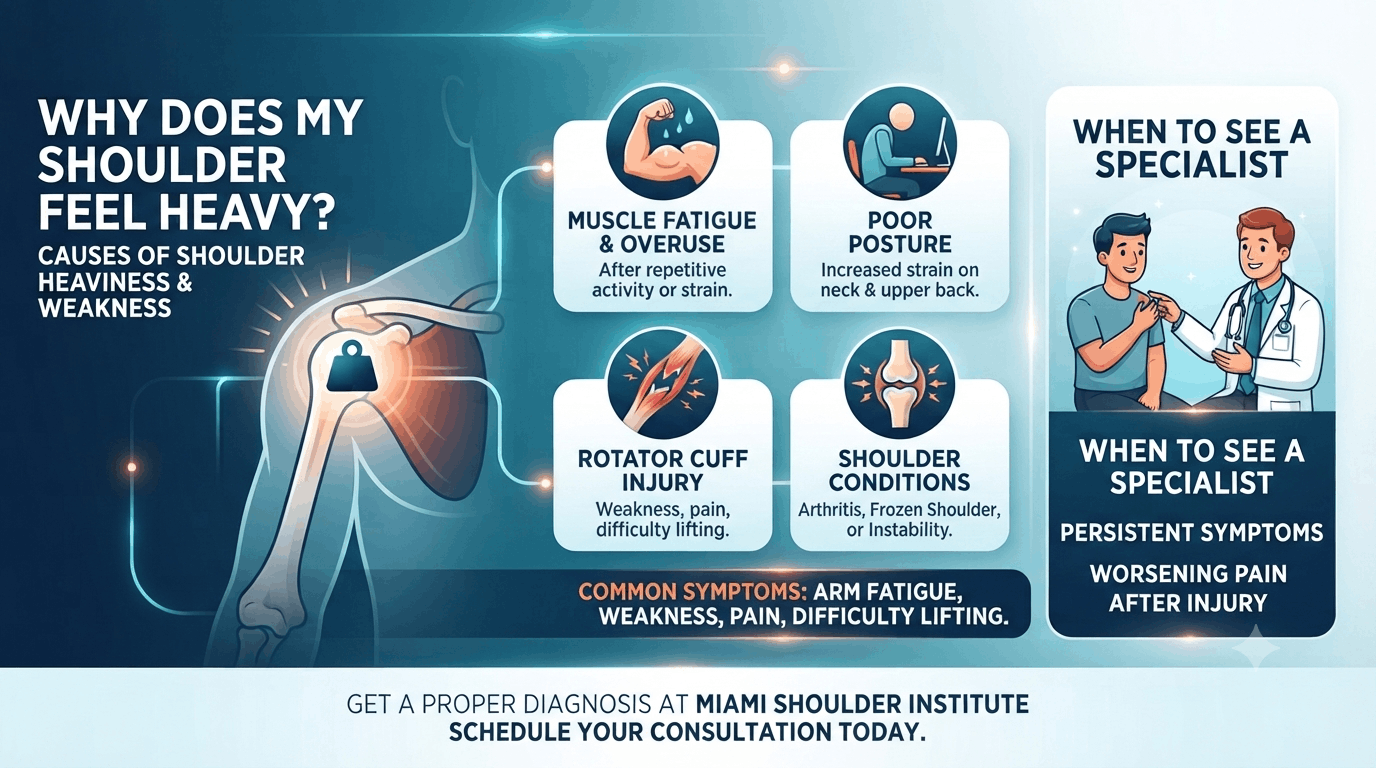
If your shoulder feels heavy, tired, weak, or difficult to move, the sensation can have several possible causes. Shoulder heaviness may occur after overuse, muscle fatigue, inflammation, poor posture, nerve irritation, or an injury involving the shoulder joint or tendons. In some cases, persistent heaviness can be associated with shoulder weakness or a rotator cuff injury.
Not every heavy-feeling shoulder indicates a serious problem. Temporary heaviness after exercise or repetitive activity may improve with rest. However, heaviness that persists, progressively worsens, or occurs with significant shoulder pain, weakness, numbness, loss of movement, or an injury deserves medical evaluation.
Understanding the pattern of symptoms is important because the sensation of heaviness can originate from different structures. A proper examination can help determine the underlying heavy shoulder causes and guide appropriate treatment.
At Miami Shoulder Institute, evaluation focuses on identifying the source of shoulder symptoms and developing a treatment plan based on the underlying condition.
A heavy shoulder can feel as though the arm is difficult to lift, unusually tired, weighed down, or harder to control than normal.
Some people describe it as:
The feeling can occur with or without pain.
This distinction matters.
If your shoulder simply feels tired after strenuous activity and improves with rest, the cause may be temporary muscle fatigue.
If your shoulder feels heavy every day or the sensation is accompanied by weakness or loss of function, an underlying shoulder condition may need to be investigated.
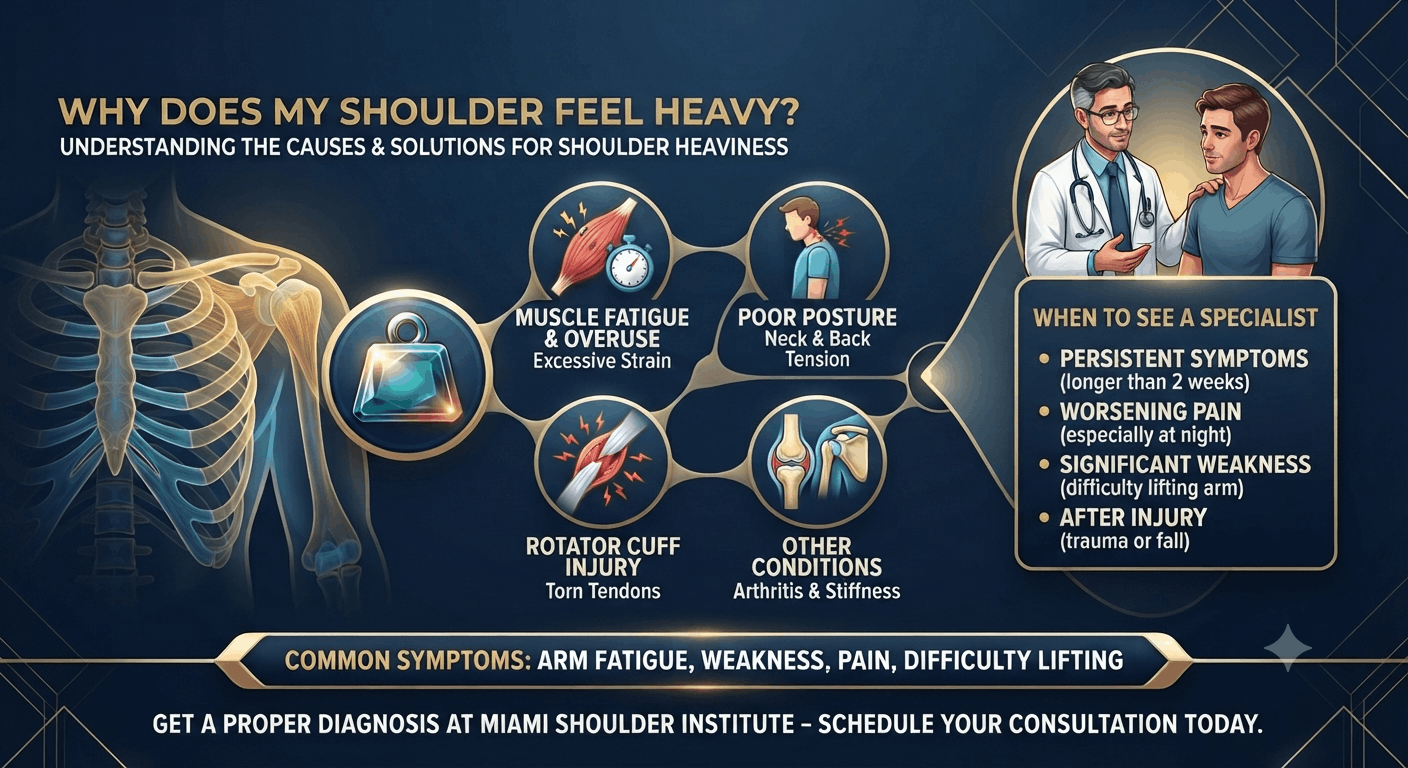
There is no single explanation for shoulder heaviness.
Possible causes include:
The symptoms and circumstances surrounding the heaviness can help narrow down the possibilities.
Also Read More – 8 Possible Reasons Your Shoulder Pops or Cracks During Workouts
One of the simplest explanations is muscle fatigue.
Your shoulder muscles work throughout the day to position and stabilize your arm. Repetitive activities can place additional demands on these muscles.
Examples include:
After excessive activity, the shoulder may feel heavy or tired.
Temporary muscle fatigue usually improves with appropriate rest and recovery.
However, repeatedly pushing through symptoms can contribute to irritation or injury.
Posture can influence how the muscles around the neck, upper back, and shoulder function.
Sitting for prolonged periods with the shoulders rounded forward may increase muscular strain and alter normal shoulder mechanics.
You may notice:
Poor posture is not necessarily the sole cause of persistent shoulder symptoms, but it can contribute to muscular fatigue and discomfort.
If changing your posture does not improve persistent symptoms, further evaluation may be appropriate.
Tendons connect muscles to bones and help transmit force during movement.
Irritation of shoulder tendons can produce pain, weakness, and fatigue.
You may notice heaviness particularly when:
The shoulder may feel progressively more tired during activity.
Depending on the tendon involved, symptoms may resemble other shoulder conditions.
A rotator cuff injury is an important potential cause of shoulder weakness and difficulty lifting the arm.
The rotator cuff consists of four muscles and their tendons that help stabilize and move the shoulder.
Injury can result from:
Symptoms can include:
A significant rotator cuff tear can cause noticeable weakness.
However, not every rotator cuff injury requires surgery.
Treatment depends on the type and severity of the injury, symptoms, activity requirements, and other factors.
Read More – Top Orthopedic Shoulder Surgeons in Miami
The rotator cuff helps keep the upper arm bone centered within the shoulder socket while the arm moves.
If one or more rotator cuff tendons are injured, the shoulder may not function as efficiently.
You may compensate by using other muscles more heavily.
This can create a sensation of:
For example, you may be able to lift your arm initially but find it increasingly difficult after several repetitions.
That pattern may be different from simply having a painful shoulder.
These symptoms can overlap, but they are not identical.
Shoulder heaviness
You may feel:
“My shoulder feels like it weighs more than usual.”
The arm may feel tired or difficult to hold in certain positions.
Shoulder weakness
You may feel:
“I am trying to lift my arm, but I cannot generate enough strength.”
True weakness can be associated with:
A physical examination can help distinguish between fatigue, pain-limited movement, and actual weakness.
Arthritis can affect the shoulder joint and gradually change how it moves.
Common symptoms include:
The shoulder may feel heavy because movement becomes more difficult and surrounding muscles may compensate for reduced joint function.
Arthritis usually develops gradually, although symptoms can sometimes worsen over time.
Frozen shoulder, or adhesive capsulitis, causes progressive stiffness of the shoulder.
People may have difficulty:
The shoulder may feel heavy because normal movement becomes increasingly restricted.
Pain is often present, particularly during the earlier stages.
Unlike simple muscle fatigue, frozen shoulder tends to persist and progressively limit mobility.
Read More – How to Sleep After Shoulder Surgery in Miami
Nerves play an important role in controlling the muscles of the shoulder and arm.
A nerve problem may cause:
Some nerve-related problems originate in the neck rather than the shoulder itself.
If shoulder heaviness occurs with numbness or tingling extending into the arm or hand, the cervical spine and nervous system may need to be considered during evaluation.
Shoulder instability occurs when the joint does not remain adequately stable during movement.
It can occur after:
Patients may describe the shoulder as:
Some people experience a sensation that the shoulder may slip or give way.
Persistent instability can affect confidence and shoulder function.
A previous injury can sometimes affect shoulder mechanics even after the initial pain improves.
For example, after an injury, you may unconsciously change how you move your shoulder.
Over time, this can contribute to:
If your shoulder remains heavy or weak after an injury, evaluation can help determine whether the original problem has fully healed.
Repeated overhead movement places significant demands on the shoulder.
This can occur in:
If recovery time is inadequate, muscles and tendons may become irritated.
You may initially notice fatigue before developing significant shoulder pain.
Ignoring these early symptoms and repeatedly loading the shoulder may allow a minor problem to become more persistent.
Read More – Shoulder Surgery in Miami: Cost, Insurance, and What to Expect
A heavy shoulder deserves more attention when the sensation:
The severity of symptoms is not always determined by how much pain you have.
Some structural injuries can produce substantial weakness without severe pain.
A painless heavy shoulder can still have several possible explanations.
Temporary fatigue after activity may not be concerning.
However, persistent heaviness without pain may sometimes be associated with weakness or nerve-related problems.
For example, if you notice that you cannot lift objects that were previously easy to handle, or your arm repeatedly gives out during activity, an evaluation may be appropriate.
True weakness should not automatically be dismissed as simple tiredness.
The combination of heaviness and shoulder pain can occur with several conditions.
Possible causes include:
The location and behavior of the pain can provide useful information.
For example, pain that consistently occurs when lifting the arm may point toward a different problem than pain associated with neck movement or numbness.
A clinical examination is usually the first step.
A specialist may evaluate:
Range of Motion
Can you raise your arm fully?
Can you move it behind your back?
Does the shoulder move normally?
Strength
Does the affected side generate the same strength as the other shoulder?
Shoulder Stability
Does the shoulder feel stable during specific movements?
Pain Pattern
Where does the pain occur?
What movements reproduce it?
Neurological Function
Are there signs of numbness, altered sensation, or nerve weakness?
This information helps determine which structures may be involved.
Imaging depends on the suspected diagnosis.
X-Ray
X-rays can evaluate:
MRI
MRI can provide detailed information about:
An MRI may be considered when a significant tendon or soft-tissue injury is suspected.
Ultrasound
Ultrasound can be useful for evaluating certain tendon conditions and can provide dynamic assessment in some situations.
Not everyone with a heavy shoulder needs imaging.
The appropriate test depends on the clinical findings.
Often, yes.
Treatment depends on the underlying cause.
Possible non-surgical approaches include:
For some tendon, inflammatory, or mild structural problems, conservative treatment may be sufficient.
However, certain injuries may require surgical consideration.
The goal is to treat the cause rather than the sensation of heaviness itself.
Read More – Can Shoulder Pain Become Permanent If Left Untreated?
Surgery is not automatically required because a shoulder feels heavy.
It may be considered when there is a significant structural problem that is causing persistent symptoms or functional limitations and appropriate non-surgical treatment has not provided sufficient improvement.
Depending on the diagnosis, surgical treatment may be considered for conditions such as:
The decision should be individualized after an appropriate evaluation.
If your shoulder feels heavy after unusual activity and symptoms are mild, temporarily reducing aggravating activity and allowing adequate recovery may help.
However, avoid repeatedly testing the shoulder with heavy lifting to “see if it is better.”
If symptoms persist, keep track of:
This information can be helpful during an evaluation.
Consider seeing a shoulder specialist if your shoulder feels heavy and:
Prompt evaluation is particularly important after significant trauma or when weakness develops suddenly.
At Miami Shoulder Institute, evaluation focuses on identifying the specific reason behind shoulder symptoms rather than treating heaviness as a diagnosis itself.
If your shoulder feels heavy, the cause could be temporary fatigue, overuse, inflammation, weakness, a rotator cuff injury, arthritis, instability, or another condition.
A detailed evaluation can help distinguish between these possibilities.
Understanding whether the primary problem is pain, weakness, stiffness, tendon dysfunction, joint disease, or another source is important for choosing the appropriate treatment.
Depending on the diagnosis, treatment may involve conservative care, rehabilitation, medication, imaging, or surgical options when appropriate.
1. Why does my shoulder feel heavy?
A heavy shoulder can result from muscle fatigue, overuse, inflammation, poor posture, tendon problems, rotator cuff injury, arthritis, frozen shoulder, instability, or nerve-related problems.
2. Is a heavy shoulder a sign of a rotator cuff injury?
It can be. A rotator cuff injury may cause weakness, fatigue, pain, and difficulty lifting the arm. However, heaviness alone cannot confirm a rotator cuff problem.
3. Can shoulder weakness make the arm feel heavy?
Yes. Reduced muscle strength can make the arm feel difficult to lift or hold, creating a sensation of heaviness.
4. Why does my shoulder feel heavy but not painful?
Temporary muscle fatigue can cause painless heaviness. Persistent heaviness without pain may also be associated with weakness or nerve-related problems and should be evaluated if it does not improve.
5. Can poor posture cause a heavy shoulder?
Poor posture can contribute to muscle fatigue and tension around the neck, upper back, and shoulders. Persistent symptoms may have another underlying cause and should not automatically be attributed to posture.
6. When should I worry about a heavy shoulder?
Seek evaluation if heaviness persists, worsens, follows an injury, or occurs with significant weakness, pain, numbness, tingling, or loss of movement.
7. Can arthritis make the shoulder feel heavy?
Yes. Arthritis can cause pain, stiffness, reduced movement, and weakness that may make the shoulder feel heavy or difficult to use.
8. Can a nerve problem cause shoulder heaviness?
Yes. Nerve irritation or dysfunction can produce weakness, heaviness, tingling, numbness, or changes in muscle control.
9. Do I need an MRI for a heavy shoulder?
Not necessarily. Imaging depends on your symptoms and examination. An X-ray, MRI, ultrasound, or no imaging may be appropriate depending on the suspected cause.
10. When should I see a shoulder specialist?
Consider seeing a shoulder specialist if the heaviness persists, affects your normal activities, is associated with weakness or pain, or began following an injury.
Also Read More – Shoulder MRI vs X-Ray: Which Test Do You Need?
Most Common Sports Shoulder Injuries and Their Treatments