

 EN EN
EN EN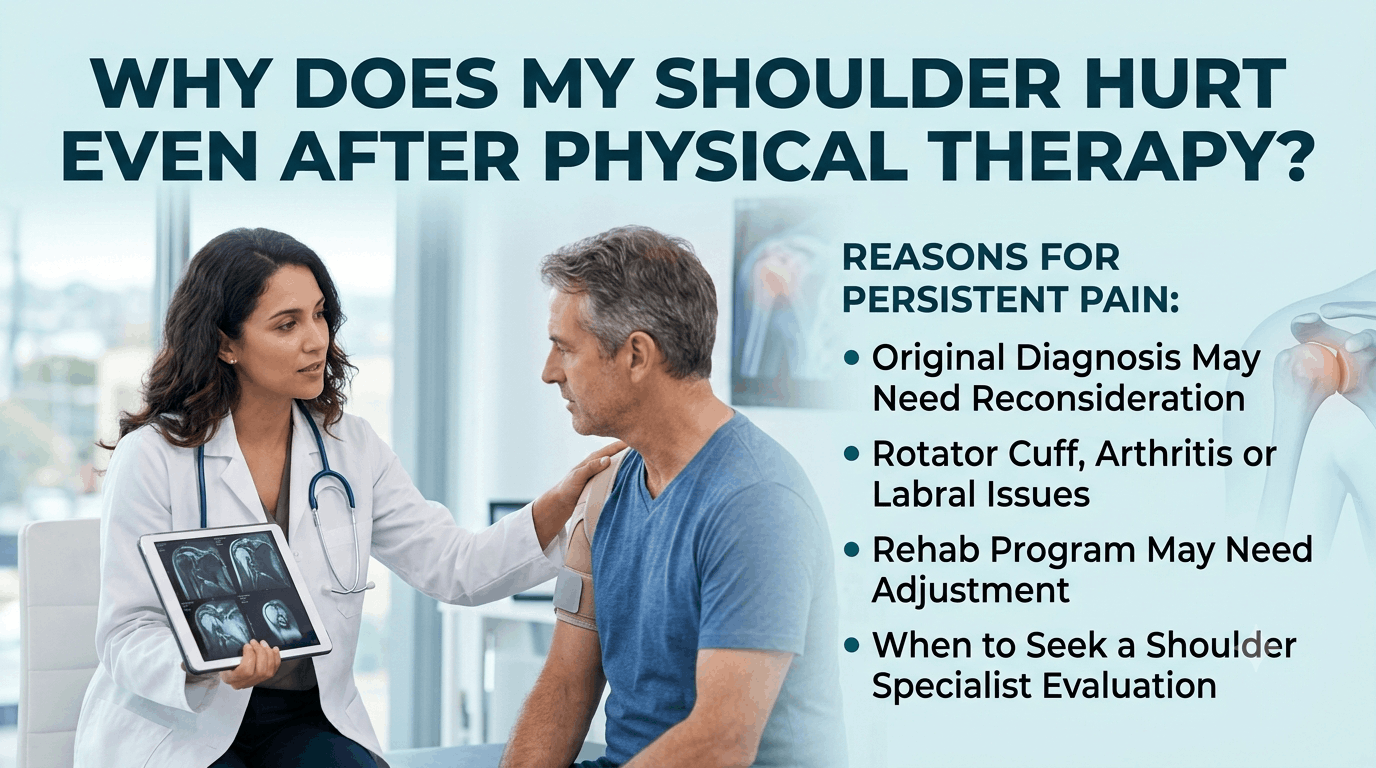
If you still have shoulder pain after physical therapy, it does not necessarily mean physical therapy failed or that you automatically need surgery. Persistent symptoms may mean the underlying diagnosis needs to be reconsidered, the shoulder has not fully healed, the rehabilitation plan needs to be adjusted, or there is structural damage that requires further evaluation.
Common shoulder pain causes that may continue despite physical therapy include rotator cuff tears, frozen shoulder, shoulder arthritis, labral injuries, instability, tendon problems, nerve-related conditions, and significant joint damage.
A failed physical therapy shoulder treatment plan should prompt a reassessment when pain remains significant, weakness is increasing, movement is becoming more restricted, or daily activities are still difficult. A shoulder specialist can review your symptoms, physical examination, previous treatment, and imaging to determine the next step. In selected cases, a shoulder surgery evaluation may be appropriate, but surgery is not automatically the answer.
At Miami Shoulder Institute, treatment decisions are based on the underlying condition, symptoms, functional limitations, and individual recovery goals.
Physical therapy is an important treatment for many shoulder conditions, but it does not guarantee that every cause of shoulder pain will resolve.
If you have shoulder pain after physical therapy, several explanations are possible:
Persistent pain does not automatically mean that physical therapy was unsuccessful. It means the situation may need to be reassessed.
When symptoms continue despite appropriate rehabilitation, evaluation by a shoulder specialist can help determine whether additional conservative treatment, diagnostic testing, or a shoulder surgery evaluation is appropriate.
Physical therapy aims to improve strength, mobility, mechanics, and function. However, the underlying problem determines how well the shoulder responds.
For some conditions, improvement can take several weeks or months.
For others, rehabilitation may control symptoms without completely correcting the structural problem.
For example, physical therapy can strengthen the muscles around a torn rotator cuff, but it does not necessarily reattach a completely detached tendon.
Similarly, therapy can improve mobility in an arthritic shoulder but cannot restore cartilage that has already been significantly damaged.
This distinction is important when evaluating persistent shoulder pain.
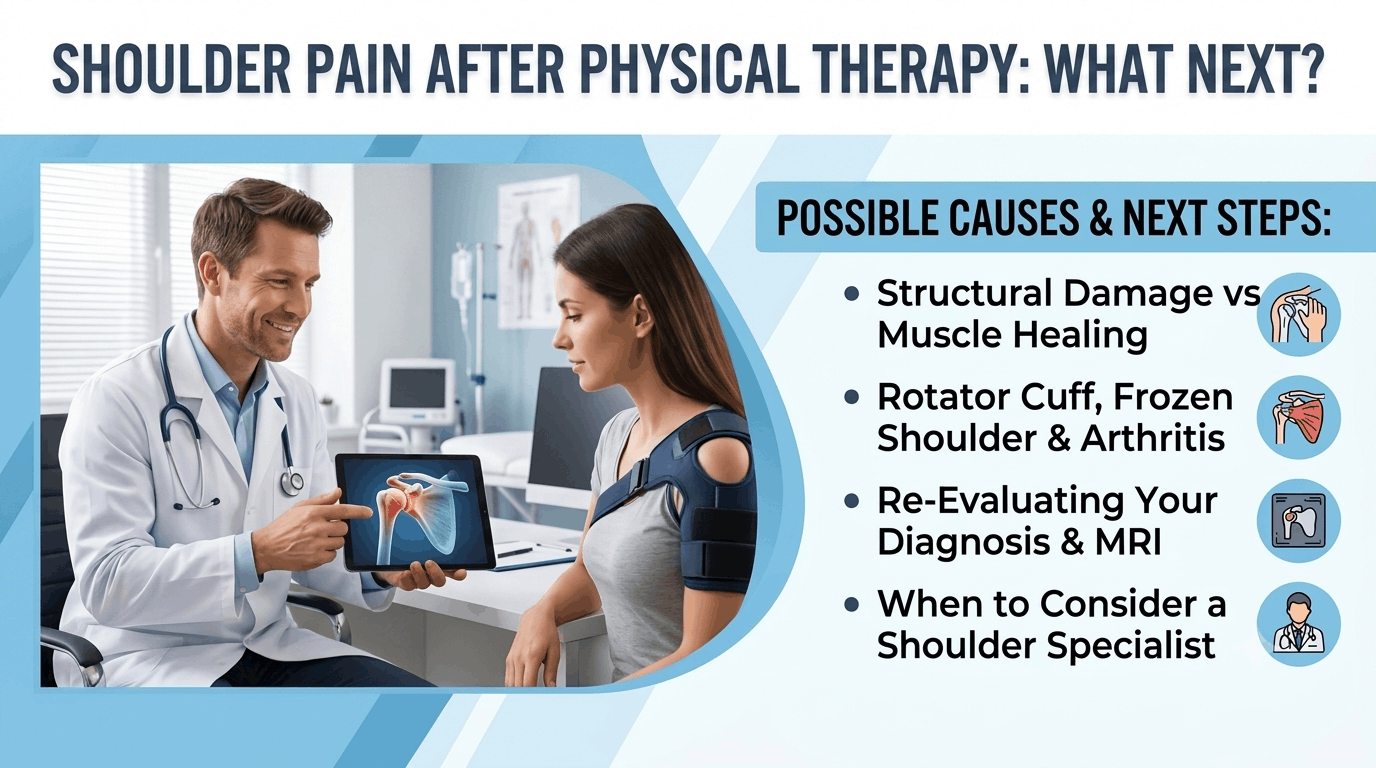
Shoulder pain can be difficult to diagnose because several conditions can produce similar symptoms.
Pain when lifting the arm, for example, may be caused by:
If treatment has not produced the expected improvement, the diagnosis may need another look.
A new evaluation can help determine whether another condition is contributing to the symptoms.
Also Read More – Shoulder Surgery in Miami: Cost, Insurance, and What to Expect
Recovery does not always follow a predictable timeline.
Depending on the injury, recovery may take:
Some patients become concerned when they still have discomfort during the middle of rehabilitation.
However, gradual improvement is generally more important than immediate elimination of pain.
If your symptoms are steadily improving, additional rehabilitation may still be appropriate.
If symptoms are worsening or not improving at all, reassessment becomes more important.
Physical therapy is not necessarily a fixed treatment plan.
Exercises may need to change as:
A program that was appropriate at the beginning of treatment may not remain appropriate later.
For example, progressing strengthening exercises too quickly may aggravate an injured tendon.
On the other hand, insufficient progression may fail to restore adequate strength.
Communication between the patient, therapist, and treating specialist is important.
Rotator cuff injuries are a common cause of persistent shoulder symptoms.
Symptoms may include:
Physical therapy is commonly used as part of rotator cuff tear treatment.
However, the appropriate treatment depends on:
Some patients manage rotator cuff tears successfully with non-surgical treatment.
Others with significant weakness, persistent symptoms, or certain traumatic tears may eventually require surgical consideration.
Shoulder arthritis can produce:
Physical therapy can help maintain mobility and strengthen supporting muscles.
However, therapy cannot reverse advanced cartilage loss.
If arthritis is significantly affecting function despite conservative treatment, further evaluation may be necessary.
Frozen shoulder, or adhesive capsulitis, can cause prolonged stiffness and pain.
Recovery can be slow.
Patients may experience difficulty:
Physical therapy is often an important part of treatment, but progress may be gradual.
If stiffness remains severe despite appropriate therapy, additional treatment options may need to be considered.
Some patients experience pain because the shoulder repeatedly feels as though it is:
This may occur after a previous dislocation or due to ligament or labral problems.
Strengthening can help improve stability, but recurrent instability may sometimes require additional evaluation.
Physical therapy is designed to improve function, but some structural injuries may require additional treatment.
Examples include:
This is one reason persistent symptoms should not simply be treated with more exercises indefinitely without reassessing the diagnosis.
Not every symptom felt around the shoulder originates inside the shoulder joint.
Pain may sometimes be associated with:
If shoulder treatment has not helped, evaluating other possible sources may be important.
The phrase failed physical therapy shoulder can be misleading.
Physical therapy may not have failed.
Instead, one of several situations may be occurring:
Before concluding that therapy has failed, it is important to determine why symptoms remain.
There is no universal recovery timeline.
Recovery depends on:
Some minor conditions improve quickly.
More complex problems can take months.
The most important question is:
Are your symptoms gradually improving?
If pain, strength, and function are improving, continuing rehabilitation may be appropriate.
If symptoms remain unchanged or become worse despite an appropriate course of treatment, a reassessment may be warranted.
Persistent shoulder pain deserves further evaluation when it:
You should also seek reassessment if a new injury occurs during rehabilitation.
When pain continues after therapy, possible shoulder pain causes include:
Rotator Cuff Disorders
Tendinitis, partial tears, and full-thickness tears can produce pain and weakness.
Labral Injuries
Labral damage may cause clicking, catching, or instability.
Cartilage deterioration can cause progressive pain and stiffness.
Capsular tightening can severely restrict movement.
Biceps tendon inflammation or tearing can cause pain at the front of the shoulder.
Repeated slipping or dislocation can produce pain and weakness.
Injuries or arthritis affecting the acromioclavicular joint can cause pain on the top of the shoulder.
Nerve-Related Conditions
Pain originating from the neck or nerves may mimic shoulder pain.
At Miami Shoulder Institute, an evaluation may begin with a detailed review of your symptoms and previous treatment.
Medical History
Your specialist may ask:
Previous medical records and imaging can also be useful.
Physical Examination
A shoulder examination may assess:
The examination can help determine whether the pain is primarily related to a tendon, joint, muscle, labrum, or another structure.
Imaging is not required for every patient.
However, additional imaging may be considered when:
Depending on the suspected condition, imaging may include:
An MRI can provide detailed information about rotator cuff tendons, labrum, cartilage, and other soft tissues.
Not necessarily.
A shoulder surgery evaluation is not the same as being told that you need surgery.
The purpose is to determine whether surgery could provide meaningful benefits based on your specific condition.
A specialist may recommend continued conservative treatment if:
Surgical treatment may be discussed when:
You should consider seeing a shoulder specialist if you continue to experience:
A specialist can help determine whether the problem is related to the original diagnosis or whether another condition is responsible.
Yes, in many cases.
The treatment for chronic shoulder pain depends on the underlying cause.
Possible approaches include:
The goal is to treat the cause of the pain rather than simply masking symptoms.
No.
This is one of the most important misconceptions to avoid.
If physical therapy has not resolved your symptoms, the next step should generally be reassessment, not automatically surgery.
A specialist may discover that:
Treatment should be based on evidence and individual circumstances.
Until your shoulder is reassessed:
If you experience sudden severe pain, a new injury, obvious deformity, or sudden inability to move the arm, seek prompt medical attention.
Read More – After Shoulder Surgery Therapy in Miami: Best Practices for a Smooth Recovery
Miami Shoulder Institute focuses on the diagnosis and treatment of shoulder conditions, including rotator cuff injuries, shoulder instability, arthritis, frozen shoulder, labral problems, tendon disorders, fractures, and sports-related injuries.
If you have shoulder pain after physical therapy, the goal is to understand why your symptoms remain rather than simply repeating the same treatment indefinitely.
A comprehensive evaluation can help determine whether you need continued rehabilitation, additional diagnostic testing, different conservative treatment, or a shoulder surgery evaluation.
Every treatment plan is individualized according to the diagnosis, symptoms, functional limitations, and recovery goals.
1. Why does my shoulder hurt even after physical therapy?
Shoulder pain may persist because the injury needs more time to heal, the rehabilitation program needs adjustment, the original diagnosis needs reconsideration, or an underlying structural problem remains.
2. Does shoulder pain after physical therapy mean the therapy failed?
Not necessarily. Shoulder pain after physical therapy can occur during recovery. If symptoms are not improving or are getting worse, however, a reassessment may be appropriate.
3. What should I do if physical therapy did not help my shoulder?
Consider a follow-up evaluation with a shoulder specialist. The diagnosis, previous treatment, imaging, strength, and range of motion can be reassessed.
4. Can a rotator cuff tear cause persistent pain after physical therapy?
Yes. Rotator cuff tears can continue to cause pain or weakness despite rehabilitation. The appropriate rotator cuff tear treatment depends on the tear and the patient’s symptoms and goals.
5. Does persistent shoulder pain mean I need surgery?
No. Persistent pain does not automatically mean surgery is necessary. A specialist should first determine the underlying cause and whether other treatment options remain appropriate.
6. When should I get a shoulder surgery evaluation?
A shoulder surgery evaluation may be appropriate when significant structural damage, persistent weakness, recurrent instability, or symptoms that have not responded to appropriate conservative treatment are present.
7. Can chronic shoulder pain be treated?
Yes. Chronic shoulder pain can often be managed or improved once its underlying cause is identified. Treatment may include rehabilitation, medication, injections, or surgery in selected cases.
8. How do I know if my shoulder pain has another cause?
Persistent symptoms despite appropriate treatment can be a reason to reconsider the diagnosis. A shoulder specialist can perform another examination and determine whether additional imaging or testing is appropriate.
9. Should I stop physical therapy if my shoulder still hurts?
Do not make major changes to your rehabilitation program without discussing them with your treating clinician or therapist. Some discomfort can occur during rehabilitation, but increasing or severe pain should be assessed.
Read More – How to Find the Best Shoulder Doctor Near You: Step-by-Step Guide