

 ES ES
ES ES
Yes, sleeping on an injured shoulder can increase pain and irritation, particularly when the shoulder is already inflamed or a tendon, bursa, ligament, or other structure has been injured. Sleeping directly on the affected side places pressure on the shoulder and may increase discomfort, stiffness, and shoulder inflammation.
However, sleeping on the injured side does not necessarily cause additional structural damage every time. The effect depends on the underlying injury, its severity, and how much pressure is placed on the joint during sleep.
Shoulder pain while sleeping is common with conditions such as rotator cuff injuries, bursitis, shoulder arthritis, frozen shoulder, and shoulder instability. If pain repeatedly wakes you at night or continues despite appropriate rest and treatment, evaluation may be necessary.
At Miami Shoulder Institute, identifying the cause of nighttime shoulder pain is an important part of developing an appropriate treatment and shoulder injury recovery plan.
Sleeping position can significantly affect shoulder discomfort after an injury. Sleeping on an injured shoulder may increase pressure on irritated tendons, the bursa, joint surfaces, and surrounding soft tissues. This can make shoulder pain at night more noticeable and interfere with sleep.
The safest sleeping position depends on the specific injury. In many cases, sleeping on the opposite side while supporting the injured arm with pillows can reduce pressure. Another option is sleeping on your back with the affected arm comfortably supported.
Rotator cuff pain at night is particularly common because lying directly on the affected shoulder can compress sensitive tissues. However, nighttime pain can have several causes, and persistent symptoms should not automatically be attributed to sleeping position.
If pain continues, becomes more severe, causes weakness, or interferes with normal shoulder function, a shoulder evaluation can help determine whether the problem is related to a rotator cuff injury, inflammation, arthritis, instability, frozen shoulder, or another condition.
Many people notice that their shoulder hurts more at night even when they are relatively comfortable during the day.
There are several possible reasons.
During the day, you are frequently changing positions and moving your shoulder. At night, you may remain in one position for several hours.
This can place prolonged pressure on irritated tissues.
Other factors may include:
For some patients, shoulder pain at night is one of the earliest signs that a shoulder condition needs evaluation.
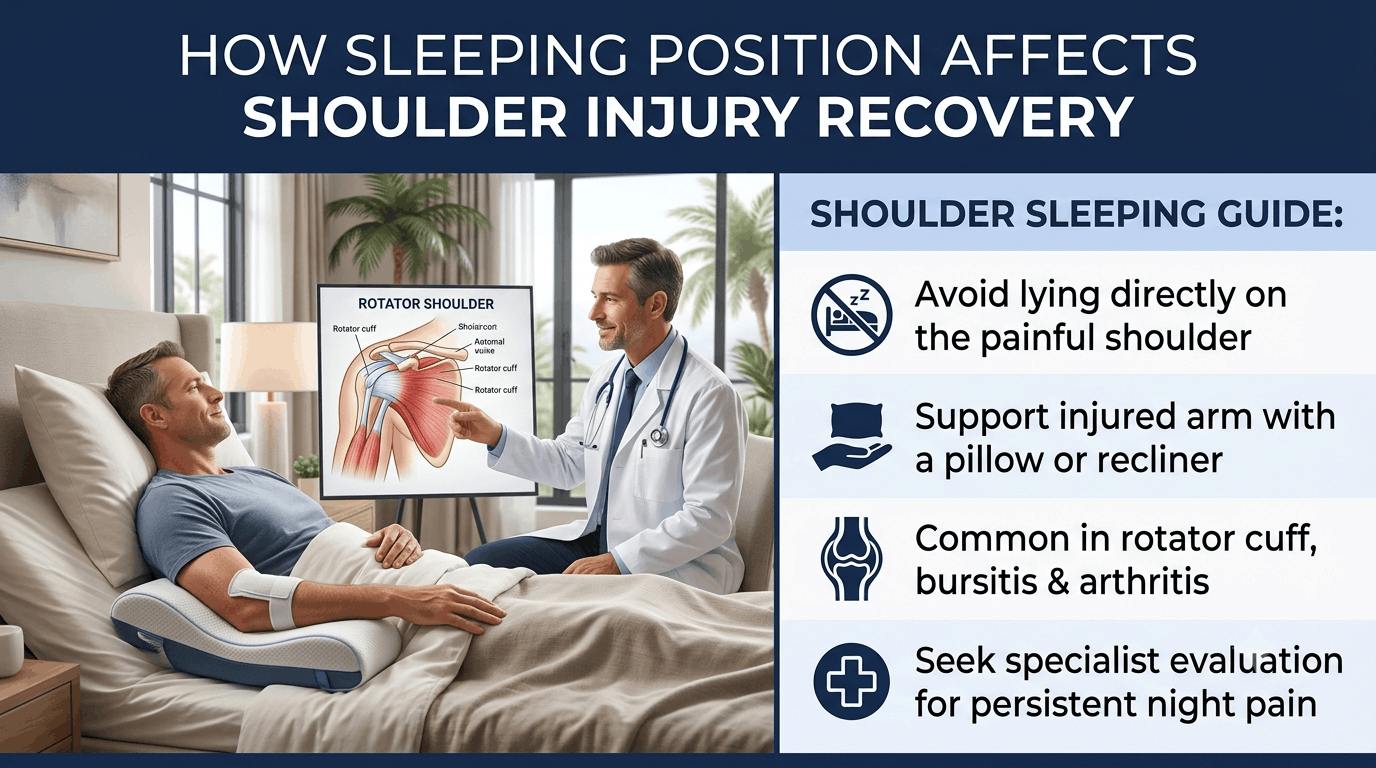
This depends on the injury.
In general, sleeping on an injured shoulder may increase pain and irritation without necessarily causing new structural damage.
For example, if the rotator cuff is inflamed, lying directly on that side can compress the affected tissues and increase discomfort.
However, certain injuries require additional protection.
Patients recovering from:
may have specific postoperative sleeping instructions.
In these situations, follow the instructions provided by your treating clinician rather than choosing a sleeping position based solely on comfort.
Also Read More – 8 Possible Reasons Your Shoulder Pops or Cracks During Workouts
Your sleeping position can change the amount of pressure placed on the shoulder.
The three most common sleeping positions are:
Each affects the shoulder differently.
Side sleeping is not necessarily bad, but sleeping directly on the injured shoulder may increase pressure.
When your body weight rests on the affected side, the shoulder may be compressed against the mattress.
This can aggravate:
If you naturally prefer side sleeping, lying on the opposite side is often more comfortable during recovery.
Supporting the injured arm with a pillow can also reduce stress on the shoulder.
There is no single position that works for everyone, but several approaches can help.
1. Sleep on Your Back
For many people, sleeping on the back is one of the most comfortable options during shoulder recovery.
Place a pillow beneath the affected arm or elbow.
This can:
A slightly elevated upper body may also be helpful for some patients.
2. Sleep on the Opposite Side
If you prefer side sleeping, lie on the side opposite the injury.
For example:
Right shoulder injury → sleep on your left side.
Place a pillow in front of your chest and rest the injured arm on it.
This provides support and may prevent the injured shoulder from rolling forward.
3. Use a Reclined Position
Some people experience less discomfort when sleeping partially upright.
A reclining chair or adjustable bed can reduce pressure on the shoulder.
This may be particularly helpful after surgery or during periods of significant inflammation.
For many shoulder injuries, the least comfortable position is lying directly on the painful side.
However, there is no universal “worst” position.
If a specific position causes:
try changing positions.
Comfort is an important guide, but patients recovering from surgery should follow their specific postoperative instructions.
Rotator cuff pain at night is a common complaint.
Rotator cuff injuries may become more noticeable while sleeping because the shoulder remains in one position for an extended period.
Lying on the affected side can also compress the tendon and surrounding tissues.
Patients may experience:
Night pain does not automatically mean that the tear is becoming worse.
However, persistent nighttime symptoms can be an important clue when diagnosing a rotator cuff problem.
There are many potential causes of shoulder pain while sleeping.
Rotator cuff tendinitis or tears may cause nighttime discomfort.
Patients often report pain when lying on the affected side.
Inflammation of the bursa can make direct pressure painful.
Stiffness and inflammation can cause pain both during movement and at rest.
Arthritis may cause:
A shoulder that feels unstable may become uncomfortable in certain sleeping positions.
Injuries or arthritis affecting the AC joint may make side sleeping particularly uncomfortable.
Shoulder inflammation occurs when tissues around the shoulder become irritated.
Inflammation can involve:
Inflammation may be caused by:
When you sleep directly on an inflamed shoulder, pressure may increase discomfort.
It can affect comfort and potentially make recovery more difficult if the shoulder is repeatedly irritated.
Good sleep is an important part of shoulder injury recovery.
Poor sleep may contribute to:
If your sleeping position repeatedly causes significant pain, changing your position may help make recovery more comfortable.
However, sleeping position alone cannot repair a torn tendon, fractured bone, or significant structural injury.
Try these strategies.
Support the Injured Arm
Place a pillow beneath the elbow or forearm.
This can reduce tension on the shoulder.
Hug a Pillow
When sleeping on the opposite side, holding a pillow can help keep the injured arm supported.
Use a Pillow Behind Your Back
If you tend to roll onto the injured side, placing a pillow behind your back may discourage that movement.
Elevate Your Upper Body
Some patients find sleeping slightly upright more comfortable.
This can be achieved with:
Avoid Sleeping Directly on the Injured Shoulder
If lying on the affected side increases pain, avoid that position while the shoulder recovers.
For some shoulder conditions, cold therapy may temporarily reduce discomfort and shoulder inflammation.
If your clinician has recommended ice, follow their instructions regarding:
Do not place ice directly against the skin.
For certain conditions, heat may be more comfortable, particularly when stiffness is the primary problem.
The appropriate approach depends on the underlying diagnosis.
Gentle mobility exercises may help some patients.
However, aggressive stretching can aggravate an injured tendon or joint.
Your exercises should be based on your condition and rehabilitation plan.
If a particular movement causes sharp or increasing pain, discuss it with your therapist or treating clinician.
Occasional discomfort after a long day may not be concerning.
However, persistent shoulder pain at night should be evaluated when it:
Night pain is not a diagnosis by itself.
It is a symptom that can occur with several shoulder conditions.
Consider an evaluation by a shoulder specialist if nighttime symptoms persist despite reasonable changes to your sleeping position.
You should especially consider evaluation if you have:
A specialist can determine whether your symptoms are caused by a rotator cuff problem, arthritis, frozen shoulder, instability, or another condition.
Read More – Shoulder Surgery in Miami: Cost, Insurance, and What to Expect
Diagnosis begins with your symptoms and medical history.
Your provider may ask:
A physical examination can evaluate:
Imaging may be recommended when necessary.
Depending on the suspected condition, this could include:
Yes, but nighttime pain alone cannot diagnose a rotator cuff tear.
A rotator cuff tear may also cause:
If these symptoms occur together, further evaluation may be appropriate.
Sleeping on your side does not typically cause a rotator cuff tear by itself.
Rotator cuff tears are more commonly associated with:
However, sleeping directly on an already injured shoulder may make existing symptoms more noticeable.
If pain repeatedly prevents you from sleeping, it is worth determining why.
Try:
Sleep disruption can become a significant quality-of-life issue and should not simply be accepted as part of aging.
Shoulder injury recovery depends on the injury.
A mild strain may improve within weeks.
A tendon injury, fracture, or surgical repair may require several months.
Recovery can depend on:
Improvement is often gradual.
The goal is not simply to eliminate nighttime pain but to restore shoulder strength, mobility, and function.
Miami Shoulder Institute focuses on the diagnosis and treatment of shoulder conditions, including rotator cuff injuries, shoulder instability, arthritis, frozen shoulder, tendon problems, fractures, labral injuries, and sports-related conditions.
If you are experiencing shoulder pain while sleeping, persistent shoulder pain at night, or rotator cuff pain at night, an evaluation can help determine whether the symptoms are related to your sleeping position or an underlying shoulder condition.
Treatment is personalized according to the diagnosis and may include rehabilitation, activity modification, medication, injections, or surgery when appropriate.
The goal is to help patients sleep more comfortably while addressing the underlying cause of their shoulder symptoms.
1. Can sleeping on an injured shoulder make it worse?
Yes. Sleeping on an injured shoulder can increase pressure on irritated tissues and make pain or inflammation worse. It does not necessarily cause additional structural damage in every case.
2. What is the best sleeping position for shoulder pain?
For many people, sleeping on the back or the opposite side while supporting the injured arm with a pillow is more comfortable.
3. Why does my shoulder hurt more at night?
Shoulder pain at night can result from prolonged pressure, inflammation, rotator cuff problems, arthritis, frozen shoulder, or other conditions.
4. Why is rotator cuff pain worse at night?
Rotator cuff pain at night may increase because lying on the affected shoulder puts pressure on irritated tendons and surrounding tissues.
5. Should I sleep on the opposite side of my injured shoulder?
Often, yes. Sleeping on the opposite side and supporting the injured arm can reduce pressure on the affected shoulder.
6. Can sleeping on my shoulder cause a rotator cuff tear?
Sleeping on your side generally does not cause a rotator cuff tear by itself. However, sleeping directly on an already injured shoulder can aggravate symptoms.
7. How can I reduce shoulder pain while sleeping?
Try supporting the affected arm with a pillow, avoiding the injured side, sleeping on your back, or using a slightly elevated position.
8. When should I see a shoulder specialist for nighttime pain?
Consider evaluation if nighttime pain persists, repeatedly wakes you, is associated with weakness or limited movement, or follows an injury.
9. Does nighttime shoulder pain mean I need surgery?
No. Nighttime pain can have many causes, and many shoulder conditions improve with non-surgical treatment. Surgery is considered only when appropriate for the underlying condition.
10. Can better sleep improve shoulder injury recovery?
Adequate sleep supports overall recovery and can make rehabilitation easier. Finding a comfortable sleeping position can also reduce unnecessary irritation during recovery.
Read More – Top Orthopedic Shoulder Surgeons in Miami