
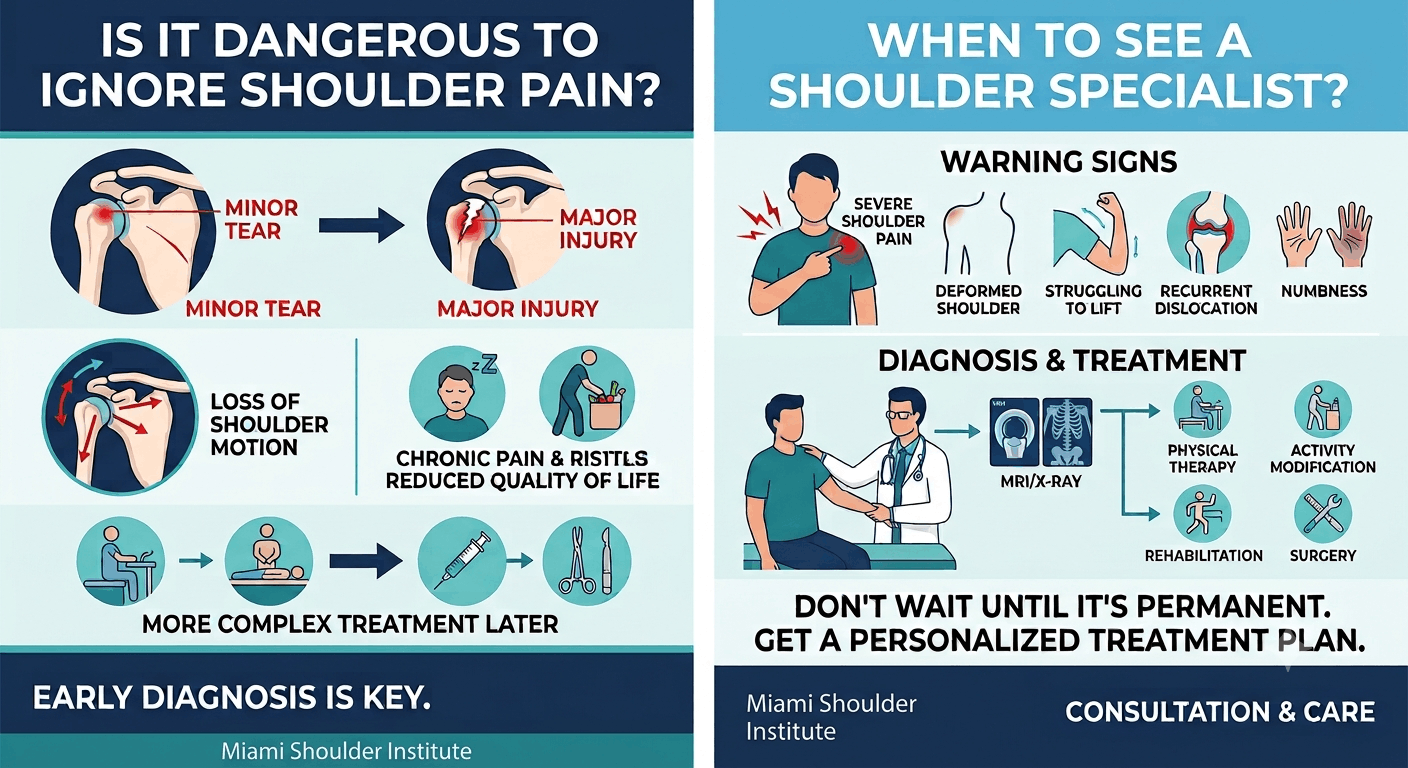
it can be dangerous to ignore shoulder pain, especially if it lasts for more than a few days, becomes progressively worse, follows an injury, or is associated with weakness, limited movement, numbness, swelling, or deformity. While some mild muscle strains improve with rest, persistent or worsening pain may indicate a rotator cuff tear, frozen shoulder, arthritis, tendon injury, fracture, instability, or another condition that requires medical evaluation.
Leaving untreated shoulder pain alone may allow the underlying condition to progress, potentially leading to chronic shoulder pain, reduced mobility, muscle weakness, joint damage, or the need for more complex treatment later. At Miami Shoulder Institute, early diagnosis and personalized care help patients identify the cause of shoulder pain and choose the most appropriate treatment before complications develop.
If you’re wondering whether you can simply wait for shoulder pain to disappear, the answer depends on the underlying cause. Mild soreness after exercise often improves within a few days, but pain that persists, worsens, interrupts sleep, or limits everyday activities should not be ignored.
Common shoulder pain causes include rotator cuff injuries, shoulder impingement, arthritis, frozen shoulder, labral tears, tendon injuries, bursitis, fractures, and instability. Some of these conditions improve with conservative care, while others may progressively worsen if left untreated.
The key message is simple: persistent shoulder pain is a symptom—not a diagnosis. Finding the underlying cause early often leads to better outcomes and may reduce the likelihood of surgery.
The shoulder is one of the most mobile joints in the human body.
Its ability to move in multiple directions depends on the coordinated function of:
When any of these structures become injured or diseased, pain develops as a warning sign.
Ignoring that warning sign may allow the problem to worsen over time.
No.
Not every episode of shoulder pain indicates a major injury.
Temporary discomfort may occur after:
These symptoms often improve with:
However, pain lasting longer than one to two weeks—or pain that becomes worse—deserves professional evaluation.
Understanding the most common shoulder pain causes helps explain why symptoms vary from person to person.
Rotator Cuff Tears
One of the most frequent causes of persistent shoulder pain.
Symptoms include:
Untreated tears may enlarge over time.
Occurs when the rotator cuff tendons become compressed beneath the acromion.
Common symptoms include:
Also called adhesive capsulitis.
Symptoms include:
Without treatment, recovery may take many months or even years.
Cartilage breakdown causes:
Arthritis often progresses gradually.
Occurs when the shoulder repeatedly slips or dislocates.
Repeated instability can damage cartilage and bone.
Damage to the labrum may produce:
Pain is usually felt at the front of the shoulder.
Patients may notice weakness during lifting.
Fractures
Shoulder fractures require immediate medical evaluation.
Symptoms often include:
Many patients delay seeking care because they hope symptoms will disappear.
Sometimes they do.
However, untreated shoulder pain may allow certain conditions to progress.
Possible shoulder pain complications include:
The sooner the underlying cause is identified, the more treatment options may be available.
1. A Small Injury Can Become a Larger One
Minor tendon injuries may worsen if repetitive stress continues.
For example, a partial rotator cuff tear may enlarge over time, making repair more challenging.
2. Loss of Shoulder Motion
Pain often causes patients to avoid moving the shoulder.
Reduced movement can eventually lead to stiffness and frozen shoulder.
3. Chronic Shoulder Pain
Persistent inflammation may result in chronic shoulder pain that affects:
Treating pain early may help prevent long-term disability.
4. Muscle Weakness
Shoulder injuries frequently lead to reduced strength.
Over time, weakened muscles can alter shoulder mechanics and increase stress on surrounding structures.
5. Arthritis Progression
Some untreated injuries accelerate cartilage damage, increasing the likelihood of arthritis.
6. Reduced Quality of Life
Patients with ongoing shoulder pain often struggle with:
These limitations can affect both physical and emotional well-being.
7. More Complex Treatment Later
Conditions that are identified early may be managed conservatively.
Delaying treatment sometimes leads to:
Certain shoulder injury symptoms require prompt evaluation.
Seek medical attention if you experience:
These symptoms may indicate a serious injury.
Although most shoulder pain is not life-threatening, emergency evaluation may be needed if:
Immediate care helps reduce complications.
You should consider seeing a shoulder specialist if:
Early evaluation often improves treatment outcomes.
At Miami Shoulder Institute, diagnosis begins with understanding why the pain is occurring—not simply treating the symptom.
Medical History
Your provider may ask:
Physical Examination
The shoulder is evaluated for:
Specific tests help identify the injured structures.
Depending on your symptoms, imaging may include:
X-rays
Useful for identifying:
MRI
MRI provides detailed evaluation of:
Ultrasound
Sometimes used to assess tendon movement dynamically.
The most appropriate shoulder pain treatment depends entirely on the diagnosis.
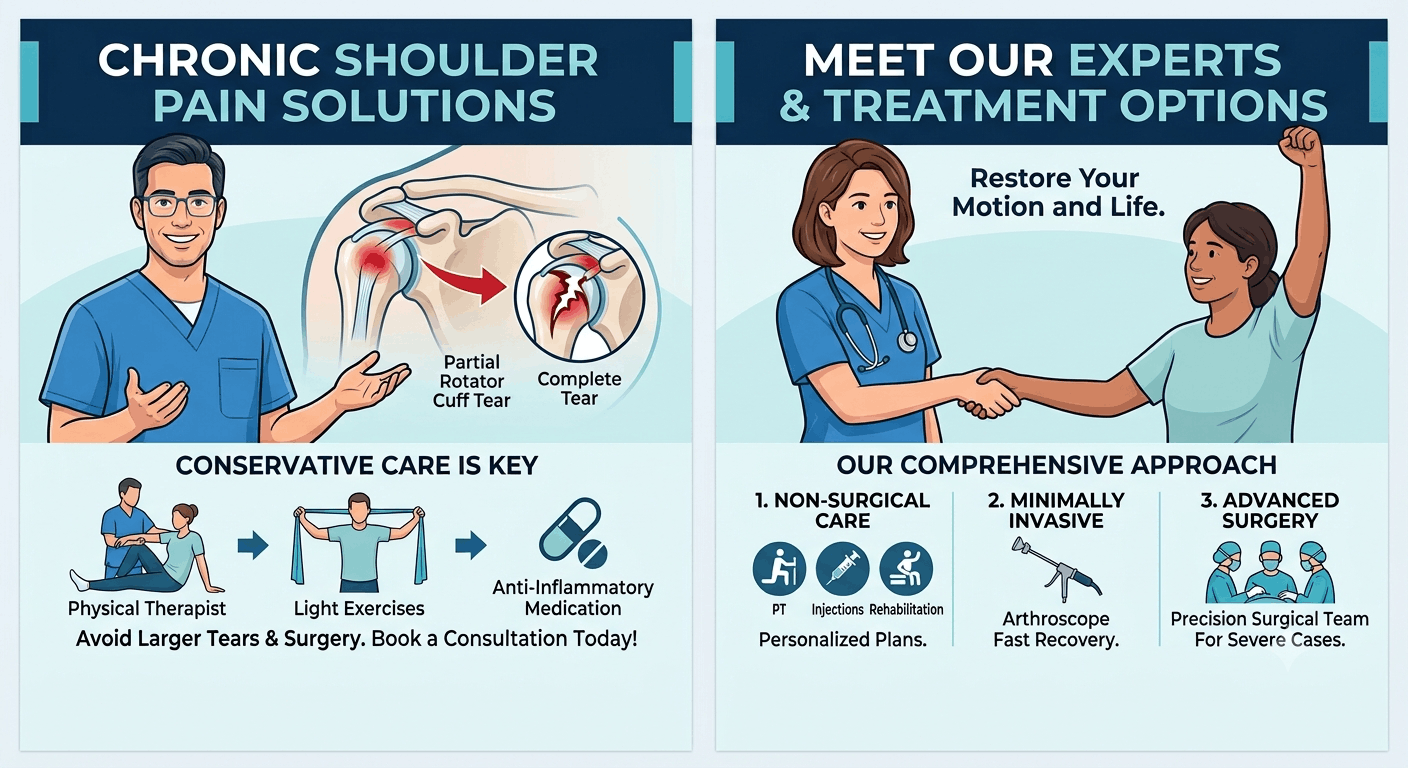
Many patients recover without surgery.
Physical Therapy
Often the foundation of treatment.
Therapy focuses on:
Avoiding painful activities allows injured tissues to recover.
Rehabilitation
A structured rehabilitation program improves mobility and long-term function.
Anti-Inflammatory Treatment
Reducing inflammation may relieve pain and improve participation in therapy.
Injections
Selected patients may benefit from injections to reduce inflammation.
Surgery
Surgery is generally considered when:
The decision is individualized.
Yes—some cases do improve naturally.
Examples include:
However, persistent or worsening symptoms should never be assumed to be harmless.
Ignoring pain without understanding its cause may delay appropriate treatment.
In some cases, yes.
Conditions such as:
may lead to long-term functional limitations if not properly managed.
This is why early evaluation is important.
You can reduce your risk of shoulder injuries by:
Healthy shoulder mechanics help reduce stress on tendons and joints.
Miami Shoulder Institute is dedicated exclusively to diagnosing and treating shoulder conditions, including rotator cuff tears, frozen shoulder, arthritis, instability, tendon injuries, fractures, labral tears, and sports-related injuries.
Whether your symptoms require conservative shoulder pain treatment, advanced imaging, rehabilitation, or surgery, every treatment plan is tailored to your diagnosis, activity level, and long-term goals.
The focus is not simply relieving pain—it is restoring healthy shoulder function while helping patients avoid preventable complications.
1. Is it dangerous to ignore shoulder pain?
Yes. Persistent shoulder pain may indicate an underlying condition that can worsen without appropriate treatment.
2. How long should I wait before seeing a shoulder specialist?
If shoulder pain lasts longer than one to two weeks, worsens, or limits your daily activities, professional evaluation is recommended.
3. Can untreated shoulder pain become chronic?
Yes. Some conditions may progress to chronic shoulder pain if the underlying problem is not addressed.
4. What are the most common shoulder pain causes?
Common causes include rotator cuff tears, arthritis, frozen shoulder, impingement, instability, labral tears, tendon injuries, and fractures.
5. What are the warning signs of a serious shoulder injury?
Severe pain, inability to lift the arm, deformity, numbness, swelling, weakness, or pain after trauma should be evaluated promptly.
6. Will every shoulder injury require surgery?
No. Many shoulder conditions improve with conservative shoulder pain treatment, including rehabilitation and physical therapy.
7. When should I see a shoulder specialist instead of waiting?
Persistent pain, progressive weakness, limited motion, recurrent instability, or symptoms following an injury should be evaluated by a shoulder specialist.
Also Read More – Shoulder Surgery in Miami: Cost, Insurance, and What to Expect
8 Possible Reasons Your Shoulder Pops or Cracks During Workouts
Finding the Best Shoulder Surgeon in Miami: What Patients Should Look For